


This article is brought to you by American Purpose, the magazine and community founded by Francis Fukuyama in 2020, which is proudly part of the Persuasion family.
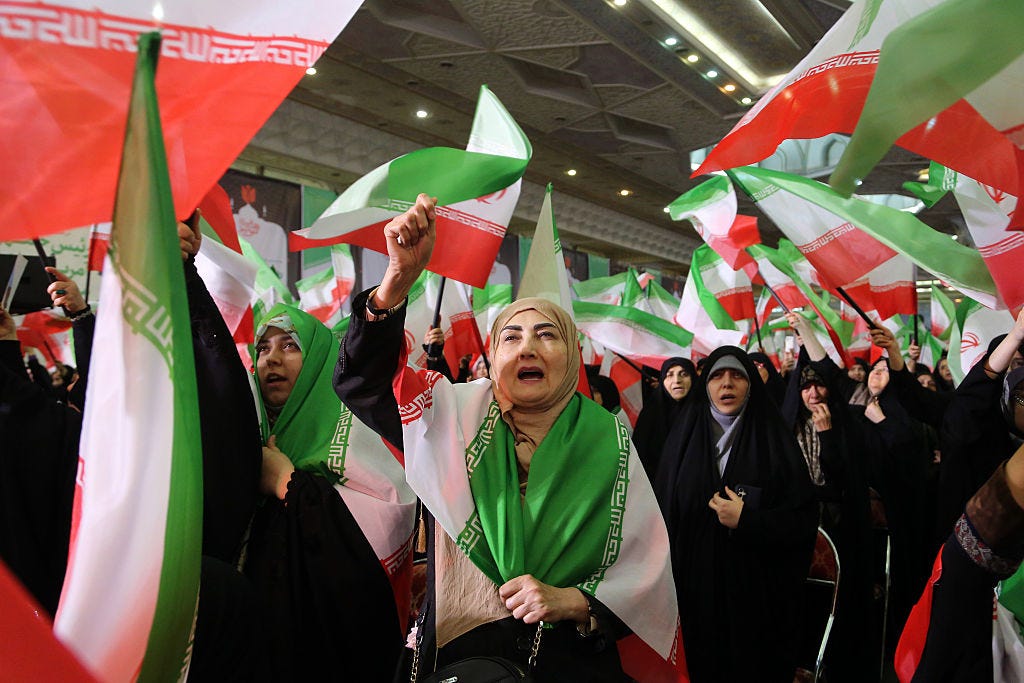
January 2026 will be remembered as the month the Islamic Republic tried to break Iranian society’s political spine through mass violence and fear. More than one million people poured onto the streets across the country, demanding the regime’s downfall. The state responded with overwhelming force. Rights groups and international reporting describe killings on a scale that reached into the thousands during the peak days of the crackdown, alongside mass injuries and arrests. The regime treated public assembly as an existential threat and acted as if it were at war with its own population.
Among those targeted were university students. Student networks say at least 130 students were killed in connection with the January uprising. The youth were not on the margins of Iran’s street politics. They were again at its center.
On campuses, repression was not limited to bullets, arrests, and prison vans. It also moved through paperwork. Authorities forced universities into silence by closing dormitories, shifting exams online, and dispersing students across cities and provinces. The goal was not only to punish but also to interrupt the protest movement’s most persistent engine: organized youth living, studying, and mobilizing in dense social spaces.
Faced with unrest, the state returned to a familiar tactic: mass arrests of students and emptying campuses. Multiple universities in different cities announced online classes, online final exams, or dorm evacuations. Some outlets inside Iran framed these steps as routine “management” during an exceptional period. But the operational purpose was dispersal. Reporting in higher education media also described campus shutdowns and dorm evacuations as protests spread.

This is a distinct phase of repression. After killing, injuring, and arresting students, the next move is repression by memo and circular. It does not replace the rifle but aims to reduce reliance on it by hindering concentration and coordination. The regime understands that the university is not simply a physical space, but a social infrastructure built on networks, trust, and shared political language. A dorm isn’t just a building; it’s a vibrant community where information circulates rapidly, enabling collective action. Closing dormitories alters this pattern of dense living.
Yet January also revealed the limits of this strategy. Students continued to organize even as campuses were hollowed out. Pro-opposition outlets reported joint student calls for coordinated action in mid-February, including a nationwide strike on February 17 and 18 to commemorate those killed and to express solidarity with families seeking justice. Although the specifics of these calls may not be externally verifiable, their importance lies in what they indicate: connectivity remains intact, and student politics continue to exist.
The most revealing feature is the form of struggle that is emerging. The university is being pushed online, yet student contention is adapting to an online and semi-clandestine environment. The regime wants remote exams and empty dorms to produce isolation. Students are using the same conditions to build safer channels: encrypted groups, decentralized coordination, and dispersed actions that are harder to decapitate. When open protest becomes too costly, political life does not disappear. It shifts into low-visibility spaces. In authoritarian systems, that shift is often a bridge to the next wave, not the end of the previous one.
To understand why this keeps happening, January 2026 must be placed in the context of Iran’s post-1979 history.
The Islamic Republic emerged from a revolution in which universities had already become centers of opposition. From the earliest days of the new state, the regime treated campuses as both a resource and a danger. Universities produce skilled labor and future administrators, but they also concentrate young people with time, grievances, and the capacity to organize. The state wants modern education without political autonomy. This is the classic authoritarian dilemma: modernizing the country while preventing the university from becoming an opposition headquarters.
The Islamic Republic tried to manage this dilemma through repeated cycles of control. It shut down universities during what it called the “Cultural Revolution,” purged faculty, redesigned curricula, and built loyalist structures inside campuses to police student life. Over time, it combined direct repression with quieter methods: disciplinary committees, ideological screening, control over appointments, and selective rewards for loyalty. It also dramatically expanded higher education, producing millions of students while seeking to neutralize the political consequences through surveillance, co-optation, and ideological management.

These measures produced periods of containment, but they never solved the problems. Student politics reemerged across decades, from the late 1990s through the 2009 Green Movement and later protest cycles. By 2026, the tone hardened further. For many students, the horizon is no longer reform within the system but dismantling the regime itself. Students openly called for regime change, including support for restoring the Pahlavi monarchy. Whether one agrees with that direction or not, it signals a deeper point: A growing segment of the young no longer sees the regime as negotiable. They see it as irredeemable.
This demand is not romantic, nor is it simply nostalgic. It has social roots. Iran is a young society living under heavy political repression amid collapsing life prospects. Degrees do not translate into stable futures for many graduates. Mobility is blocked by corruption, patronage, and an economy shaped by security institutions and politically connected networks. For millions, education has become a promise that ends in unemployment, exclusion, and humiliation. When the university stops functioning as a social and political ladder, it becomes a staging ground. Students become politically dangerous not because they are inherently heroic, but because they are trapped.
That is why the move to close campuses and shift exams online is so telling. It reveals fear of student concentration. It reflects awareness that universities remain among the few places where collective identity can still form despite censorship. The state can shut gates, empty dorms, and move exams to screens. But it cannot remove the university from society, because the university is embedded in it.
For nearly five decades, the Islamic Republic has tried to domesticate the university through purges, ideological policing, and now digital dispersal. January 2026 shows that it still cannot. A regime can force quiet for a season, arrest thousands, and kill on a massive scale, but it cannot permanently solve the contradiction it created: mass higher education inside a political order that offers young people domination without a future.
The conclusion is not that repression is ineffective, but that repression cannot address the underlying conditions that continuously generate dissent. The university is still breathing in Iran because the forces that politicize it are still alive. Since 1979, the regime has treated campuses as a danger to be contained. January 2026 suggests that containment is no longer enough, and that dispersal is the new language of fear. Students, in turn, are learning how to turn dispersal into a new kind of collective life.
Saeid Golkar is an associate professor of political science at the University of Tennessee-Chattanooga, a senior advisor at United Against Nuclear Iran (UANI), and a writing fellow at the Middle East Forum.
Follow Persuasion on X, Instagram, LinkedIn, and YouTube to keep up with our latest articles, podcasts, and events, as well as updates from excellent writers across our network.
And, to receive pieces like this in your inbox and support our work, subscribe below:
