


Remember: we are hosting our first Ask the Author Zoom call with Francis Fukuyama TONIGHT at 4pm PT/ 7pm ET! He will be answering your questions about his recent article “Why American Governments Can’t Get Things Done.” Click here to sign up.
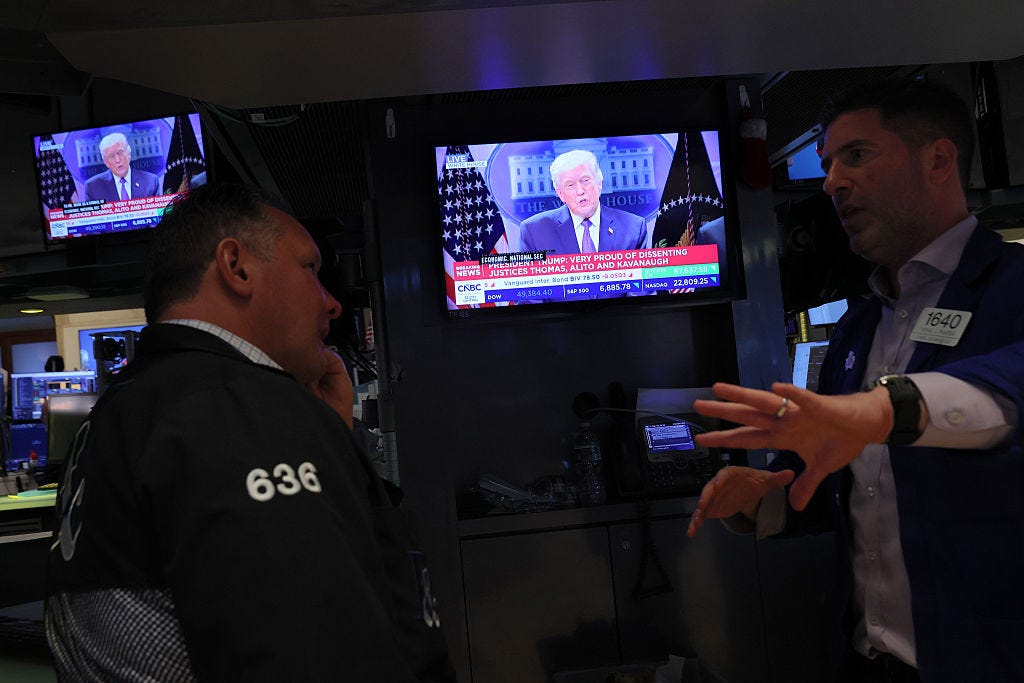
Much of the commentary about the Supreme Court’s invalidation of Donald Trump’s use of tariffs under the International Emergency Economic Powers Act (IEEPA) has focused on its macro consequences: things like inflation or the government’s repayment of tariff revenues to companies. Trump immediately replaced the “Liberation Day” tariff regime with a uniform 10 percent duty (subsequently raised to 15 percent) under Section 122 of the Trade Act of 1974, and will doubtless come up with other creative interpretations of existing statutes to re-institute as many new tariffs as possible. But his use of tariffs as a political weapon has been fatally undercut.
One of the worst aspects of Trump’s original tariff regime was his belief that he as president had unlimited discretion to set tariff rates on individual countries. Trump saw tariffs not just as economic tools but as all-purpose political weapons that he could turn against any country he didn’t like, as well as a source of personal enrichment.
There were many examples of this. After a conversation with the Swiss president that rubbed him the wrong way, he imposed a 39 percent duty on the country’s goods. After receiving a fancy Rolex desk clock and a gold bar inscribed with the numbers of his two presidencies, Trump reduced Switzerland’s rate to 15 percent. We don’t know what happened to the gifts that were in effect bribes. Another example was Greenland: as part of his effort to take over Greenland, the president threatened countries that had sent troops there in solidarity with Denmark with high tariffs if they did not accommodate his bid for sovereignty over the island. This was again the use of an economic instrument for strategic purposes.
This kind of bespoke tariff policy is bad for any number of reasons. Even if one accepts the premise that tariffs are useful in encouraging domestic manufacturing—a questionable proposition—tariffs should be imposed in a uniform, transparent, and consistent manner. Importers and manufacturers need clear rules that apply to categories of goods if they are to plan and invest properly. There should not be different tariff rates on the same goods produced in different countries. And as almost every business owner affected by tariffs has said, it is impossible to plan in an environment where rates are set by the whim of the president.
The discretionary ability to set individual tariff rates is an open invitation to corruption. Following the “Liberation Day” announcement of high global tariffs last year, virtually every U.S. trading partner came to Washington to try to strike a deal with the Trump administration. We know about the Swiss payoff and the golf courses offered by Vietnam, but when the history of this period is written, we will doubtless learn about many, many other side payments that were made to Trump or one of his associates in order to get a deal done.
Trump is said to be transactional. He does not think in terms of institutions or broad policies. An institution is a rule that is not dependent on particular individuals and persists past the moment when the maker of the rule passes from the scene. If a president wants to leave a lasting legacy, he needs to do that by getting Congress to pass legislation.
Trump has left virtually no institutional legacy. The 119th Congress that came to power with Trump’s second term and is controlled by the Republicans has been one of the least productive in recent history. What we have instead is a whole series of executive orders and one-off deals. This means that Trump’s legacy will be potentially very evanescent: what can be done through an executive order or a one-off deal can be undone by a subsequent executive order or a new deal.
The Supreme Court has done the country a service by invalidating Trump’s use of IEEPA tariffs. The Section 122 authority he subsequently turned to mandates a uniform tariff, and not one that can be targeted against disfavored countries. Moreover, that authority expires after 150 days, undercutting its utility as a political weapon. Future tariffs under other authorities may be possible, but almost all of them reduce the president’s discretion in imposing them, requiring formal procedures to justify the imposition of the levy.
So, Trump has not just lost the foundation of his economic policy; he has also been stripped of a political weapon that he was particularly fond of deploying against friendly countries. Overall, this is a win for the United States and for the rest of the world.
Francis Fukuyama is the Olivier Nomellini Senior Fellow at Stanford University. His latest book is Liberalism and Its Discontents. He is also the author of the “Frankly Fukuyama” column, carried forward from American Purpose, at Persuasion.
Follow Persuasion on X, Instagram, LinkedIn, and YouTube to keep up with our latest articles, podcasts, and events, as well as updates from excellent writers across our network.
And, to receive pieces like this in your inbox and support our work, subscribe below:
Frank, you’re absolutely right that this outcome is a win for the United States and for the world. But it isn’t the triumph you’re describing. Celebrating a victory over Trump may feel satisfying, but it doesn’t touch the deeper problem. As the Court made clear, the real issue lies as much with Congress as with any president.
For years, members of both parties have weaponized the democratic process to protect their own reelection prospects and to deepen division. Congress has repeatedly failed to use its constitutional powers to give the country coherent, workable policy on immigration, debt‑driven inflation, tax inequity, and other long‑standing challenges. The current President was elected precisely because Congress had allowed these problems to fester.
This is where scholars of politics—especially those with your stature—could make a real contribution. The crisis we’re facing is not simply the product of one president or one party. It stems from the inherent vulnerabilities of our democratic system and the way those vulnerabilities have been exploited. Replacing a president or shifting party control won’t fix those structural faults. Naming them, analyzing them, and helping the public understand them just might.
The propagandist MSM are making a meal out of the recent SCOTUS ruling 6 to 3 on the legalities of trumps’ tariffs . The Leftist controlled MSM trumpet this ruling by saying this decision may help “save the Republic,” which is absolute garbage. For years, presidents of both parties have used broad and vague language in federal statutes to engage in de facto lawmaking. Others in the MSM trumpet that Trump has taken this to extremes, and his “presidential power grab” on tariffs was so big and so bold that it threatened the very foundations of our constitutional system. What? What all this present MSM gumph does not say is that the American Constitution – on this occasion at least – worked to rein in a president’s actions that were deemed to be “non-constitutional” by the Court. That’s what the SCOTUS is Constitutionally there for. That’s all. With the Nelsonian eye, what the MSM don’t emphasis is that all this fear mongering they spread in the leftist press about “what Trump will do about running for a Third Term;” what Trump will do that will “destroy America and American democracy;” what Trump will do to when he “takes over the American Armed forces,” and all the other scare mongering spread about by “the resistance” to the present democratically elected POTUS, has been shown to be nothing but scaremongering, as there is a SCOTUS and the American Constitution works. So, the BS in the MSM continues. Any unbiased person can clearly see that the conservative-controlled court pushing back, reasserts the separation of powers on which the entire Constitution is built. The Constitution makes it clear that Congress, not the president, is responsible for taxation, which obviously includes tariffs. This ruling by the SCOTUS clearly shows that on this occasion at least in the matters of tariffs, the Constitution is interpreted as Congress having to be involved for these tariffs to continue. The legislative process can be slow and frustrating, but that is by design – so that major decisions are made by the people’s elected representatives rather than just “one faction or man”. Credit to the Supreme Court for doing what the Leftist MSM will say the Republican-controlled Congress has abjectly failed to do. That’s all. Life goes in. Period.