


Remember: we are hosting our first Ask the Author Zoom call with Francis Fukuyama TONIGHT at 4pm PT/ 7pm ET! He will be answering your questions about his recent article “Why American Governments Can’t Get Things Done.” Click here to sign up.

This article is part of an ongoing project by American Purpose at Persuasion on “The ‘Deep State’ and Its Discontents.” The series aims to analyze the modern administrative state and critique the political right’s radical attempts to dismantle it.
To receive future installments into your inbox—plus more great pieces by American Purpose and Francis Fukuyama’s blog—simply click on “Email preferences” below and make sure you toggle on the buttons for “American Purpose” and “Frankly Fukuyama.”
When wildfires tore through Los Angeles County last year, millions of people reached not for a government alert, but for a nonprofit app called Watch Duty. Emergency managers had it open in their operations centers. Tanker pilots and dozer operators checked it between runs. Families at their kitchen tables watched its maps to judge whether they had hours, minutes, or seconds to leave. Official channels existed, of course, but the information they offered was too old and fragmented to be helpful in the moment of encroaching danger. In practice, one of the most basic public-safety functions in fire country—timely, intelligible information about where the fire is and where it’s headed—is now being performed by a civil-society organization that didn’t exist a few years ago.
If that feels jarring, I get it. Real-time warning in the face of an advancing fire sounds like an obvious thing the government should do: high stakes, large scale, life and death. Yet when the smoke rolls in, the provider people actually trust to get the job done is a volunteer-driven nonprofit that listens to radios, watches public cameras, and pushes out clear, verified, usable information. One could interpret this as a solution born of bureaucratic failure, and in one sense it is. More importantly, though, it’s an object lesson. In a liberal society, even in a moment of crisis, government is not the only arena in which important public challenges can be overcome.

In my own research on post-disaster recovery, this lesson asserted itself repeatedly. Businesses, neighborhood associations, congregations, and ad hoc volunteer networks routinely solve problems that governments struggle to handle: housing people in the days after a disaster, restoring livelihoods, rebuilding not only physical spaces but the texture of neighborhood life. The point is not that government is useless. It is that different forms of social coordination—government, markets, and civil society—have different strengths. When we treat government as the default solver of every problem, we miss opportunities to get important things done better and faster.
That lesson matters, not only for disaster response, but for liberal democracy.
It’s no secret that public trust in our governing institutions is plummeting. In 1964, 77 percent of Americans said they trust the federal government to do the right thing “almost always” or “most of the time.” In September 2025, that number was 17 percent. That trust gap is more than a messaging problem. Many Americans feel that “the system” just isn’t working for them. Even amid long-run growth, the cost and complexity of the basics—housing, healthcare, education, energy—has made everyday life feel like a rigged obstacle course. Rules intended to make the world cleaner, safer, and fairer have accumulated into compliance thickets where delays and regulatory roadblocks become the default and nobody is clearly accountable for results. And when everyday experience teaches broad swaths of citizens that “the system” can’t deliver, we shouldn’t be surprised that strongman populism becomes the dominant political force.
This line of critique is now firmly established in our public discourse. In housing, Matt Yglesias and the broader YIMBY movement argue that housing crises aren’t inevitable. They are the predictable result of rules that treat population density as a social ill and make homebuilding more complicated, time-consuming, and expensive. In their book Abundance, Ezra Klein and Derek Thompson widen the lens. Layer enough mandates, reviews, and process checks, and the public interest turns into a recipe for permanent shortage of housing, energy, infrastructure, even basic scientific and commercial innovation. In Recoding America, Jennifer Pahlka shows the same pattern from inside government. Hierarchy, cumbersome procurement processes, and risk-aversion reward cautiousness, punish delivery, and freeze government in a perpetual state of technological backwardness. In Why Nothing Works, Marc Dunkelman describes the political end-state as a “vetocracy,” where everyone has a say, no one owns the outcome, and the easiest move is “no.”

Out of this discourse, a rough consensus has emerged around both the diagnosis and the needed course correction. Our governing systems, built to prevent mistakes, have also learned to prevent progress. And this creates a vacuum into which strongman and authoritarian politics rushes in. If we want to restore public trust in liberal democratic institutions, we must make them worthy of that trust.
That means at least two things. First, the government must stop getting in its own way, and in ours, when problems need solving—by pruning back needless veto points, modernizing procedures, and clearing the thicket of rules that make it easier to block than to build.
Second, where government does have a proper role, it must have the capacity to do that work well. It must have the talent, information, and institutional agility to deliver critical services in ways that citizens perceive as clear, fair, and humane.
As someone trained in the public choice tradition of political economy, there’s a lot I admire about this turn in our discourse. Public choice scholars have long warned that when government gets in the way of solutions, or fails to provide clear, general, and transparent rules of the game, it will not be trusted for long. The new emphasis on unblocking “yes” in critical areas like housing, healthcare, and clean energy is a welcome shift, as is the insistence that citizens should expect government to perform well the things it promises to do. If citizens are to buy into the liberal democratic project, they need a sense of certainty about what government services they can in fact rely upon.
That said, what tends to drop out of view in this conversation is a systematic account of which things government should take on as its responsibility, and which are better left principally to markets and civil society. As a classical liberal, I have a general concern about the size of government. But, in this context, my concerns are less about size and more about scope. Of all the important things that need to be done, what should we be asking government to do? If we don’t have a way to properly define the scope of government action, the emerging emphasis on abundance and state capacity risks becoming an agenda that expects too much from government. Worse, it risks devolving into a campaign designed to overpromise and underdeliver. When disappointment returns, as it will, the crisis of confidence will be even deeper, not shallower.
We need a mental framework that helps us sort what we should and shouldn’t be asking government to do. Before we say “there ought to be a public program for this,” this image should flash in our minds:
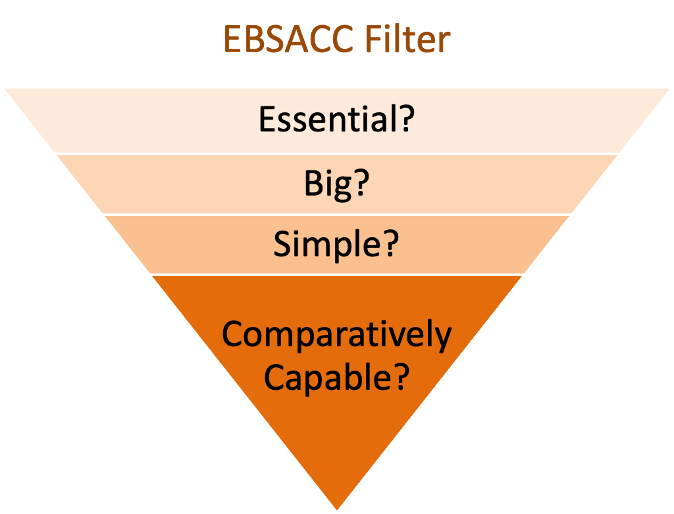
We should ask four basic questions. Is the project under consideration essential? Is it big? Is it simple? And is government, in the world as it actually is, comparatively capable of taking on the tasks we assign to it?
In what I call the EBSACC filter—Essential, Big, Simple, and Comparatively Capable—it’s worth noting how much work that little word “and” is doing. Unless the answer to all four of these questions is “yes,” we should default away from expecting government to take primary responsibility for its provision and instead look first to the coordinating capacities within markets and civil society.
Is it essential?
Identifying the “essential features of a functioning society” could be the focus of a rich philosophical seminar. But its purpose here is not philosophical; it’s basic housekeeping. It forces us to ask, before anything else, whether a given project is anywhere near the front of the line. One need only consider lavish subsidies for professional sports arenas and bespoke tax breaks crafted for a single corporate headquarters to recognize that this question doesn’t get asked often enough.
Of course, doing so will not sweep away the forces of cronyism from our politics. But nor should we be resigned to those forces. Among the most important roles policy advisors and citizens can play is to remind the government to refrain from doing the unimportant. Every non-essential project the government takes on consumes fiscal and administrative capacity that cannot be used to deliver truly essential public services.
In addition to calling out obvious boondoggles, the “essential” filter disciplines against the impulse that says, “If it truly matters, surely the government must provide it.” Look around. Food, clothing, shelter, medical services, childcare, eldercare, mentoring, and the mutual support that holds communities together are all, arguably, essential. But most of these essential things, most of the time, are provided privately, through a combination of markets and civil society. That pattern of non-governmental provision is so familiar that, often, we just don’t see it.
None of this means that the government has no role where essentials are concerned. But it does mean that “This is essential,” is not, by itself, an argument for public provision.
Is it big?
Among the projects we consider essential, which are of a scope that individuals, households, and local communities cannot manage on their own? Maintaining a highway system that moves goods and people across a continent, building flood defenses for an entire river basin, coordinating a public-health response to a fast-moving pandemic—these are all obvious candidates. But again, not all projects that are both essential and big require government provision. In fact, most do not. Insurance risk pools, large-scale manufacturing, and transcontinental shipping are just a few of the big things that markets provide.
Here we must acknowledge the critical role that government plays in all this: enforcing a rules-based order that has businesses fulfilling their promises to their clients, employers honoring their commitments to employees, and drivers respecting the rights of their fellow travelers along the highway, and so on. That acknowledgement is itself a lesson for liberal democracy. When we’re narrowing the set of things that the government must do, we should focus on those big and essential things that create the conditions in which people are well positioned to exercise their agency, collaborate, and solve the problems that are within their capacity to solve.
Is it simple?
“Simple” is likely the most counterintuitive filter. Our impulse is to say, “When it comes to our most complex challenges, wouldn’t we want the most powerful institution to take them on?”
Not necessarily.
Development economist William Easterly offers a helpful way of thinking about this. He asks why, given many good intentions and decades of international development aid, the West had failed to end global poverty. Foreign aid, he observed, is like a cow. Cows can do many useful things. They can provide a poor family with milk, butter, cheese, and more cows. But we shouldn’t expect the cow to win the Kentucky Derby. If we ask foreign assistance to put cash in the hands of expectant and new mothers, it can do that. Premature births and infant mortality will fall. But as soon as we ask foreign aid to do something as complex as ending global poverty, we’re asking it to do the wrong thing.
Generalizing Easterly’s point, the more elaborate, the more complex, the more complicated the project, the less likely it will be that government is well-situated to achieve success. We saw this in the Covid-19 pandemic. When the first vaccines were made available, the impulse was to ensure that the rationing scheme was optimally designed to get the vaccine into the arms of those at greatest risk, based on criteria like health history, comorbidities, and socio-economic status. This approach tracked with the best advice coming from the public health community at the time.

But it proved far more complicated in practice, which left valuable vaccines on the shelves unused for weeks at the height of the pandemic. In hindsight, it would have been much more effective to ration according to a single simple criterion, such as age, which could have been easily verified with a driver’s license. A key lesson here is that when asking government to do something, you should ask it to do the simplest possible version of that thing.
None of this is to suggest that complex problems can’t be solved, nor that government has no role in solving them. On the contrary, as the abundance and state capacity discourse suggests, government has a critical role to play in ending wicked problems like homelessness and climate change, by removing compliance barriers that stand in the way of solutions emerging within markets, civil society, and government itself. The removal of such barriers has the doubly beneficial impact of tapping capacity within households, businesses, and communities and freeing up government capacity to take on the pieces of the challenge it is best positioned to take on.
Is government comparatively capable?
In the face of our most complex challenges, fully-formed solutions rarely present themselves from a single source. Pieces of a solution emerge over time, from different, often unexpected quarters. In a pluralistic society, with multiple arenas of social coordination, that’s an advantage. It means that we can break a challenge down into its constituent parts. And when we do, we should only be asking government to supply those elements for which it is comparatively capable.
Disaster settings are instructive on this point. In the wake of catastrophic flooding, for example, the government is well-positioned to pump flood waters out from low-lying areas, clear mountains of debris from roadways, and protect evacuated neighborhoods from would-be looters. These are important but simple tasks that individuals cannot do on their own, and for which government has the resources, equipment, and authority to perform well. When it does those things quickly, it unlocks the capacity of everyone else. Residents can re-enter and begin repairing their homes. Businesses can reopen. Employees can return to work. And voluntary groups can move supplies where they are most needed.
Comparative capability, in other words, is not a veto on government action. It is a design principle. It tells us to look for the critical but simple enabling pieces that the government is best positioned to provide, and to provide them in ways that tap—rather than replace—the agency and capacity of individuals, businesses, and civil society organizations.
Bringing it back to trust
The Watch Duty story is one small example of this principle at work. Wildfire safety in the American West is an essential, big, complicated challenge. Within that challenge, there are crucial tasks that public agencies are, arguably, better positioned to perform: forest management on public lands, funding and training fire crews, maintaining a network of detection cameras on which others rely.
But when it comes to the complicated task of turning raw information into clear, verified, real-time alerts that reflect local conditions, a lean, private non-profit has proven itself to be the more effective provider. Rather than resisting this fact, as they did early on, official firefighting authorities should be welcoming the capacity Watch Duty is freeing up.
That is the pattern a liberal democracy should want to reproduce. Even if we succeed in making government more technically capable, we will not rebuild trust by asking it to do more. We will rebuild trust by becoming more candid about what work properly belongs to government at all—and by designing institutions that concentrate public effort on the essential, big, simple tasks they can do well, leaving space for solutions to emerge from other domains.
An EBSACC-shaped government would still be busy. It would maintain order, uphold rights, provide core infrastructure, prepare for pandemics and disasters, establish and enforce easy-to-follow rules that keep people safe, and clear the way for solutions—in housing, healthcare, energy, and so on—to be discovered and built. But it would also be recognizable for its restraint, frank about the many essential aspects of a good life that are better provided elsewhere, and focused on doing its own part in ways that empower rather than displace the agency of self-governing citizens.
If we want people to trust liberal democracy again, we must create the conditions by which our governing institutions make fewer promises and keep the promises that they do make, leaving room for the other dimensions of a liberal society to do their work.
Emily Chamlee-Wright is the president and CEO of the Institute for Humane Studies.
Follow Persuasion on X, Instagram, LinkedIn, and YouTube to keep up with our latest articles, podcasts, and events, as well as updates from excellent writers across our network.
And, to receive pieces like this in your inbox and support our work, subscribe below:
