

Back When Football Was Innocent—And the World, Too
The game of 1970 was nothing like today. That doesn't mean I'll stop watching.

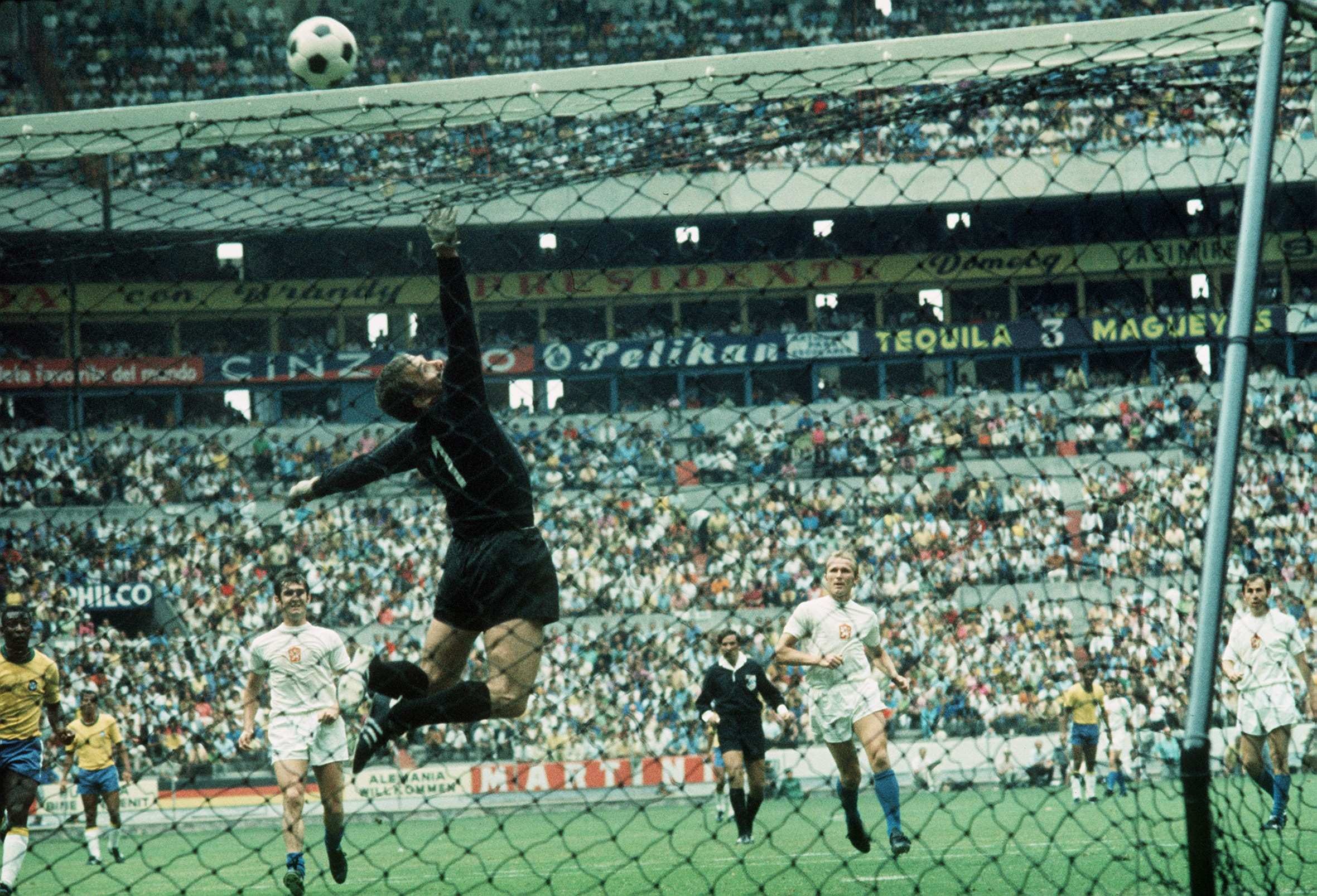
There’s a particular rhythm to the World Cup, a progression. It begins as an all out bacchanalia, a frenetic all-you-can-eat football buffet of multiple games each day. There’s a wonderful sense of serendipity in the wildly mismatched pairings: there is no other context in which Panamanians will all collectively channel their national fervor into temporary animosity against Croatia, and yet there it is, playing out on your screen.
The quality varies—no one I know had Uzbekistan-Congo circled in red marker on their calendar—but the intensity doesn’t: every match is the biggest match the particular 22 players on the pitch have ever played in their lives, and so the levels of commitment on display are always off the charts. Some matches inevitably fall flat—tapes of Japan-Tunisia could be prescribed as an effective treatment for insomnia. But others reach frenzied peaks of unlikely excitement, like the astonishing epic that Austria-Algeria turned into. Now, with the tournament expanded to 48 teams, what was already an embarrassment of riches has turned into a kind of firehose of football, an unmanageable explosion of games—some intriguing, many one-sided, a few just absurd—that exist, I’m quite sure, mostly to juice FIFA’s profits. (Not, of course, that I’ll look away for that reason.)
Of course, the cornucopia can’t last forever. As the tournament moves forward teams get knocked out, and as their numbers dwindle, the math shifts. Suddenly, you come to that cruel day at the end of the Quarterfinals. Players must rest, and so you wake up to find yourself faced with an intolerable outrage: a day when, even though there’s a World Cup on, there’s no fútbol.
This year it was on July 8, and as happens every four years, I hated it. I tried to console myself, like I do every four years, reflecting that this is just, in reality, the way the whole rest of my life is. I don’t follow club football closely—a Champions’ League match now and again, no more than that—so when the mundial is not on, a day without football is just a day. Now, though, I saw the confusion in my kids’ eyes when I explained that the schedule forced a day off, and realized I had to do something about it.
Fortunately, the good people at ITV—the other British broadcaster—knew this day was coming, and they were prepared. In a moment of marketing genius, they prepared World Cup Classics, a whole section of their streaming platform serving up great games from World Cups past. Like a junkie minutely searching the rug for bits of dope that might have fallen there, I found myself looking through their offerings before clicking on the Brazil-Czechoslovakia match from Mexico 1970.
My kids gathered around, shooting each other concerned looks. “Wow, he’s worse than I thought,” said the 12 year old. Pretty soon, though, their eyes were on the screen… and drawn into the World Cup definitely not as we know it. There’s no 21st century razzmatazz on display, none of the hyper-produced HD glitter FIFA has learned to lard on in the intervening decades. Stadium security is a bunch of fat Mexican cops in brown uniforms sitting on the side of the pitch just watching the game. There’s no sky-cams, no referee-view, certainly no VAR, hardly even a replay after a goal. The advertising hoardings don’t flash and shift, they just sit there, selling you Camel cigarettes and Martini-brand Vermouth, Zagal shirts and t-shirts (presumably a local shirt shop in Guadalajara). When the camera pans out to the crowd, everyone is wearing their normal clothes. When it pans to the bench, it’s an actual bench, not a row of branded leather armchairs that look like they belong in a sports car.

“Why are they all moving so slow?” my 12 year old asks, visibly confused. “Hadn’t they invented the concept of closing people down?” Then you notice it. The Czechoslovak defense just sort of hangs back, giving the Brazilians four or five yards in every direction on the edge of the box. Tackling is rare, and often hilariously ineffective.
“None of these people would get picked for any team in this year’s tournament, would they?” the 14 year old asks. “Not even for Jordan,” the 12 year old answers.
Of course they wouldn’t. Back in 1970, the average professional footballer in England earned the equivalent of $28,000 a year, with star players earning the equivalent of $100,000. Training sessions stopped for cigarette breaks. It was the dawn of color TV, and the sport had yet to begin its transformation into the global commercial behemoth it has since become.
“Daddy,” the 12 year old says after a while, “this game is super, super boring!”
I can’t quite disagree.
Look, I love to hate FIFA for the incredible empire of greed they’ve built. But then, the training-sponsorship-ratings arms race that has developed around football is not their fault. The torrent of cash that’s poured into the game has the power of a flood, rearranging the whole football landscape and turning the somewhat frumpy spectacle of Mexico ‘70 into the dazzling show we get to see now.
Because for all its faults, for all the meaningless games between zero-hope tier teams, for all the soporific Qatar-Switzerlands and New Zealand-Egypts FIFA inflicted on us in its money-grubbing ways, this year’s show has been spectacular. From Norway’s inspired run to the almighty scare Cape Verde gave Argentina, this year’s tournament has already done that thing it seems to do every four years: force us to forget FIFA’s sins by enthralling us with jaw-dropping performances.
A month of scintillating football has led up to today’s final between Spain and Argentina. As a non-Argentinian South American I am, of course, honor bound to support whomever is playing against Argentina—it’s tradition! It helps that Spain is certainly an easy team to love. And yet it’s a testament to Messi’s unlimited on-field charisma that I would, in my heart of hearts, not really hate it if Argentina won. Because Lionel Messi long ago burst the banks of the superlatives channeled to him, transcended his Argentinianness, almost his humanity, to become a myth. Scoring eight goals in seven games at the age of 39, Messi makes the impossible routine. Surely, the moral order of the universe demands that he lift the trophy once more.
Sitting here hoping for these two remarkable teams to give this tournament the final it deserves, I can’t help but feel that the distance between the languid, staid football of 1970 and the turbocharged game that’s played today captures the transformation our societies have undergone these last 56 years as neatly as anything else I can think of. We live in a faster, sharper-edged world, slicker, much more competitive and much richer. What passed for entertainment back then bores the hell out of us today. Our society is brighter, sharper edged, the stakes are higher.
And it just left me wondering how this year’s World Cup will look from the vantage point of 2080, when it’s Argentina-Spain 2026 that’s playing on the World Cup Classics feed, presumably, on ITV’s neurolink-enabled Experience Machine. Are my kids doomed to sit around explaining to their grandkids that they can remember back before cyborgs were allowed on the pitch? How much faster can the game get, how much more aggressive the tackling and more precise the passing? Come to think of it, how much more competitive can society go on getting?
Idle thoughts, of course, that you’d only entertain because you’re bored, desperate on the days-without-a-match and watching a half-century old match between guys who wouldn’t get picked to play in today’s Bulgarian second division. Which is to say, this delectable Argentina-Spain final can’t come a moment too soon.
Quico Toro is a contributing editor at Persuasion, the founder of Caracas Chronicles, Director of Climate Repair at the Anthropocene Institute, and writes the Substack One Percent Brighter. He lives in Tokyo.
Follow Persuasion on X, Instagram, LinkedIn, and YouTube to keep up with our latest articles, podcasts, and events, as well as updates from excellent writers across our network.
And, to receive pieces like this in your inbox and support our work, subscribe below:
When I was five years old, the same year the US beat England in the World Cup of 1950, two school mates and I were playing one fall morning in our suburban Philadelphia school’s large outdoor sandbox. A man we’d never seen before wandered up and tossed a nondescript brown ball in our midst. One my mates picked it up and tossed it back to him. He said, in an accent entirely new to us, “Ah, no laddie. You kick the damned thing!”
Turned out he was a Scot, newly hired to teach English in our Upper School and to coach our varsity soccer team. He was ‘recruiting’. The three of us would play soccer together, and with the others who joined us along the way until the fall of 1962 when we tied for our league championship.
Now I can only watch as men and women far more skilled than I ever was vie for victory in ‘the beautiful game’.
I actually met Pele, who is often credited with the appellation, after he had come to New York to finish his career with the NY Cosmos. I was coaching a 5/6th grade team in a small green patch in New York’s Central Park when I noticed a small group of similarly aged kids playing and being filmed with a smallish man in the other corner of the area. He came over and introduced himself, asking if I minded if my kids joined his for a bit of the filming of what turned out to be one his youth training films. My kids were a bit surprised at my telling him, almost before he spoke, that I knew who he was, and that we’d be honored.
To this day, I can feel the bite of my cleats in new mown, late summer grass during our double session pre-season training. I am now the only one of those three mates left, but the games we played, often with no other spectators than the moms who drove us, remain one of my favorite memories.
And the coach who introduced us, well, when I went to UPenn in the fall of ’63, I made the freshman soccer team as a walkon, like all my teammates. By the time the coach’s son , himself quite skilled, when to UPenn several years after that, he was told the freshman team was already chosen. American soccer was on its way.
And the cup will feature the mighty Czechoslovak team once again 😎