

British Jews Are Tired
Reflections on the UK’s latest antisemitic attack.

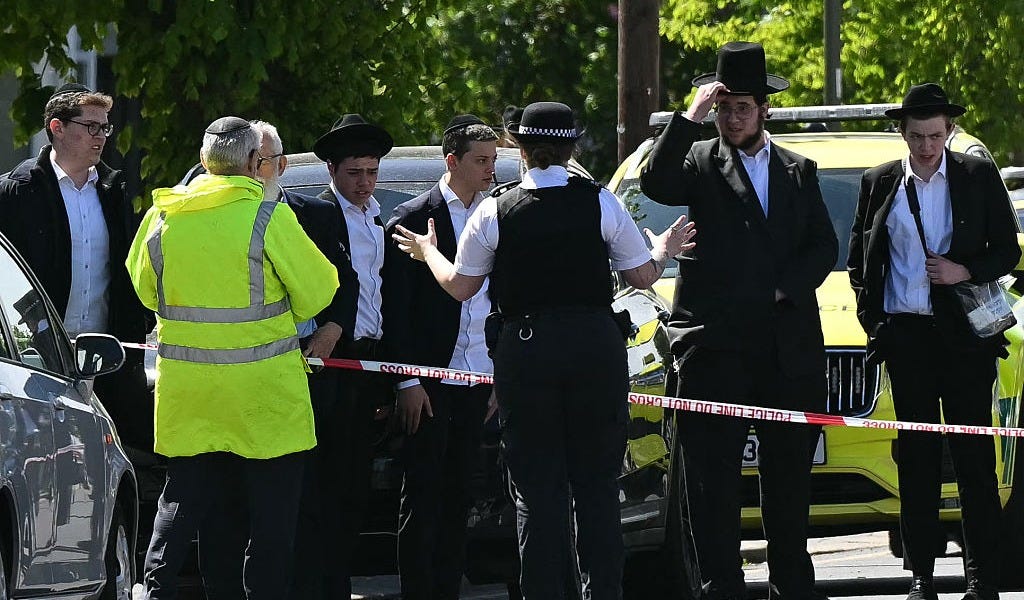
On Wednesday afternoon, a man with a knife ran down a street in north London trying to stab Jews. Two were wounded. I want to tell you why this did not surprise me. But first, a story.
In my early twenties I spent a summer traveling: two months in Ghana on an internship with a small NGO, several weeks in Jerusalem at a religious seminary at the foot of the Western Wall, then home to London for the last year of my studies.
Before I left for Ghana, my family were appalled. Wasn’t it dangerous? What about the state of the hospitals? I went, and even though I eventually did spend a few days hospitalized, I never once felt unsafe.
When I told my Ghanaian colleagues I was going on to Israel, their faces paled. Suicide bombs. Rockets. Stay with us, they said, where it’s safe. But rarely have I felt more at home than when wandering through the cobbled streets of the Old City.

And when I told my teachers that I was flying back to London, they shook their heads. What about the antisemitism? The radicalization? But I came home to my mum’s cooking, to unarmed police, to quiet streets and football on the TV.
I tell the story as a subtle rebuke: nowhere is as bad as the news might suggest. It’s like the opening image of Carol Rumens’s “The Émigrée”:
The worst news I receive of it cannot break / my original view, the bright, filled paperweight.
Solid. Durable. Belonging to a person who knows the truth about their home and is holding on to it.
This week’s attack in Golders Green has shaken a community that was already shaking. The paperweight is cracking.
Golders Green is the closest thing London has to a Jewish neighborhood: kosher bakeries, multiple synagogues within ten minutes’ walk, the kind of place where you hear Talmud discussed on the bus. Two men, one in his seventies, one in his thirties, were stabbed by a man who ran down the road targeting Jews. Both survived. They were the latest casualties on a list that includes the two killed in Manchester last Yom Kippur, when an Islamic State-inspired attacker drove into worshippers outside a synagogue and stabbed his way towards the entrance.
Between those two attacks, the months were not quiet. Arson at a synagogue in Harrow. An attempt in Finchley. An attack on a building formerly used by a Jewish charity in Hendon. Hatzola ambulances, the Jewish volunteer medical service, set on fire. In fact, the Community Security Trust recorded 3,700 antisemitic incidents in Britain in 2025, the second-highest figure on record.
Counter-terror officers are investigating links to Iranian proxies. A group calling itself HAYI has claimed responsibility for several of the arson attacks, and three Iranian nationals were charged last year under the National Security Act for surveillance of UK targets.
People are afraid. They are asking the questions quietly, and then aloud, in living rooms and synagogues: Are we doing now what German Jews did years ago? Are we ignoring the same warning signs?
Britain in 2026 is not Weimar Germany. The government has not been captured. Jews are not being stripped of citizenship by statute.
But we might be France. In 2012, a gunman murdered three children and a teacher at a Jewish school in Toulouse. In 2015, four shoppers were killed at a kosher supermarket in Paris. In 2017, Sarah Halimi, a Jewish retiree, was beaten and thrown from her apartment window by a neighbor shouting “Allahu akbar.” In 2018, an eighty-five-year-old Holocaust survivor was stabbed eleven times and set on fire in her Paris flat.
The French Jewish community has lost tens of thousands to emigration since the early 2000s, well over ten percent of its number—not under fascism but under a functioning republic, with courts and civil rights law and presidents who gave speeches denouncing the attacks. What is happening in Britain today looks less like Germany in 1933 and more like France 15 years ago: pressure, applied from multiple directions, inside a democracy that keeps expressing its concern.
The attack was shocking. But it was not a surprise.

What we have lived with for the past few years is the slow normalization of a particular kind of language. Zionism is not a political ideology with internal debates, it is a cancer. Its adherents are not citizens, they are a parasitic body to be excised.
But once a person is a parasite, the moral grammar of what one does to him changes. You do not negotiate with cancer. You eliminate it. In central London, marchers have carried placards describing Zionism as Nazism, in public, in daylight.
The “eternal Jew” of the propaganda, redrafted as the “eternal Zionist.”
Rabbi Lord Jonathan Sacks, the former Chief Rabbi of the Commonwealth, described antisemitism’s survival strategy as mutation: “In the Middle Ages, Jews were hated because of their religion. In the 19th and 20th centuries they were hated because of their race. Today they are hated because of their nation state.” The new antisemite, he observed, declares: “I’m not a racist. I have no problem with Jews or Judaism. I only have a problem with the State of Israel.”
But a Jew does not need to be a state actor to be a target. Mere affiliation is enough: a flag in a window, a cousin in Tel Aviv, a kippah worn without a keffiyeh. It marks you as unaligned, which is to say suspect.
Meanwhile, the chorus is the one we have heard for decades. Politicians find the attack “deeply concerning.” Cross-party statements arrive within the hour, sincere but impotent. A site visit, a photo opportunity, a BBC interview. We are asked, again, to mobilize around the fact of being hated.
But that is the trap any besieged minority faces.
Most of us are scared. Some are angry. Many are tired. Tired of being asked to rally around a Jewish identity that, for many, has thinned to a surname and a grandparent. We have spent a lifetime being told that being Jewish is incidental, a private flavoring in an otherwise universal British self. Now we are asked to be Jews in public at the moment many of us have the least Jewish vocabulary to draw on.
The temptation, in that vacuum, is to let the fight become the identity. To be a Jew because you stand against antisemitism. To be proud because you are not afraid. But what would any of us be if there were no antisemitism to fight? Would we still stand and declare ourselves proud? And if so, proud of what?
It is a negative theology. Judaism defined by what is done to it, by what it endures, by what it is not. It hollows from the inside.
In his book A Letter in the Scroll, Sacks warned that a community whose shared content is the experience of attack will, when the attack eases, find it has nothing left to share. This was not an argument against the fight. It was an argument about what must exist alongside it: a Judaism defined by more than external opposition, by what it affirms rather than simply what it endures.
That, I think, is the real precipice in front of any minority under siege. Not the one usually offered, between flight and resistance. The deeper choice is whether we let ourselves be defined by our opposition to antisemitism.
In what may be the most quoted passage of that book, Sacks wrote: “I am a Jew because, knowing the story of my people, I hear their call to write the next chapter. I did not come from nowhere; I have a past, and if any past commands anyone this past commands me.”
Any community whose only language is its own defense will, in the end, have nothing left worth defending. Instead, the call to action is not a fight for our “right” to be Jews. It is to engage in our responsibility to “be them.” Light the candles on Friday night. Make our sabbaths feel different. Learn the Hebrew you always awkwardly stumbled through. Open the books our grandparents kept and rarely read aloud. Argue about the weekly Torah reading. Sing Jewish songs badly. Make blessings on the good that we have with our children.
To live in our own language with fluency and conviction, with pride and with joy, is more than half the battle.
A community that can do that has nothing to prove and everything to keep.
Matt Marks runs Tribe, the United Synagogue’s youth arm, advises the BNJC on Jewish life, and is a south-coast rabbinic chaplain with University Jewish Chaplaincy. He is a Sacks Scholar writing a PhD on Rabbi Lord Jonathan Sacks’ intellectual legacy.
Follow Persuasion on X, Instagram, LinkedIn, and YouTube to keep up with our latest articles, podcasts, and events, as well as updates from excellent writers across our network.
And, to receive pieces like this in your inbox and support our work, subscribe below:
 | A guest post by
|
In a left leaning substack, lets just say the truth. Mass immigration of people from muslim countries to gated rigid societies like France, and UK, has not been successful. That's one big reason why Farage and Le Pen are so popular. I lived in France for 20 years. It is not sucessful, and never will be, at integrating immigrants- in spite of black and brown faces on TV and in publicity campaigns.
You ask us to embrace a Judaism in which we do not believe. Many of us are secular Jews. we are proud to be Jewish. We cringe whenever someone in the news who does something bad is Jewish. We qvell when we read of Jewish people doing something good. But we do not believe in an all-powerful deity like Adonai.
To the rest of the world, we still are Jews. If believing Jews shut us out, that will not reduce antisemitism. It will make us angry, but it also should not reduce our connection to our Hebrew past.
Think of this, please, in terms of young Jews. Take this example: Though even at 13, I was a non-believer, I was Bar Mitzvah because my grandma (who was Orthodox) would have been disappointed otherwise, and I recognized that I owed it to her. But at the end of the service, an old man blocked my way and insisted that I was "a good boy" and should come to synagogue regularly. I was frightened and put off. The incident made me want not to attend synagogue. You make me feel that way again, some 73 years later.