

They Went Hard Against Woke. And Then… Went Even Harder Against Trump
Don’t blame the free speech crowd for Trump’s assaults on free expression.
Cathy will be interviewed about this article by our senior editor Luke Hallam for our latest Ask the Author livestream on Substack Live, Tuesday May 5 at 6pm ET. Stay tuned! And click here to watch recordings of our recent livestreams.
As Donald Trump tries to strong-arm the media into compliance using federal agencies as his weapon, and to purge undesirable content everywhere from museums to universities, freedom of speech in America under the second Trump administration faces real and urgent dangers. Amid these dangers, charges of hypocrisy and opportunism are frequently leveled at those who advocated for free speech and intellectual tolerance during the era when censorious “woke” progressivism was at its height (roughly 2013-2021). The title of an episode of the progressive podcast “Cancel Me, Daddy” sums it up: “They Screamed ‘Cancel Culture’—Then Went Silent While Trump Gutted Free Speech.”
Others, such as writer David Klion in The Nation last June and, most recently, attorney and blogger Ken White in The UnPopulist, make a charge that goes beyond hypocrisy or silence: they argue that critics of “wokeness”—such as the signatories of the July 2020 “Letter on Justice and Open Debate” in Harper’s Magazine—bear at least some blame for the Trump administration’s war on speech.1 Such critics, it is argued, partly enabled Trump’s current actions with their hyperbolic claims of speech suppression by the left.
Likewise, former Yale philosophy professor Jason Stanley, now at the University of Toronto, has accused the Foundation for Individual Rights and Expression (FIRE), the premier free-speech group that challenged speech suppression by the illiberal left at the height of “woke,” of fostering a “moral panic about leftism [in] universities” that supposedly cleared the way for the Trump administration’s assaults on the academy.
Is there any substance to these arguments?
First, the hypocrisy claim. It is very true that some vocal opponents of “woke” left-wing illiberalism have not acquitted themselves well under Trump. Political hacks like anti-woke activist Christopher Rufo have gleefully embraced right-wing “cancel culture,” and have been quite upfront about having double standards on the issue.
Before the 2024 election, I wrote about other anti-woke culture warriors who had gotten on the Trump train in the hope that a new Trump presidency would effectively combat far-left progressivism. Some have stayed on that train. Colin Wright, an evolutionary biologist who claims he was denied a position at Cornell University because of discrimination favoring racial minorities, has not only defended Trump’s widely criticized deportation policies, but has insisted that “for wokeness to go away—to salt the Earth of it—Republicans must win again in 2028.”
When you start talking about “salting the earth” to exterminate a viewpoint you dislike, maybe it’s time to consider the “are we the baddies?” meme.
A far more prominent—though more complicated—case is Bari Weiss, whose magazine, The Free Press, was recently acquired by Paramount under the new leadership of Trump-friendly tycoon David Ellison. Weiss herself was elevated to editor-in-chief at CBS News last October.

Despite Weiss’s stated commitment to fairness, independence, and truth-seeking, both Weiss and The Free Press have taken a largely accommodating stance toward the Trump administration. A lot of Free Press content still focuses on the absurdities and abuses of the “woke left,” including articles that revisit “cancel culture” episodes from a few years ago.
Much of its coverage of the Trump presidency, meanwhile, qualifies as out-and-out cheerleading or even attempts to push the administration further. Last year, the site published a manifesto by Rufo (co-signed by a few dozen mostly pro-Trump pundits) calling for a de facto White House takeover of American universities—with no reply or counterpoint from any Rufo (or Trump) critics, many of whom are also critics of the academic left. Rufo’s proposed “contract with the universities” would strip schools not only of public funds but of accreditation for failing to comply with the right’s nebulous ideological demands.
Perhaps more disturbingly, The Free Press has trodden softly on an issue indirectly related to Weiss’s position at CBS: the Trump administration’s use of the FCC’s powers to strong-arm broadcast media. (Its article on the subject focused on the agency’s excessive powers in general, only briefly mentioning the specific, and unique, Trump-era abuses.)
Meanwhile, the site’s criticism of the government—including immigration enforcement tactics that trample due process, and blatant abuse of federal prosecutorial powers to punish Trump’s enemies—tends to be tempered with soft-pedaling and “Democrats do it too” both-sidesing.
I happen to agree that it’s important not to forget the real harms of left-wing illiberalism (more on that in a moment). But to act as if left-wing illiberalism is still the main threat to freedom of speech in America during the second Trump administration is an egregious failure to keep things in perspective. Weiss has been wrongly caricatured as a pro-Trump or right-wing propagandist, but it’s fair to say that she has failed to live up to her stated principle of holding both left and right accountable without fear or favor.
But does this reflect a more general trend among anti-woke “free speech warriors”?
Of the still-living signatories of the Harper’s Letter, I could find one, the writer Sarah Haider, who has emerged as cautiously pro-Trump. She hailed Trump’s victory in November 2024 and suggested that concerns about the harmful effects of his presidency were overblown. (There is no evidence that she has come around to a more critical view since; her recent posts on X are still in a “Democrats bad” vein.) Three or four others, including Weiss, can be counted in the “anti-anti” or “both sides” column, or punch predominantly left.
But such people are vastly outnumbered by those signatories who have been scathingly critical of the administration: Anne Applebaum, Garry Kasparov, Thomas Chatterton Williams, Jonathan Rauch, Nadine Strossen, Caitlin Flanagan, David Frum, Matt Yglesias, Damon Linker, Judith Shulevitz, Jesse Singal, Steven Pinker, and Persuasion’s own Yascha Mounk and Francis Fukuyama—and that’s far from a complete list. The “where are they now?” critique is manifestly wrong.
It is also worth noting that FIRE, the vanguard of opposition to “woke” speech-policing, has emerged as one of the strongest free speech advocates opposing Trump’s attempts to bully and muzzle critics. It filed a legal challenge to the administration’s move to deport noncitizen students who have expressed pro-Palestinian views, and backed Harvard’s lawsuit challenging the Trump administration’s cuts in research funds. It also represented, pro bono, Iowa pollster J. Ann Selzer, who had been sued for “fraud” by a Trump supporter claiming that she had misrepresented poll results to help Kamala Harris. And it has stood up against Trump’s own lawsuits against media organizations.
So, for the most part, the “free speech warriors” have acquitted themselves quite well.
That brings us to the second charge. Klion concedes that many signers of the Harper’s Letter have criticized Trump’s abuses—but he thinks they’re evading their own partial responsibility for our current predicament. What they did, according to Klion, was “build a broad elite consensus that has functioned mainly to legitimize Trump’s actions.”
White’s piece in The UnPopulist makes a more fundamental case against “the ‘free speech culture’ ethos” espoused by FIRE and the Harper’s Letter—an ethos that he believes absurdly inflates the threat from the progressive left and allows bad-faith actors on the right, including authoritarians like Trump and Elon Musk, to pose as free speech warriors challenging a “totalitarian” order.

Few people would deny that pro-free-speech arguments criticizing the left can be, and are, disingenuously misused by bad-faith actors on the right. White’s point, however, is that these were bad-faith arguments in the first place: in his view, “free speech culture” champions have relentlessly hyped a supposed left-wing threat from “relatively powerless people like students,” whose worst offenses are to respond too rudely or obnoxiously to speech they consider harmful. The result, he says, is to blur the lines between rudeness and repression, and to elevate a phantom menace that serves both to distract from and to excuse repressive measures by “antiwoke” government officials.
But this account fundamentally misunderstands, or misrepresents, what happened in American culture during the “Great Awokening.”
To begin with, one may quibble with the depiction of students as “powerless” when they have the institutional backing of schools. During the protests that followed the murder of George Floyd in the summer of 2020, Leslie Neal-Boylan, Dean of the University of Massachusetts-Lowell School of Nursing, was fired after a student’s Twitter “call-out” of her email which said, “BLACK LIVES MATTER, but also, EVERYONE’S LIFE MATTERS.” Several years earlier, Northwestern professor Laura Kipnis was put through two formal Title IX investigations for criticizing what she saw as overreactions by colleges to allegations of sexual misconduct.
What’s more, plenty of “cancel culture” episodes happened in non-academic settings, and involved people being fired, or forced out of their jobs, over very tame “problematic” opinions or trivial offenses against progressive racial etiquette.
Neal-Boylan was one of several people, including a school principal and a sports broadcast host, who lost their jobs in the wake of the 2020 protests for social media posts dissenting from the Black Lives Matter movement over its coercive tactics or its racial focus. Around the same time, the Journal of the American Medical Association fired a deputy editor over a podcast questioning the existence of “structural racism” in medicine. Philadelphia Inquirer editor Stan Wischnowski was pressured into resigning over an article on the damage from property destruction during riots, headlined “Buildings Matter Too.”
Meanwhile, a senior curator at the San Francisco Museum of Modern Art stepped down under fire for “white supremacist beliefs” because he said that refusing to acquire works by white artists is “reverse discrimination.” A Denver yoga studio chain was driven out of business by a social media backlash after “callouts” from a few employees who felt that the management’s statement of solidarity with Black Lives Matter was “too little, too late,” and who dredged up other vague grievances.
The list goes on and on—and, contrary to White’s assertion that the backlash against “cancel culture” has protected primarily powerful people such as pundits or politicians, many of the casualties were working-class employees. A truck driver lost his job after being accused of making a “white supremacist” gesture at another driver. (Around that time, there was a trollish effort by the far right to popularize the idea that the “okay” symbol—an “O” formed with two fingers—is a badge of white-power loyalty.) In Portland, Oregon, two bakery employees were fired after a black activist made a video claiming a racist slight because the shop refused to serve her several minutes after closing time.
Even children got caught in the net: Two teenage boys in California were expelled from school after a goofy photo they had shared of themselves wearing dark green acne masks was mistaken for blackface.
It’s also worth noting that critiques of left-wing illiberalism did not come solely from conservatives or liberal centrists prone to “both-sidesing.” In 2023, PEN America, a veteran free-expression advocacy group that strongly supports racial and gender diversity, issued a report documenting the chilly climate in publishing created by speech-policing in the name of social justice—including books canceled by publishers or withdrawn by authors because of an online backlash against writers of the “wrong” identity depicting “marginalized” characters and cultures.
Of course, none of the cases described above were assaults on the First Amendment, since the government was not involved in censoring speech. But are “free speech culture” advocates either unable to make that distinction, or unwilling to admit that state repression is worse than non-state “cancel culture,” as their detractors suggest?
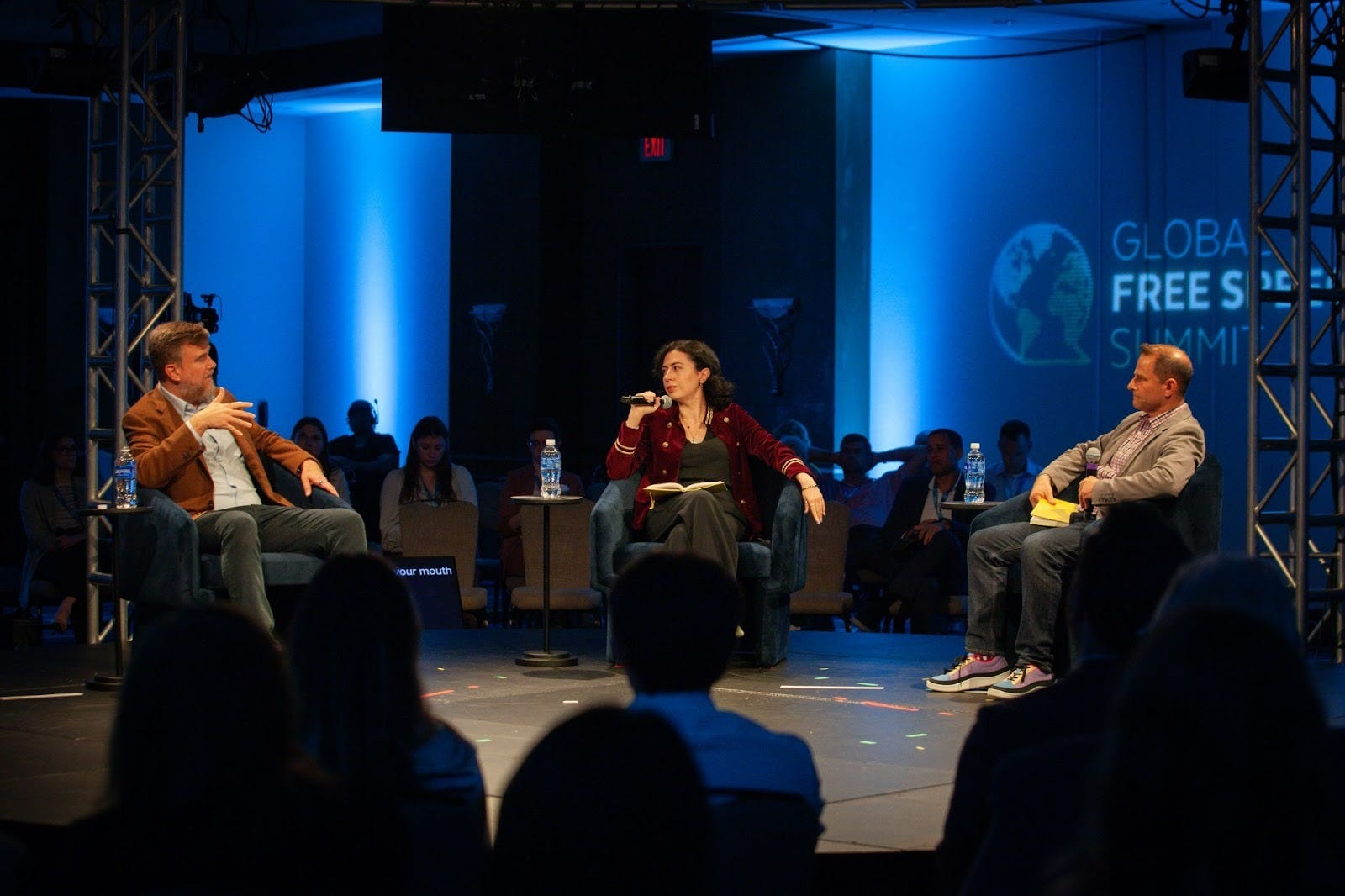
At the “Global Free Speech Summit” held at the University of Vanderbilt in Nashville, Tennessee last October, most speakers did agree that while it’s important to continue opposing cultural repression of unpopular speech, it is also important to acknowledge that repression by the government is worse. As Jonathan Rauch put it in one of the panels, “We do have to walk and chew gum.”
True, in some ways, the existence of left-wing illiberalism does complicate opposition to right-wing authoritarianism. Trump’s moves to yank funds from universities and browbeat them into bending to his ideological agenda may look a little less outrageous if one acknowledges (as does FIRE) that many of these universities have a not-so-great record on intellectual freedom themselves—and that some of the steps schools have pledged to take as a sign of compliance, such as more support for diverse ideas and civil discourse, are positive.

Likewise, the Trump administration’s war on “diversity, equity and inclusion” initiatives at schools and in workplaces may not seem so straightforwardly authoritarian or bigoted if one admits that many DEI programs have had strong elements of enforced ideological conformity and even compelled speech, sometimes of a creepy and intrusive kind. (One program developed by the Seattle Office of Civil Rights, for example, required white city employees to share “a time in the past two to three months when [they] caused harm to a person of color.”)
But should liberals avoid talking about these issues simply because it might give ammunition to the right? That doesn’t seem like a winning strategy. White thinks that free speech advocates who oppose left-wing cancel culture spout such blatantly hypocritical “bullshit” that they turn multitudes of people off the free speech cause. But surely it’s much more off-putting to evade or sanitize the truth—evasions plenty of people are savvy enough to notice. Given today’s free-for-all media ecosystem, liberal and centrist silence about the abuses of the illiberal left is not going to sweep those problems under the rug (even if that were desirable); it will only boost right-wing media that will happily report these problems—and, sometimes, misreport them in the service of their own agenda.
There is no question that the populist right, including Trump, has exploited the issue of free speech and “cancel culture” for its own authoritarian power grab. (And no, it didn’t need any assistance from the Harper’s Letter, whose outlook was explicitly anti-Trumpian, or from FIRE, which has opposed speech suppression regardless of ideology since its inception in 1999.) It is equally true that plenty of anti-woke “free speech warriors” turned out to be unprincipled or opportunistic, cheering on the government when it attempted to impose ideological conformity on colleges or bully the media.
But plenty of others have been at the forefront of standing up to the Trump administration’s assaults on civil liberties. Seeking to pillory them for imaginary sins of complicity with the right is not just intolerant—it’s remarkably self-defeating.
Cathy Young is a writer at The Bulwark, a columnist for Newsday, and a contributing editor to Reason.
Follow Persuasion on X, Instagram, LinkedIn, and YouTube to keep up with our latest articles, podcasts, and events, as well as updates from excellent writers across our network.
And, to receive pieces like this in your inbox and support our work, subscribe below:
Full disclosure: I was among the signers of the Harper’s Letter; I have also been a regular contributor to The UnPopulist, a fine magazine despite my disagreements with some of its articles.
 | A guest post by
|
The Free Press's commitment to publish a true diversity of voices and perspectives is weaponized against them once again. I'm sorry their editorials aren't 100% pearl-clutching hysterics, but we have plenty of that already. Anybody who reads more than a few cherry-picked examples knows that they've called out Trump plenty, including on free speech. And because they don't do it reflexively like everyone else, it actually means something when they do.
fair commentary, Ms. Young! I've always been on the side of F.I.R.E . in BOTH instances and I am glad you give them their credit and their due, along with the Harper's Letter signatories! Mr Rufo I smelled out very early on was a wolf in sheep's clothing and frankly, he shortly thereafter starter admitting to it, saying he was an "activist". As soon as I heard the ill "Activist" label (remember kids! A is for activism) Rufo immediately exposed himself.