

What “Western Civilization” Really Means
It has less to do with faith—and more to do with the Enlightenment—than Marco Rubio thinks.

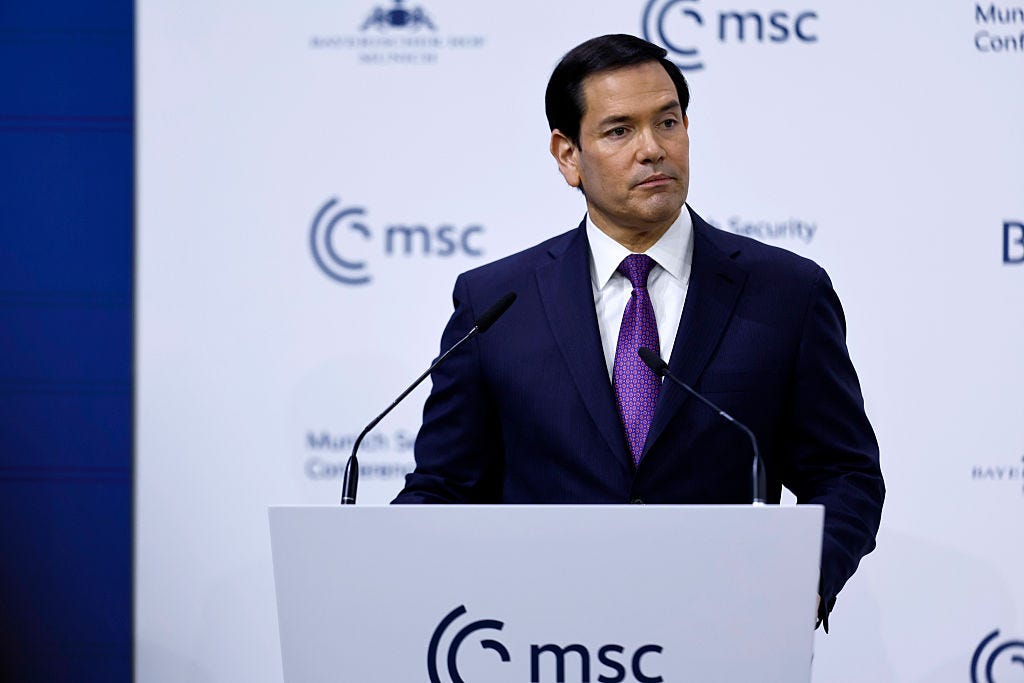
We are part of one civilization—Western civilization. We are bound to one another by the deepest bonds that nations could share, forged by centuries of shared history, Christian faith, culture, heritage, language, ancestry, and the sacrifices our forefathers made together for the common civilization to which we have fallen heir.
—Secretary of State Marco Rubio at the Munich Security Conference, February 14, 2026.
Secretary of State Marco Rubio got a standing ovation at the end of his talk at the Munich Security Conference in February, largely for his assertion, quoted above, that the United States and Europe are all part of a single “Western Civilization.” His listeners were doubtless gratified that he backed away from the aggressive nastiness towards Europe displayed by Vice President JD Vance the year before, and that he seemed to be anchoring the trans-Atlantic relationship in values, as countless American leaders had done in the years before the rise of Donald Trump.
But what is the “Western Civilization” to which Rubio was referring? His version of it is likely to be quite different from the understanding of most contemporary Europeans, and from mine as well. (Rubio did manage to get in a dig at me and the “end of history.”)
For an important group of American conservatives, “Western Civilization” denotes a specifically Christian civilization, and a culture built around active Christian belief. Rubio alludes to this by speaking not of “Christian heritage” but of “Christian faith” in his remarks. His list of shared aspects of common civilization also includes the words “heritage” and “ancestry,” which echo Vance’s use of the term “heritage Americans” to imply, it would seem, that our culture is based on a common ethnicity as well as shared religion.

There is no question that Western civilization is rooted in “Christian heritage.” One of the deepest Christian values is belief in the universal equality of all human beings in the eyes of God. National conservatives mock the liberal belief in universal human equality, and Rubio himself argues that no one fights for an abstraction, but for a particular way of life. But there’s one important abstract idea that lies at the core of Christianity and of Western culture. It was expressed by the Apostle Paul in Galatians 3:28: “There is neither Jew nor Gentile, neither slave nor free, nor is there male and female, for you are all one in Christ Jesus.”
Many important thinkers, from Alexis de Tocqueville to G.W.F. Hegel to Friedrich Nietzsche, have understood that Christianity spawned modern liberal democracy. Most people who defend human rights today do not do so in religious terms, but there is no question that modern understandings of rights descend from Christian religious beliefs.
But in making this transition, Western civilization detached itself from any overt identification with religion. The reasons for this were historical: following the Protestant Reformation, Europeans spent the next 150 years killing each other over differing interpretations of Christian doctrine, over ideas like transubstantiation or childhood baptism. Since Medieval times, there has been no monolithic Christian doctrine; Protestantism spawned a “way of life” quite different from Catholicism.
As a result of this disagreement over final ends, the Enlightenment founders of modern liberalism agreed to push religion into the realm of private belief, and to focus politics on life itself rather than the good life as defined by a particularly religious doctrine. In addition, early natural scientists were engaged in a prolonged struggle with the Catholic Church; it was only with the separation of empirical inquiry from religious dogma that modern natural science, and the economic world it made possible, emerged.
So there is in fact a very different understanding of Western civilization from the one that Rubio advances, one that is built around liberalism itself, encompassing Enlightenment values like openness, tolerance, and skepticism about received ideas. This version of Western civilization downgraded the role of religion in politics. We can fully acknowledge the Christian origins of many of our ideas about democratic rights without defining our shared civilization in religious terms. Indeed, societies were very diverse with regard to religious belief not just in the current era of mass migration, but all the way back to the sixteenth century.
Even worse than shared religion is an effort to define our civilization in terms of “heritage” or “ancestry.” I hate to remind Marco Rubio, but his particular heritage and ancestry lead back to an authoritarian and Catholic Habsburg Empire, while that of James Monroe and Thomas Jefferson lead to a very different and more liberal Protestant part of Europe.
Last month saw the passing of the civil rights leader Jesse Jackson. Jackson played a critical role in keeping alive the struggle for racial equality begun by his mentor Martin Luther King. But Jesse Jackson was decidedly unhelpful in one respect. Back in 1987 he came to Stanford University and participated in a march where students chanted “Hey, hey, ho, ho, Western Civ has got to go.” As a result of these sorts of pressures, Stanford and other elite universities got rid of their Western culture core courses, and replaced them with an incoherent mishmash of multicultural offerings. This was a big mistake.
Jackson apparently disavowed this rejection of Western culture, as well he might. His own life was completely framed by Western civilization, under either of its definitions. He was a Christian minister in a civil rights movement that was led by other Christian ministers like Martin Luther King, who preached succor for, as Jesus put it in Matthew, “the least of these.” And he was also an advocate for universal human rights, someone whose advocacy was protected by a rule of law established by his nation’s Declaration of Independence and Constitution.
This protection will not survive unless students in the West learn the history of their own culture. The only way to counter reactionary ideas like those of Rubio or Vance is to have a proper understanding of how Western civilization evolved and is today defined by liberal Enlightenment values that were originally rooted in Christian belief. It is these “abstract ideas” that define our way of life, and for which we should be willing to struggle and die today.
Francis Fukuyama is the Olivier Nomellini Senior Fellow at Stanford University. His latest book is Liberalism and Its Discontents. He is also the author of the “Frankly Fukuyama” column, carried forward from American Purpose, at Persuasion.
This article has been updated to reflect the fact that Jesse Jackson disavowed the chant at Stanford.
Follow Persuasion on Twitter, LinkedIn, and YouTube to keep up with our latest articles, podcasts, and events, as well as updates from excellent writers across our network.
And, to receive pieces like this in your inbox and support our work, subscribe below:
Excellent!! And spot on
White Christian ethno-nationalists like Rubio and Vance are indifferent to the Enlightenment which inspired our Founders- and also- curiously, to St. Paul in the glorious Epistle to the Galatians
The irony of today's effort to topple a theocracy in the Middle East is that conservative Christian Nationalists are desperately trying to create one here.