

Rubio Wants Democracy, Trump Wants Oil
One month on, it’s clear which approach to Venezuela is winning.

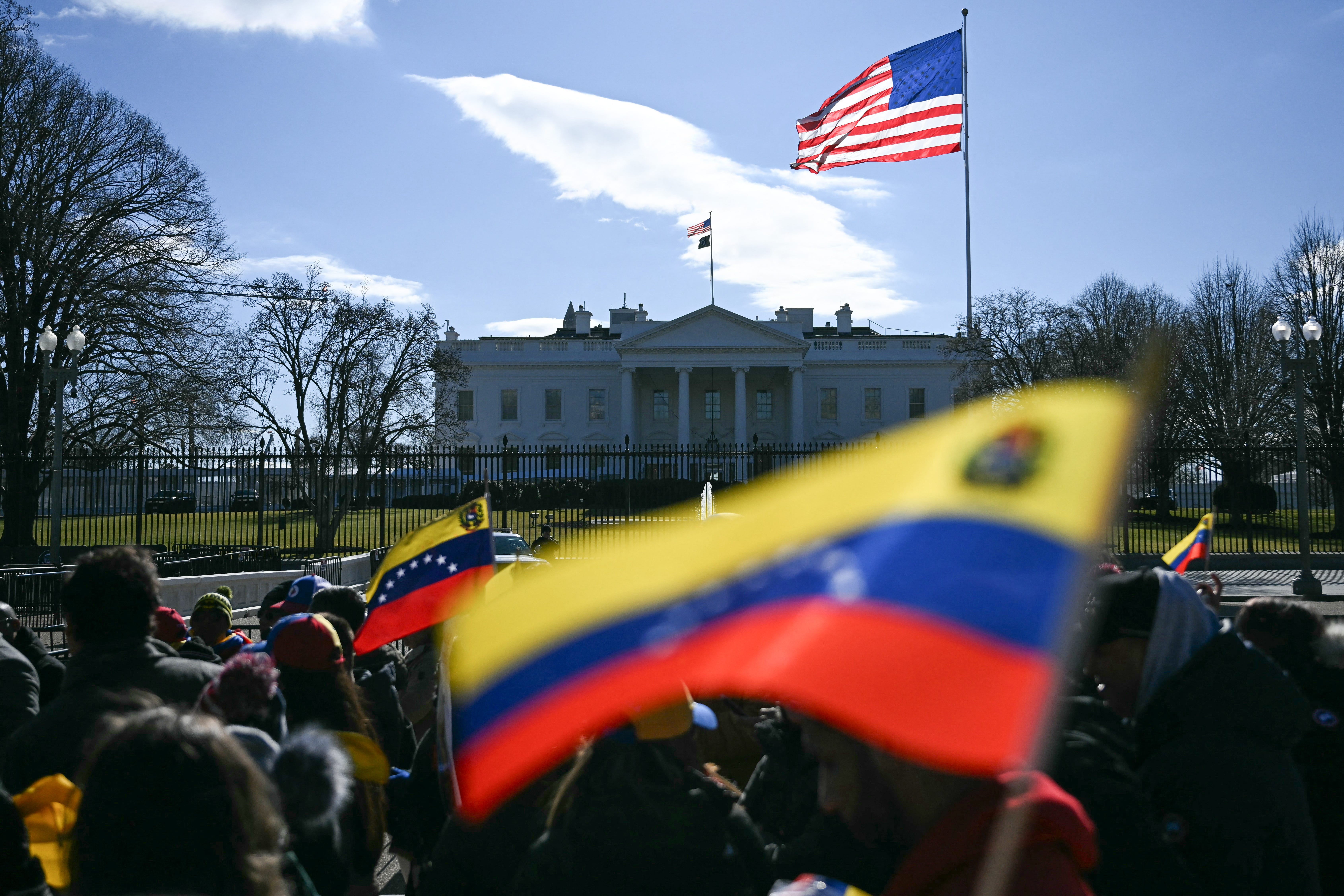
It’s been exactly a month since special forces snatched Nicolás Maduro and his wife from bed and bundled them into an American prison. For Venezuelans, it’s been a disorienting experience: the dictator is gone, but the dictatorship is still there.
For now, we know Delcy Rodríguez, Venezuela’s new and technically still “interim” president, will do pretty much anything to stay in power and keep Venezuela autocratic. As a blockbuster report in The Guardian revealed, Delcy more or less explicitly sold Maduro out to the gringos on January 3, pledging her cooperation with Trump ahead of the extraction operation. For Delcy, survival trumps everything, and if that means kowtowing to Trump, so be it.
One way of looking at it is that Bolivarian socialism, never the most ideologically coherent of movements, has deepened its schizophrenia. A movement that stood for nothing if not anti-imperialism shape-shifted into a willing vassal of Washington literally overnight, under the leadership of insiders who until 15 minutes ago counted themselves as the most anti-imperialist of the anti-imperialists. This weird, disjointed reality seems hardly sustainable, though in the funhouse mirror world of Trump 2.0 geopolitics, anything goes.

If political opening is your priority, the regime’s ghastly prisons are the emblem of authoritarian control. So far, signals have been mixed. Out of nearly a thousand political prisoners, roughly 300 had been released as of late January. But prominent opposition figures—including Freddy Superlano, a former lawmaker, Perkins Rocha, a lawyer for exiled opposition leader María Corina Machado, and Juan Pablo Guanipa, former vice president of the National Assembly—remain behind bars. Machado herself, appearing on CBS this weekend, noted that not a single military political prisoner has been freed.
Worse yet, even as old prisoners are released, new ones are coming in to replace them: soon after the extraction, the regime approved a decree making it a crime to celebrate Maduro’s capture. Reports circulate of peasants in their sixties being trundled away for firing celebratory gunshots in the air.
And yet, the news is not all bad. After years of stagnation, the economy got a shot in the arm when millions of dollars from oil sales to the United States got deposited into a moribund banking system. Disorienting absolutely everyone, some grocery prices have started to go down, giving people hope that at least in the short term, things are looking up. Some of Venezuela’s eight million displaced people stopped dreaming of coming home and started planning to. They know they won’t be returning to a free country, but they hope they’ll be heading to one that’s minimally functional.
Still, whatever you want to call what’s happening in Venezuela, a political opening it is not. The question everyone is asking themselves is: Can this rump regime possibly hope to keep power now that its powerlessness has been so humiliatingly established?
Alas, it might.
How? By exploiting the fault line that runs straight through the center of the Trump administration itself.
President Trump has been up front about what he wants from Venezuela: oil. He has said so plainly, repeatedly, and with zero ambiguity. On the day Maduro was captured, Trump told reporters he would send American companies to “spend billions of dollars” fixing Venezuelan oil infrastructure. Three days later, his administration announced a deal for 30 to 50 million barrels. The “why” isn’t particularly subtle: the companies he has tapped to execute this opening have proven track records of corruption (more on them in a minute).
The irony here is thick. Hugo Chávez, the late founder of the Venezuelan regime, spent years vehemently arguing that the only reason America was interested in Venezuela was the oil. Trump, whether he realizes it or not, is fully incarnating the ugly America the chavista revolution was born to fight against. Now that a living caricature of American imperialism is actually in power, the chavista elite has suddenly lost interest in resistance.
To the extent there’s any reason for Venezuelans to be optimistic, it’s because Venezuela policy is being implemented not by Trump, but by Secretary of State Marco Rubio. Deny it though he will, Rubio’s approach is plainly different from the president’s. At his Senate Foreign Relations Committee hearing on January 28, Rubio laid out a three-phase plan: first, stabilize oil flows; second, create conditions for political reconciliation, including amnesty and the return of exiled opposition figures; third, democratic transition.
Rubio told senators he wants “a friendly, stable, prosperous Venezuela—and democratic, in which all elements of society are represented in free and fair elections.” He acknowledged the administration is working with people who, in his own words, “have spent most of their lives living in a gangster’s paradise.” He conceded that prisoner releases were happening “slower than I would like.”
Still, it’s a recognizable agenda. Rubio is a child of Miami’s staunchly anti-communist Cuban-American culture. He gets Caribbean Communism, and he hates it. Democratizing first Venezuela and then Cuba appear to be life-long dreams. But his hand is weak.

A secretary of state can articulate all the phases he likes, but when the president’s stated priority is oil access and his measure of success is barrels delivered, the incentive structure for Delcy Rodríguez becomes perfectly legible. As long as the crude is flowing, she’ll always find a partner in the White House to put off democratization just a bit longer. Every barrel that reaches a U.S.-controlled account is a barrel that buys her another week of political survival—and another week in which Rubio’s democratic benchmarks can be deferred without consequence.
To his credit, Rubio does appear to be pressing for democratic opening, and he is seeing some success. On January 30, the regime’s rubber-stamp National Assembly, led by Delcy’s brother, Jorge Rodríguez, announced a broad amnesty law that would certainly never have seen the light of day without American pressure. Though a genuine step, the bill is framed by the Rodríguezes not as an acknowledgment of state wrongdoing but as a gesture of magnanimity—an act of clemency by the very people who ordered the imprisonments. Caracas understands that Rubio’s hand is weak, which is why the bill gives Delcy and Jorge plenty of discretion about who exactly gets released and when, and, more importantly, who gets thrown back in jail and why. It’s an appalling half measure of the type the regime has always specialized in: just enough to produce the illusion of reform without its substance.
The fate of Venezuela’s political prisoners will remain the best gauge of whether Rubio’s strategy is working. From an imperial standpoint—and Trump’s framing is explicitly imperialist—prisoners are a secondary concern, a humanitarian gesture to be extracted when convenient so it can be boasted about on social media. For actual advocates of Venezuelan democracy, political prisoners are the whole ballgame. You cannot have a democratic transition while the state retains the power to jail its critics. You cannot have free elections while opposition leaders rot in detention and the coercive legal frameworks that can put them there at any time remain intact.
Rubio sees all of this. He told senators that “you can have elections all day, but if the opposition has no access to the media, if the opposition candidates are unable to be on the ballot, those are not free and fair elections.”
That’s the right frame. The question is whether he has the institutional power to act on it when his president is measuring success in barrels per day.
In a useful piece in the Journal of Democracy, former opposition politician Freddy Guevara identifies five possible endgames for the regime.
The one he thinks most likely—an authoritarian capitalist model in which foreign investment coexists with political repression—is also the one most compatible with Trump’s stated priorities. A Venezuela that produces oil efficiently, buys American goods, and keeps its internal politics safely autocratic is a success story as far as Mar-a-Lago is concerned. Not for Rubio. That gap—between what counts as success for the president and what counts as success for his secretary of state—is the crack in the wall that Delcy Rodríguez will try to drive a wedge through.
Rubio’s position is weak, but it is not hopeless. History is full of examples of determined agents achieving policy outcomes that their principals didn’t particularly want. The three-phase framework Rubio has articulated creates its own logic: if phase one (oil stabilization) is already underway, the expectation of phase two (political reconciliation) becomes harder to abandon without admitting the whole enterprise was a sham. Congressional oversight, particularly from hawkish Cuban-American members who share Rubio’s instincts, provides institutional backup.
If we were in a parallel universe where President Rubio was in full control of American policy, I wouldn’t feel too bad about the prospects for democratization.
But under President Trump? Well, let’s see.
The administration’s first major oil sales—worth roughly $500 million—were brokered through Vitol and Trafigura, two commodity trading houses that were handed no-bid licenses to move Venezuelan crude. Both firms have recent histories that would, in a functioning anti-corruption regime, disqualify them from precisely this kind of work. In 2020, Vitol paid $135 million to resolve DOJ charges that it bribed officials in Ecuador, Brazil, and Mexico; a Vitol trader later pleaded guilty to bribing officials at state oil companies in Mexico and Ecuador. In 2024, Trafigura pleaded guilty to conspiring to bribe Brazilian officials and paid over $126 million. Vitol’s senior trader on the Venezuela deal, John Addison, donated $6 million to Trump’s 2024 campaign. Revenue from the sales flows into U.S.-controlled accounts in Qatar, with no congressional oversight mechanism, no inspector general, and no public accounting of how proceeds are disbursed.
The reality is that the kleptocracy Donald Trump is instituting in Washington and the one Delcy Rodríguez leads in Caracas are two peas in a pod. The confluence of interest is not subtle. Both sides want oil money flowing with minimal scrutiny. Both sides benefit from opacity, and both prefer a transaction to a transformation. Which is why, when push comes to shove, Marco Rubio is probably going to realize that there are forces at work here beyond the control of a mere Secretary of State.
If, in spite of all of this, Rubio manages to exploit Trump’s inattention and force real democratic reforms—a lasting, broad-based amnesty, opposition media access, a credible electoral timeline—he will have pulled off something remarkable. Generations of Venezuelans will owe him a debt.
But if the fiction collapses, and oil access becomes the ceiling rather than the floor of American ambition, then the continuation of Venezuelan autocracy won’t have been imposed by the Rodríguez siblings alone. It will have been co-signed by Washington.
Quico Toro is a contributing editor at Persuasion and the founder of Caracas Chronicles. Like eight million other Venezuelans, he was forced to flee Venezuela’s dictatorship.
Follow Persuasion on X, Instagram, LinkedIn, and YouTube to keep up with our latest articles, podcasts, and events, as well as updates from excellent writers across our network.
And, to receive pieces like this in your inbox and support our work, subscribe below:
No. It isnt that Trump wants the oil. He wants to prevent the commies from getting their hands on the oil.
Ceux qui estiment que le résultat de l'opération Absolute Resolve (chute d'un dictateur, régime ébranlé) compte plus que les intentions affichées ont sans doute raison. Mais pour prévaloir, la démocratie exige non seulement des actions, mais aussi des paroles