


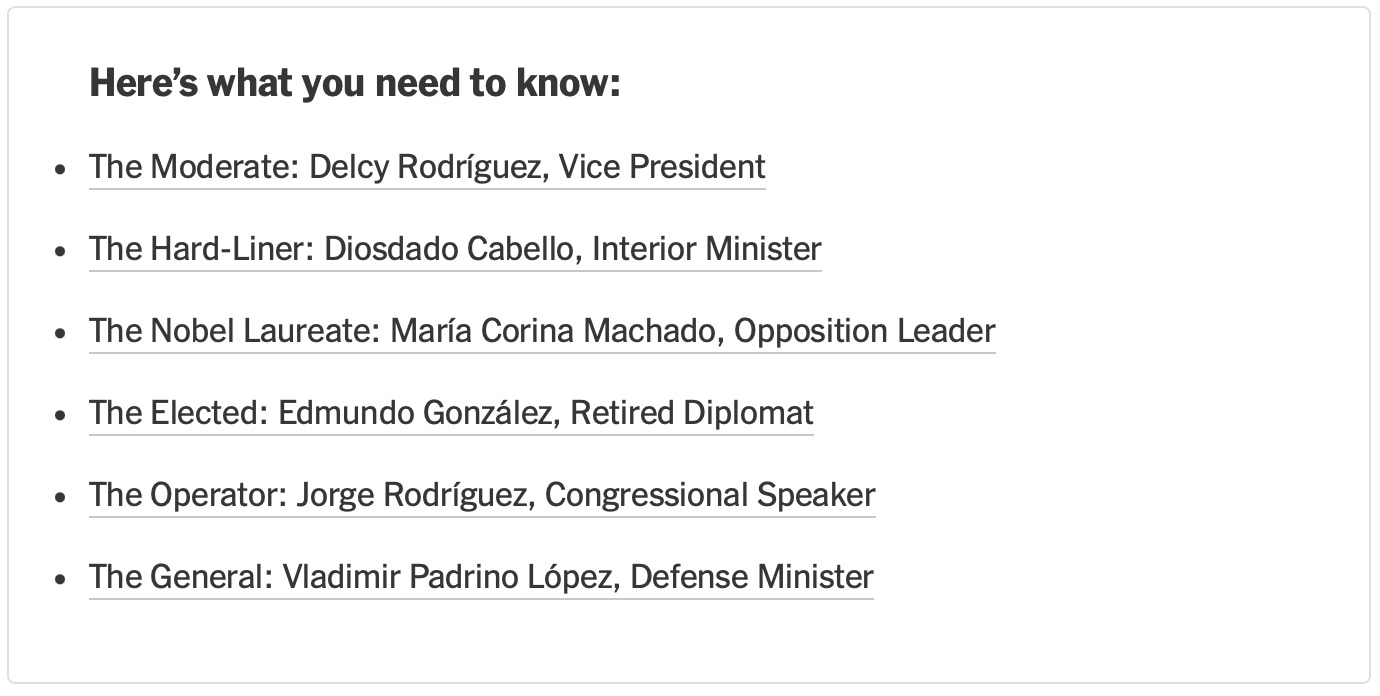
About a month ago, as America’s military presence in the Caribbean ramped up, The New York Times ran a feature on the figures that could imaginably step into the presidency in Nicolás Maduro’s absence. One heading was titled “The Moderate: Delcy Rodríguez, Vice President.”
Venezuelan Twitter erupted.
The moderate? Delcy?!?
Have they lost their minds!?
One after another, Venezuelans lined up to share instances of her awfulness: her tireless whitewashing of the regime’s crimes, the international sanctions she was under, her leadership of the sham constitutional convention Maduro had used to void the opposition’s win in parliamentary elections in 2017, and especially the close links she’s reputed to have with SEBIN, the hated secret police behind Venezuela’s most notorious political prison and torture center.
To Venezuelans who had spent over a decade seeing in her one of Nicolás Maduro’s most ardent and uncompromising acolytes, calling her a “moderate” is an outrage. Here’s a woman who has held all of the most important offices of state—oil minister, minister of foreign affairs, president of the constituent assembly, vice president—and has never allowed any hint of sunlight to appear between her and Maduro.
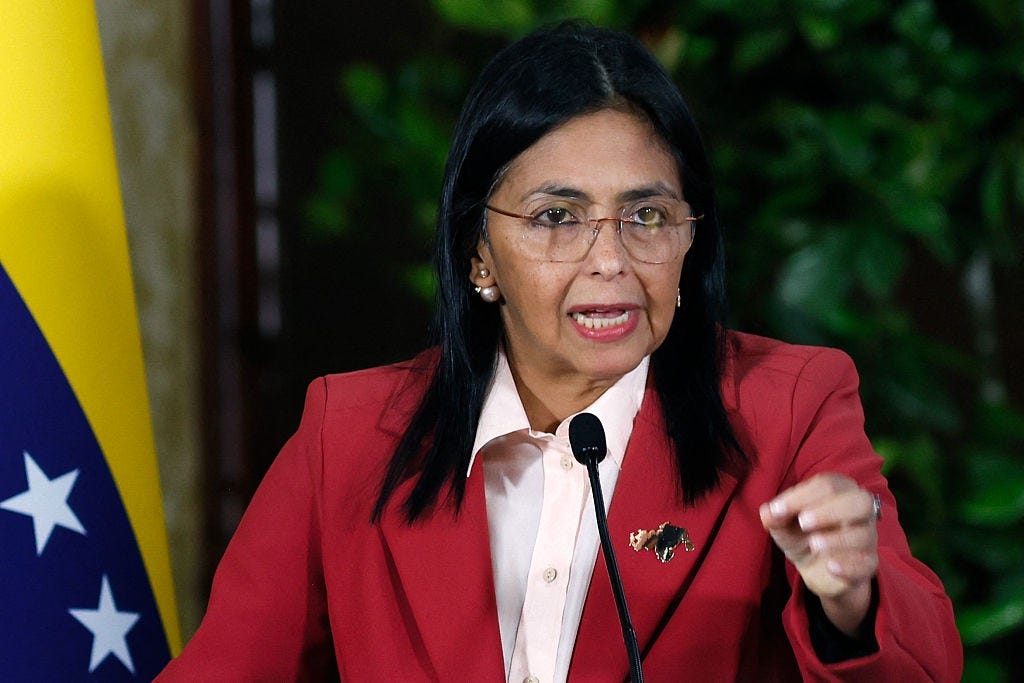
Earlier today, Delcy Rodríguez became the new president of Venezuela.

Venezuelans know leftist fanaticism runs in Delcy’s family. Her brother Jorge has been one of the government’s highest-ranking and most toxic leaders for even longer than she has: a uniquely manipulative figure who’s earned a leading spot in the demonology of the Venezuelan opposition.
Meanwhile, their father, Jorge Rodríguez Sr., is a martyr for the Venezuelan far left. Back in 1973, he founded perhaps the most extreme party in the constellation of far-left groups that soaked Venezuela in blood. The Liga Socialista was a tiny, explicitly pro-Cuban splinter from a larger (but still small) Marxist group that rejected the peace process that had ended Venezuela’s short-lived guerrilla war of the 1960s. Rejecting the Soviet Union’s leadership of international communism, these were die-hards committed to violent revolution across the developing world now, not later.
In 1976, along with a small number of Liga Socialista activists, Delcy’s father masterminded the kidnapping of William Niehous, an American executive working for Owens-Illinois, the bottle manufacturer. Picked up by Venezuela’s then U.S.-aligned police, Jorge Sr. died under torture, but never gave up the whereabouts of the kidnapped gringo. Delcy and her brother have described witnessing her father’s appalling treatment, and she once described the Bolivarian revolution as “our personal revenge” for the human rights violations leftists suffered in that era.
Passing from Nicolás Maduro to Delcy Rodríguez, Venezuela’s presidency has just gone from one former Liga Socialista activist to another. That this out-and-out pro-Cuban extremist somehow managed to persuade the gringos that she’s a technocratic moderate they can do business with is one of the strangest twists of the bizarre 72 hours Venezuela has just lived through, which saw the United States kidnap Maduro and his wife and fly them to New York to face trial. That Marco Rubio—a Cuban-American Secretary of State with as clear an understanding as anyone of the toxic role Cuba has played in backstopping Venezuelan socialism—decided to play ball with Delcy is honestly just inexplicable.

And yet there is a reason foreign journalists perceive Delcy as “moderate.” Reports keep saying she shows a different face when negotiating on behalf of the regime: affable, technocratic, reasonable. Fluent in English and French, she’s said to have a mastery of the details of energy and economic policy that always eluded Maduro. A former foreign minister, she appears well able to at least ape the conventions of normal international negotiations. People who deal with her one-on-one tend to come away impressed with her manner. Certainly, compared with the unembarrassed sadism of other senior regime figures like Interior Minister Diosdado Cabello and Defense Minister Vladimir Padrino, she is at least circumspect enough not to gloat over the violence she inflicts.
In pure realpolitik terms, then, there’s a certain twisted logic to the United States’ decision to leave her in place. Donald Trump is undoubtedly right when he says she commands respect among the armed men who administer violence in Venezuela in a way an actual moderate never could—because she’s one of them. Given that Trump does not seem willing to really countenance a full-on invasion leading to an actual change of government, leaving the chavista regime intact follows as a matter of course. From the profoundly unappetizing menu of senior regime figures, you could, if you squint, see Delcy as marginally less horrible than the rest. Marginally.
Still, it’s difficult to express how deeply betrayed Venezuela’s democratic movement will feel seeing the United States actively backing a figure as toxic as Delcy Rodríguez as the head of the Venezuelan state. She may agree to do the kinds of imperialist oil deals Trump and Rubio have already plainly spelled out they will demand as the price of leaving her and the gaggle of criminals around her in power.
But leaving Delcy in charge of Venezuela is not regime change, because she’s an emblem of the regime. It’s not even a relaxation of dictatorial conditions, because the hundreds of Venezuelans who have been languishing in Maduro’s prisons and torture chambers will just keep languishing in Delcy’s.
Three weeks ago, I mused that the emergence of a democratic state following U.S. military action is unlikely. A more realistic outcome would see Venezuela “in the hands of a right-wing dictator who pushes out Maduro and his clique, inherits the chavista state, and changes only the slogans.” In the event, what we’re going to be stuck with is even more absurd: a left-wing dictator drawn from Maduro’s own clique who won’t even change the slogans, just cut some energy deals to make Donald Trump’s cronies in the oil industry rich.
The prospect of Delcy Rodríguez teaming up with Trump to loot Venezuela’s fossil fuel resources makes me sick to my stomach. I’ve known all along the outcome would be bad. I didn’t think it would be this bad.
Quico Toro is a contributing editor at Persuasion and the founder of Caracas Chronicles. Like eight million other Venezuelans, he was forced to flee Venezuela’s dictatorship.
Due to an editorial error, an earlier version of this piece stated that Delcy Rodríguez was appointed to head the constitutional convention in 2024, not 2017. We regret the error.
Follow Persuasion on X, Instagram, LinkedIn, and YouTube to keep up with our latest articles, podcasts, and events, as well as updates from excellent writers across our network.
And, to receive pieces like this in your inbox and support our work, subscribe below:
It's a little too early to tell, Fernando. She may be under internal pressure, especially from within the military. There is zero doubt in my mind that secret deals have already been struck within the Venezuelan regime (within military I am near certain) and perhaps even within other channels of existing political power structure. Survival is at the foundation of all human impulses, especially if it can be "greased" with millions of dollars and a Costa Rican beach house. Maduro had an offer for same in Turkey. He made the wrong choice. Perhaps Ms. Rodriguez has digested that lesson.
You surely can’t believe that the only purpose of this change is to help American oil companies. A pliable if cynical self-preserving regime that is in thrall to the US will do much more of interest to us. It will downgrade or cut off Cuba Iran Russian and China. That’s a pretty good result even if the restoration of democracy takes some
More years and effort by the Venezuelan people themselves.