

A “Failure of Journalism” in Canada
What it costs to abandon objectivity.

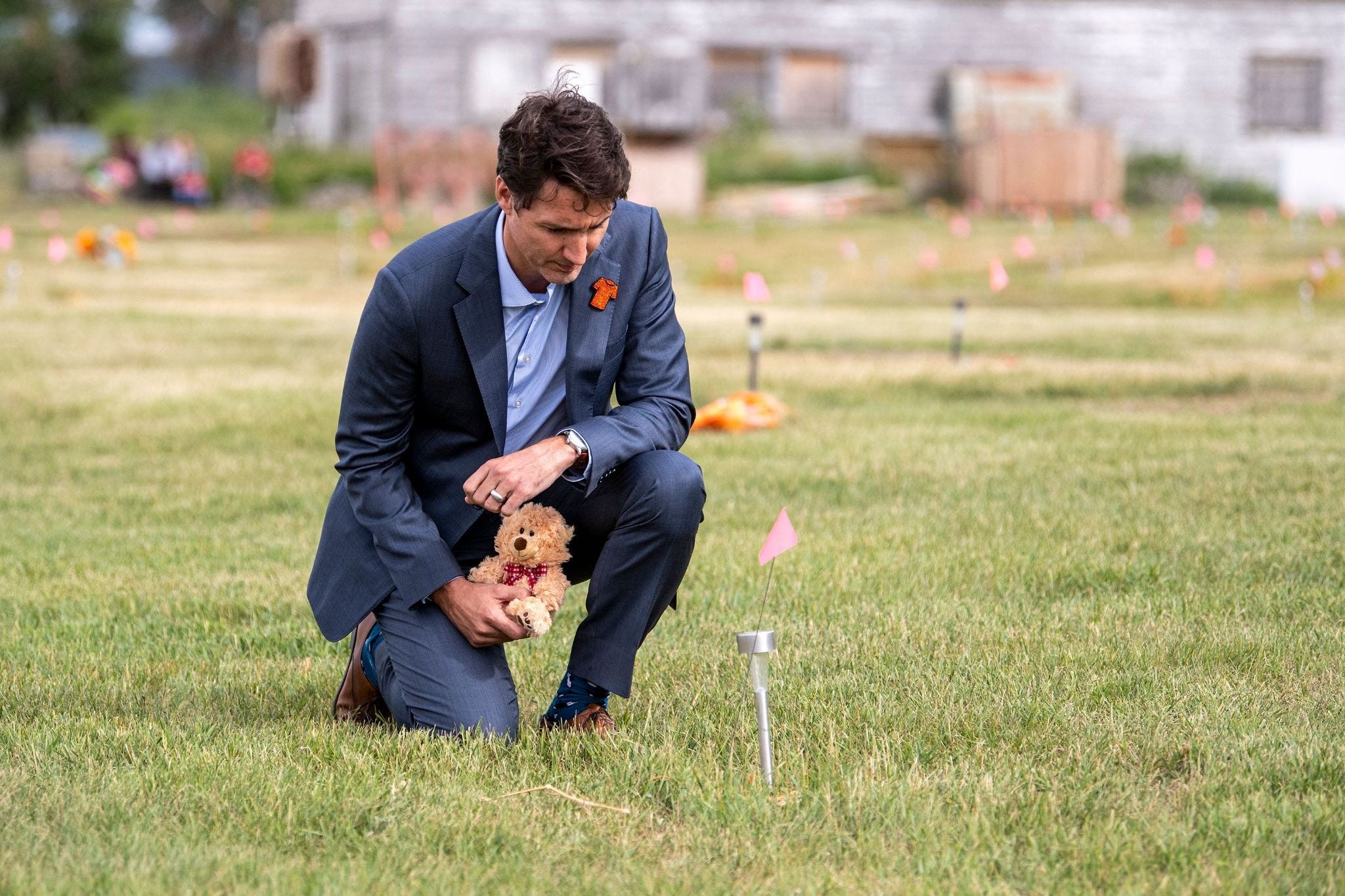
It’s a sobering moment for the Canadian press corps, which is grappling with one of the biggest reporting errors in a generation. Five years ago, on May 27, 2021, Tkʼemlúps te Secwépemc, a First Nation in Western Canada, made an announcement that shocked the country. With the help of ground-penetrating radar, the band said it had “confirmation of the remains of 215 children”—deceased students from the Kamloops Indian Residential School. Kamloops was one of more than 130 largely Catholic Church-run institutions that operated across the country from the 1830s to the 1990s, with documented histories of physical and sexual abuse and, according to the Truth and Reconciliation Commission of Canada, at least 3,200 student deaths, many from tuberculosis and influenza.
“To our knowledge, these missing children are undocumented deaths,” Chief Rosanne Casimir said in the press release for the Kamloops discovery. “Some were as young as three years old.” Grief rocked the country. Statues were torn down, churches were vandalized and at least two dozen burned to the ground, and demonstrations were staged from coast to coast. A wave of similar announcements followed, bringing the cross-country tally to more than 1,300 burials. Flags in federal buildings were at half-mast for five months and government funds were allocated to assist with First Nations investigations. Pope Francis later visited to apologize. The Canadian Press declared it the story of 2021.
The problem is that Tkʼemlúps had not actually found any remains in 2021—and still has not. What was discovered were ground anomalies, and, so far, the band has not excavated. In fact, the majority of the First Nations that reported potential grave sites have not done so. Late last month, in the leadup to the story’s fifth anniversary, Canada’s paper of record The Globe and Mail finally ventured to ask: “The lowered flags, the vigils, the hundreds of millions in government funding, the national reckoning—what if all of it was dedicated to 215 burials that don’t exist?” The reporting buried this lede, frontloading the piece with explanations for the delays in excavation efforts and with critiques of the “loud contingent of skeptics and denialists.” But a week later, the Globe editorial board was more direct: “The fact of the crimes committed against Indigenous children at residential schools over many decades does not automatically validate claims that hundreds of students were dumped into unmarked graves at Kamloops and other residential schools. That is an extraordinary assertion, one that requires proof.” The editorial board characterized the media’s lack of scrutiny, including the paper’s own, as a “failure of journalism.”
The graves story is one of the most sensitive in the country’s history. How did a well-meaning press corps bungle it so badly?
A Weak Press
What happened can be understood only in the context of the systemic weakening of the press corps. For at least two decades, Canadian media has struggled to find a workable business model. Its financial prospects are so dismal that the federal government is subsidizing the industry on a mass scale. According to the Canadian Association of Journalists, there are now fewer than 11,000 journalists covering the entire country.
Economic challenges have paved the way for timidity and groupthink. When Donald Trump arrived on the world stage, the press panicked, declaring a state of exception, pulling down journalistic guardrails, embracing activism, and publicly purging dissenters. This cycle repeated with #MeToo, the 2020 racial reckoning, and the pandemic. With each new iteration, the industry prioritized narrative over facts, botching high-profile stories and hemorrhaging public trust.
The Erosion of Standards and Practices
An obsession with American media has long been an Achilles heel for the Canadian press—and this has been especially salient in the Trump era. Canadian media paid close attention when prominent American media thinkers such as Margaret Sullivan, Jim Rutenberg, and Jay Rosen argued that Donald Trump was an existential threat that necessitated suspending old standards. Indeed, these commentators were celebrated and emulated here, invited to deliver talks and headline events. Meanwhile, on both sides of the border, practices eroded, allowing inflammatory language in headlines, substituting silent edits for corrections, editorializing, and failing to reflect the range of public opinion on contentious issues.
In Canada this trend accelerated in 2020-21, with an internal push from staff at the Canadian Broadcasting Corporation, the national public broadcaster, challenging the network’s journalistic guidelines, and the head of public affairs responding that “we have started discussions around the issue of impartiality as a journalist and reconciling, at times, a higher value as a human being and member of society.” Activist-minded journalists advocated against the newsroom norm of objectivity. “Objectivity Is a Privilege Afforded to White Journalists” ran the headline of a National Magazine Award-winning essay in The Walrus. “Is objectivity an outmoded value in journalism?” asked CBC Radio in the sub-headline of an interview with a journalism professor, who posited that objectivity could potentially be “harmful.”
A Sensitive Story
It was into this charged cultural moment that the graves story appeared. The 2021 Tkʼemlúps press release was immediately covered by CBC News, which uncritically repeated the “remains” claim. Amid an outpouring of national grief, Prime Minister Justin Trudeau called the discovery of remains “a painful reminder of that dark and shameful chapter of our country’s history.” That same day, The New York Times took the story global, introducing the loaded term “mass grave” and inadvertently picking up on unsubstantiated rumors of a vast network of graves of Indigenous children circulated for years by a defrocked United Church minister. The “mass grave” term nevertheless went on to gain traction, despite The Washington Post issuing an early correction.
Then, in July of 2021, there came what should have been a wake-up call for the press: at a Tkʼemlúps press conference, ground-penetrating radar specialist Sarah Beaulieu backtracked. “With ground-penetrating radar we can never say definitively that they are human remains until you excavate, which is why we need to pull back a little bit and say that they are probable burials, they are targets of interest for sure,” she said. Still, this did little to penetrate the established narrative, in part because a press release from that same day noted that the band’s oral history included memories from “children, as young as 6 years old, being woken in the night to dig holes for burials in the apple orchard.” This claim then became the focus of a widely-watched episode of the CBC’s The Fifth Estate.
An Illiberal Culture
Another opportunity for cooler heads to prevail arrived in May of 2022, when Terry Glavin, a veteran reporter who had co-authored a book with residential school survivors, published “The Year of the Graves” in The National Post, a 5,500-word éxposé on the media’s role in the story. Glavin’s piece was denounced by several academic organizations as “residential school denialism.” The outcry was swift and extreme. When podcaster Jesse Brown announced Glavin would be interviewed on his Canadaland show, the chairman of the board of the Canada Council for the Arts publicly pressed Brown to reconsider. The interview with Glavin wound up being, as Brown later described it, a “train wreck.” He’s since apologized to Glavin. “I think that this is absolutely a lesson about what happens when we get drunk on our own righteousness,” Brown said of the graves coverage this past week. “I think that is what happened to me.”

Watching the public shaming Glavin endured, many in the press balked. “I’ve worked in newsrooms where it was an unspoken rule that there were holes that could be poked in this story, but that you should definitely not be the one poking them,” Harrison Lowman, managing editor of The Hub, told me. “Journalists were scared.” Glavin told me in an interview over Zoom: “If I was a young journalist today, I can’t imagine myself going anywhere near this story.”
“It really was a period of intense madness,” Glavin said. “We have not emerged from it yet.”
In a 2023 threat assessment report, the Royal Canadian Mounted Police classified Glavin’s reporting as denialism, “questioning the devastating impact of residential schools” and “giving a platform” to those “calling it a hoax.”
Even as late as last year, the CBC’s chief political correspondent Rosemary Barton pushed back on doubts, saying on-air, “Yes, there have been remains of Indigenous children found in various places across the country.” (CBC swiftly issued a correction.) By then, numerous outlets had warned about the destructive impact of “residential school denialism,” compounding the climate of fear and uncertainty.
Some journalists, acting on an abundance of journalistic caution, waited to see the outcome of excavations—and waited way too long. I count myself in that group. It took me until last year to cover the controversy. Others, like Patrick White, a reporter on the recent Globe and Mail article, have argued that the press simply missed the fact that the July 2021 press conference represented “a major course correction.” White this month told The Decibel podcast: “I think some of us failed to pick up on it, and I take some responsibility for that.”
Unintended Consequences
The press corps’ lack of incisive coverage ultimately created a vacuum of information. The slogan “Dig Up or Shut Up” started circulating on social media. The right-wing British Columbia politician Dallas Brodie in 2025 called the Kamloops discovery “the greatest lie in Canadian history.” As the public conversation became increasingly polarized, tensions rose and rhetoric ratcheted up. A local official ended up in the national news for posting a sign referring to the “mass grave hoax.” The New York Post called the graves story a “scam.” Suddenly called into question were the years of work of the Truth and Reconciliation Commission of Canada, which, in its investigations between 2008 and 2015, had documented a pattern of abuse at the residential schools.
The process of establishing a shared set of facts is going to be an arduous one. For those working to untangle the story, the worry is no longer just social media mobs or reputational damage—but, incredibly, jail time. The Senate’s human rights committee recently voted on a bill to make residential school denialism a crime punishable by up to two years in prison. The Senate ultimately rejected this. But at 41 to 32, the vote was uncomfortably close.
The Lessons of Liberalism
An Angus Reid poll in 2025 found that 63 percent of Canadians—and 56 percent of Indigenous Canadians—believe more evidence is required to accept the graves claim.
No one individual did more to restore sanity to the national conversation than Aaron Pete, Chief of the Chawathil First Nation in Western Canada and host of the Nuanced podcast. (He is also the guest host of my podcast, Lean Out.) Pete’s grandmother attended St. Mary’s Indian Residential School and suffered abuse. Yet he did what almost nobody else in the national news media was willing to do: He got curious. He interviewed critics of the graves story, pushing back at times but also attempting to forge common ground through good-faith dialogue, insisting that “a public that asks hard questions is not necessarily a hostile public.” Pete demonstrated why open debate is so crucial for democracy and for the pursuit of truth. “I viewed it as my responsibility to try and bring both First Nations and everyday Canadians closer together,” he told me. “I think a lot of our history has been us looking at how we’re different rather than how we’re similar and how we can work together. And I think this has reignited a lot of those differences.”
For us in the media, the lessons for the press are manifold. We must return to a standard of objectivity, subjecting all claims to equal scrutiny, regardless of the identity of those making them. We must also recommit to rigorous debate, especially on contentious issues.
The public trust journalists lost with this one story will take years to recover. That process begins with admitting mistakes. In this, The Globe and Mail leads the way. The paper may have been late, but it showed that it’s never too late to do the right thing.
Tara Henley is a Canadian current affairs journalist, host of the Lean Out podcast, and co-host of the Full Press podcast. Her new book, The Trust Spiral: Why the Media Needs Objectivity, is out in July.
Follow Persuasion on X, Instagram, LinkedIn, and YouTube to keep up with our latest articles, podcasts, and events, as well as updates from excellent writers across our network.
And, to receive pieces like this in your inbox and support our work, subscribe below:
 | A guest post by
|
Thank you for this. The anglophone press in Canada became unhinged during the Pandemic. I’m very sorry to have read it during the period that I could not go to my home in Québec.
Previously, I only read the Francophone papers, which are (in my experience) less credulous, hysterical, and conformist. Unfortunately, the mass graves story is now a part of popular literature. I read a beach-read murder mystery in Biarritz last year where the murderer was an autochtone traumatized as a child by witnessing the mass burials.
That the leadership class bought this and acted upon it with no investigation is just another in a series of pathetic failures. The efforts to censor the handful of journalists who did their jobs is shameful. Criminalizing the truth is frightening.
I admire Persuasion for publishing such a straightforward and honest account.
Thanks for the forthright presentation of this unfortunate episode in Canadian journalism. You could have also noted some additional voices who cogently expressed reasonable doubts, such as Jon Kay at Quillette, and Frances Widdowson, who lost her academic post over this issue.