

Who Stands to Gain Most From the MAGA Split
Hint: It’s the world’s most hypocritical podcaster.

Our next Ask the Author livestream will take place today at 6pm ET on Substack Live. Cathy Young will discuss her article “They Went Hard Against Woke. And Then… Went Even Harder Against Trump.” Look out for the notification—or click here to add it to your calendar!
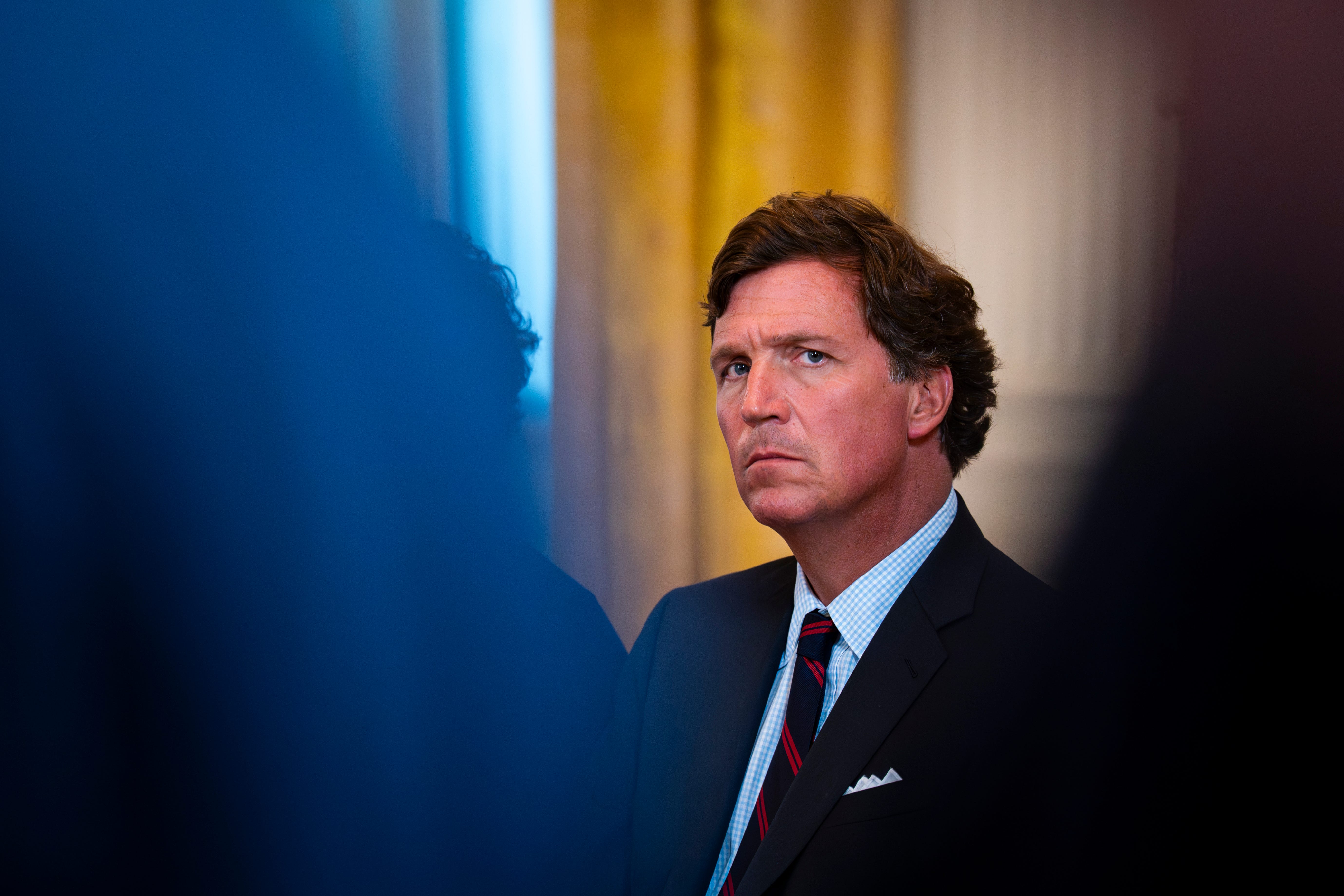
Call me naive, but I think I had given up on hypocrisy as a defining feature of American politics—I thought we had gone all the way past that to open avarice and the unapologetic exercise of force—but I guess if there’s one constant in life, it’s that there will be a place in politics for hypocrisy. So there was something refreshingly quaint about Tucker Carlson’s recent break with Trump right at the moment when a wedge issue formed in the MAGA coalition and Carlson could start to position himself for a 2028 presidential run. The news cycle was duly roiled with Tucker’s discovery of principles, even as it was evident on slightly closer inspection that the principles all benefited Tucker in the long-term.
The ostensible reason for the break is legible enough. Carlson has been an advocate for America First policies for a long time. He criticized Trump’s killing of Qasem Soleimani in 2020 and reportedly advised Trump against an Iran strike at that time. He campaigned—avidly—for Trump in 2024 on the premise that Trump would keep America out of foreign wars, and the attacks on Venezuela and then on Iran seem to have registered for Carlson as a genuine shock, and then led to the kind of falling out with Trump that, short as the memories of these two are, will be hard to patch up again.
On April 6, responding to Trump’s “Open the fuckin’ Strait, you crazy bastards” posts on Truth Social, Carlson said on his show, “How dare you speak that way on Easter morning to the country? Who do you think you are? You’re tweeting out the f-word on Easter morning?”
On April 7, Trump, skipping over the theological bits, countered by saying “Tucker’s a low IQ person that has absolutely no idea what’s going on.”
On April 20, Carlson hosted his brother, a longtime Republican operative, on the Tucker Carlson Show, and, in anguished and deeply religious terms, talked about his reasons for the break. “You and I and everyone else who supported him, we’re implicated in this for sure,” he said.
“We’ll be tormented by this for a long time, I mean I will be. And I want to say I’m sorry for misleading people. It was not intentional.”
It’s a little hard to believe that there were no warning signs of what sort of person Trump might prove to be—not calling a beauty pageant contestant “Miss Piggy,” not boasting that he likes to grab women by the pussy, not going out to see a movie on the day of his brother’s death, not exploiting his father’s dementia to bilk his relatives out of their inheritance, and not encouraging a mob to storm the U.S. Capitol. But Pastor Tucker was in a very Christian frame of mind. Yes, Trump had his character failings, but “there are tons of people of low character who outperform their character,” he declared.
And what a compelling, nay, biblical picture that makes—prodigal Tucker misled by his overly compassionate nature and his desire to avoid foreign wars having his Road to Pennsylvania Avenue (er, Damascus) moment over Trump’s “or you’ll be living in hell” post. By now fully ascending the pulpit, Tucker had it in him to offer a remarkably ecumenical message to all faiths. “No decent person mocks other people’s religions,” he said. “To mock other people’s faith is to mock the idea of faith itself.” Never mind that he has discussed the “Islamic cult” and the “Islamic problem” and in 2019 a guest on his show called Islam “the most hateful, intolerant religion in the world.” Tucker, even in the depths of his torment, was in a forgiving mood, forgiving even for such a sinner as himself, and in his grace and willingness to look beyond past trifles he appeared, yes, positively presidential.

I really mean this. The betting odds site Polymarket has JD Vance leading the Republican GOP field with 39%, followed distantly by Secretary of State Marco Rubio at 22%, and then Carlson all the way behind them at 6%. I would never ever give betting advice to any Persuasion reader, but if I did, I might well counsel laying some sweet cheddar on Carlson. Vance is giving major Jeb Bush vibes at the moment—linked to an America First point of view that he seems to at one point have felt deeply but knowing that if he breaks with Trump over Iran or anything else he loses virtually the entirety of his support. Rubio was never exactly in his element as a presidential candidate and seems to have found his ceiling as more of a backroom boy.
But Carlson is a survivor, and comes with a built-in audience, and knows how to work the media in a way that resembles Trump himself. He also speaks to what may be the single most stable voting bloc in American politics—Christian nationalism.
So Tucker really is one to watch—for her part, Marjorie Taylor Greene was virtually the first to hop on the bandwagon and declare on March 5, “I SUPPORT Tucker … Tucker would beat Trump if he ran for president”—and this break with Trump may well be the start of the Making of the President 2028, when he would be the first modern candidate to run on a Christian nationalist platform as well as the first-ever Dancing With the Stars contestant to reach the White House.
So, a pretty arresting narrative of repentance and redemption. But before you are too taken in by it, do consider this: Tucker could have broken with Trump a long time ago, and the timing of his break, when it finally happened, could not be more serendipitous to getting organized for 2028. As far back as 1999, he called Trump “the single most repulsive person on the planet.” In documents that emerged through discovery in 2023, he wrote privately of Trump, “I hate him passionately.” This was of course around the time that Tucker pushed the narrative that the voting systems had been hacked by Communists to perpetrate widespread fraud and that the January 6 Capitol attack was an FBI “false flag” operation, and, while campaigning for Trump in 2024, declared that he “always agreed with Trump’s policies” and called Trump’s survival in the Butler, PA assassination attempt “divine intervention.” So, yes, while Tucker is in torment mode, he does have some “splainin’” to do.
But, as is often the case in politics, hypocrisy is a superpower. Tucker has, as so often happens, changed his stance on every single major issue. Foreign interventions? He supported the Iraq War up until 2004. Protectionism? He was an economic libertarian until 2018. Strong borders? It wasn’t an issue for him until the Trump era. His biographer Jason Zengerle argues that Carlson’s slipperiness, and ability to always put himself first, encapsulates the “larger story of conservative media and conservative politics over the last thirty years.” When he has about-faced, it hasn’t always necessarily been for the best of reasons. His principled opposition to the Iraq War in 2004 was based above all on the observation that “Iraq is a crappy place filled with a bunch of, you know, semi-literate primitive monkeys” as well as concerns that it’s not worth invading a place where people “don’t use toilet paper or forks.”

And Carlson has an ability to not only reverse his positions but to actually voice two completely contradictory positions at the same time. In 2021, he strongly pushed Trump lawyer Sidney Powell’s allegation that Dominion Voting Machines had been hacked at the same time that he was (unfortunately, as it later turned out) writing internally that “Sidney Powell is lying by the way. I caught her. It’s insane.” That little fib—well, more the honest admission on the back end—is one reason why Fox ended up paying Dominion Voting Systems $787 million for defamation and Tucker lost his job. But Tucker, as he has so many times before, bounced back, hosting his own show without oversight from Fox.
Faith and patriotism are, in the end, the last refuge of a scoundrel—and they are formidable sanctuaries. You may have noticed that Tucker has been sometimes less than Christian-like in his behavior in the past, as for instance when on the show Bubba the Love Sponge he referred to individual women as “pigs” and “cunts,” assessed women in general as “extremely primitive,” and volunteered to give Martha Stewart’s daughter “the spanking she so clearly needs.” But that’s the beauty of cloaking oneself in faith. Repentance is the ultimate get-out-of-jail free card, and there is no reason why Carlson’s path to repentance can’t coincide with a White House run.
That really is the only meaningful fissure that can break the MAGA coalition. Epstein won’t do it; and a foreign policy excursion like Iran isn’t enough. But religion could do the trick. Evangelical voters, through a bit of deft theology and a vituperative hatred of Hillary Clinton, managed to support Donald Trump, but it was always an uneasy and sometimes comical alliance. Tucker speaks that language far better than anybody in the more Trump-y core of MAGA.
We had a glimpse of what the future of the Republican Party, if not the 2028 campaign, might look like in a contentious interview between Carlson and Mike Huckabee—formerly the preferred candidate of evangelicals and now ensconced in MAGA-dom as the U.S. Ambassador to Israel. This was before the decisive break with Trump, and Carlson frequently came across like a seventh grader on the border between a B and B+ in civics class when he, for instance, asked about public disapproval of the war in Iran: “We care deeply about [poll numbers] in what sense? If we’re ignoring it then in what sense do we care deeply about it?” Watching that had a rivetingly Shakespearean aspect to it, like viewing Macbeth wander into his sleeping king’s chamber and consider that the poll numbers gave him all the legitimacy needed to do the bloody deed.
But the conversation also took a turn. And I suppose that we all knew American politics would one day come to this, with both Carlson and Huckabee carefully parsing Genesis 15, and Huckabee articulating an interest in a Greater Israel—like, a much Greater Israel (“It would be fine if they took it all,” he said, redrawing the hypothetical map of Israel from the Nile to the Euphrates). Carlson, in the opposite vein, took a much more, er, New Testament view speculating on whether Jews “have dual loyalty” and claiming that Huckabee’s “priorities are very clear” in reference to being overly sympathetic to the Jewish state.
What Huckabee likely had in mind was “dispensational premillennialism,” the story of the rapture, with all Jews moving to Israel to initiate the “end times” button on the console. And what Carlson had in mind was revealed at Charlie Kirk’s funeral in 2025, when he compared Kirk to Jesus Christ and envisioned the conspiracy leading to Jesus’ death: “Picture the scene in a lamp-lit room with a bunch of guys sitting around eating hummus thinking about, ‘What do we do about this guy telling the truth about us? We must make him stop talking!’”
Having given the Elders of Zion their appetizer course, Carlson continued that vein of thought into this year. No sooner had he washed his hands of Trump than he was wondering aloud who the shadowy cabal was behind world events. “What was Butler? What was Ryan Routh?” his brother asked in their conversation on Tucker’s show. Tucker did not miss a beat. “I know that those investigations have been stymied. Fact,” he said. At which point his brother upped the ante by segueing to Israeli-American businesswoman Miriam Adelson’s (alleged) campaign contribution to Trump and asking, “Why would someone who has obvious and demonstrated allegiance to a foreign power give Donald Trump $250 million dollars while he’s running for president?”
The premise here is that both the assassination attempts in Butler, PA and in Mar-a-Lago were orchestrated by the Adelson family over a delicious hummus course as a way to show that they could get Trump anytime they wanted, and it’s that plot (this is also the plot of the Don DeLillo novel Libra, by the way) that accounts for Trump’s sudden turn towards warmongering in his second term—a scenario, to Tucker’s mind, that fully exculpates him for having ever been hoodwinked by Trump.
In a wide-ranging interview with The New York Times this week, Carlson—in “just asking questions” mode—took that notion well past the point of absurdity. “One thing that has bothered me for many years is the fact that a lot of people in Trump’s immediate orbit have been hurt—and really hurt. Gone to prison, become unemployable, publicly shamed, have gotten cancer,” Carlson said. Based on the unenthusiastic tone in Trump’s voice when Trump told him about the plans for the Iran War, Carlson could conclude nothing else except that “Trump was more a hostage than a sovereign decision-maker in this.” As a conspiracy theory, it’s a neat reversal of QAnon—with Trump held hostage by a shadowy cabal and needing to be rescued by a white knight, and a white knight with a mega-popular TV show.
If I am a little less than impressed by Tucker’s turn towards Christian righteousness and not exactly thrilled by the advent of of anti-Semitic blood libels into American politics, that is not to say that I find him any less formidable for it. He is extremely dangerous and he could well win. He is adaptable and resilient. He speaks fluently to the Christian Nationalist wing of the Republican Party, but for all his faith-mongering, he will not get bogged down in pieties like previous religion-oriented candidates have been.
He is as chameleonic as they come, and, in this era, with the kind of politics we have, what else can his gift for hypocrisy and shape-shifting be but a superpower?
Sam Kahn is associate editor at Persuasion, writes the Substack Castalia, and edits The Republic of Letters.
Follow Persuasion on X, Instagram, LinkedIn, and YouTube to keep up with our latest articles, podcasts, and events, as well as updates from excellent writers across our network.
And, to receive pieces like this in your inbox and support our work, subscribe below:
This is just so extremely partisan and vituperative. Why is it so unfathomable that Tucker Carlson could actually have views that evolve? ( He started out at CNN after all). Listen to his NY Time podcast interview, he explains very well his relationship with Trump and his views on the Iran war.
In that NY Times interview he recounts at length how he spoke in person with Trump and on the phone many times about going to war with Iran, always trying to convince Trump not to do it. Carlson says he had the strong impression that Trump did not want to go to war with Iran and that there was no enthusiasm for it among his advisors either. Carlson believes that Trump felt he had to attack Iran, that he was forced into it. The question that haunts Carlson and which he talks about at length in this interview is why, and who, and how is the most powerful man in the world forced into a war he doesn't want ? The answer seems to be: The Israel lobby - although Carlson is honest and says he doesn't have any direct proof.
Trump was ( WAS) always critical of foreign wars and was the first republican to break the taboo and say that Iraq was a disaster. He campaigned on getting the US out of foreign wars and keeping us out. What changed?
There is no MAGA split. Tucker and Owens are media whores looking for a niche audience to carve out. Besides, although MAGA is tasting like cheap whiskey today, voting for Democrats is like deciding to drink sewer water laced with carcinogens. Republicans are good with inter party conflict and differences of opinion compared to the Democrats that assassinate any that step out of line from their ideological purity tests.