

It’s Time For a Flexible EU
Brussels should reward Moldova’s clarity of purpose—not hold it hostage to the much harder question of Ukraine.

This article is brought to you by American Purpose, the magazine and community founded by Francis Fukuyama in 2020, which is proudly part of the Persuasion family.
There are serious countries and unserious ones. Where the United States belongs these days I leave for others to judge. But about one country I have no doubt, having recently returned from it. It may be tiny and poor, but Moldova is a serious country—and its leaders know exactly what they want.
I visited Chișinău last year, several months before Moldova’s parliamentary election, when its outcome—and with it the country’s European trajectory—hung in the balance. This time, however, the mood was different. While meeting President Maia Sandu, the prime minister, the foreign minister, members of parliament, and journalists, my American Enterprise Institute colleagues and I were struck by how uniformly serious they all were about Moldova and its place in Europe.
Anne Applebaum recently called the September result—the victory of Sandu’s party despite a deluge of Russian money, vote-buying, cyberattacks, and bomb threats—“the Moldovan surprise.” And yet, while the absolute parliamentary majority that her faction enjoys in Parliament was unexpected, I remember a number of well-placed Moldovan officials who assured me a year ago that they had a good handle on Russia’s interference in the fall election.

When she met with us, Sandu wore white trainers and a smart glenplaid suit that would have looked less conspicuous at the World Bank—where she once worked—than at the fairly monstrous Soviet-era presidential palace. But Sandu is no technocrat. She is a skilled politician who built a party from scratch, without oligarchs or networks of patronage, and stayed the course with steely determination through numerous setbacks.
Mihai Popșoi, the foreign minister, who wrote policy reports for AEI a decade ago, has yet to turn 40. His command of his brief is impressive, as is his ability to think on his feet—especially when my colleagues and I asked difficult questions about Moldova’s relationship with the United States. In a way, it mirrors the deftness with which Moldova’s ambassador to Washington avoids the traps that the Trump era presents for him—neither antagonizing Donald Trump nor cozying up to him, always working scrupulously across party lines. In an era when so many European governments lurch between sycophancy and tantrum, Chișinău’s poise is a quiet masterclass.
The prime minister, a former financier with a Columbia degree and a U.S. passport, speaks the same language. One can also see Moldova’s seriousness clearly in the unglamorous business of energy policy, which the PM is visibly passionate about. For years, Moldova was hostage to a power plant running on subsidized Russian gas in the breakaway region of Transnistria—a lever that Moscow could pull at will. That has now changed. Moldova has stopped buying Russian natural gas completely. A new 157-kilometer high-voltage line from Vulcănești to Chișinău—aptly nicknamed the “Independence Line”—connects the country directly to Romania and the European grid and will cover more than half of peak demand.
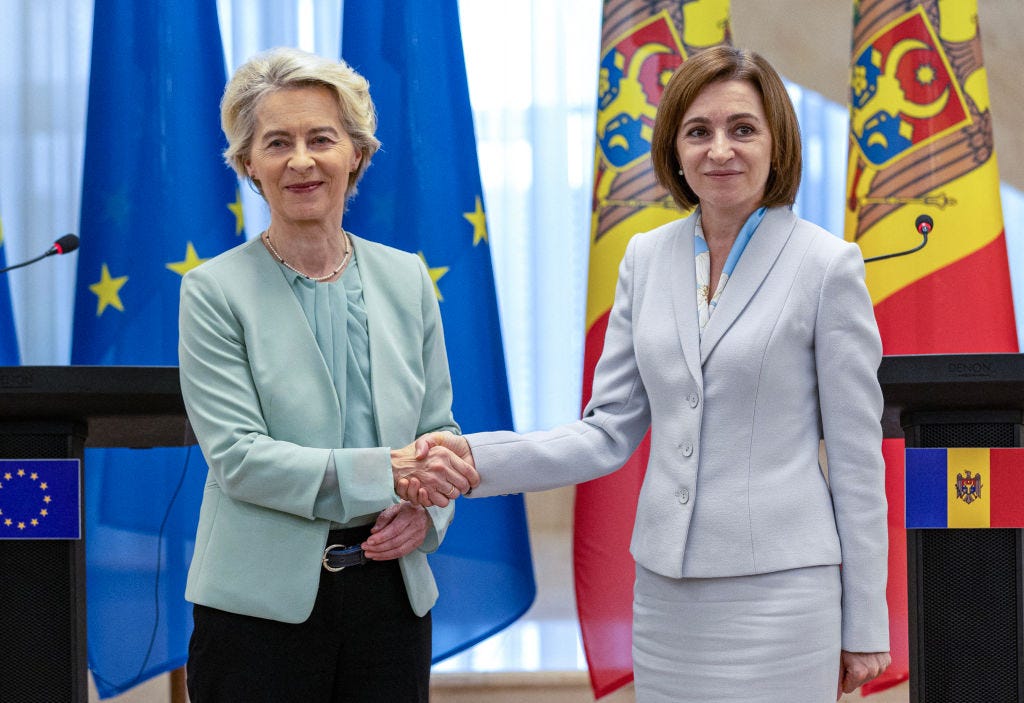
Moldova has EU candidate status, its accession negotiations are underway, and it is aiming—ambitiously—to conclude them in 2028. While not a completely unrealistic timeline, some European diplomats whom we saw were squeamish about the prospect of bringing Moldova in so rapidly. “It is not just a question of meeting the criteria, but also a political one,” we heard several times—both from one European ambassador (sincerely) and from several Moldovans (with a hint of sarcasm).
A related lesson that Brussels is slowly absorbing is that EU accession should not be an all-or-nothing prize handed over only at the very end of a decades-long marathon. The smarter approach is to frontload the benefits of membership: phased access to the single market, structural funds, and a seat—even a non-voting one—at the institutional table, so that citizens see the dividends of integration well before the final treaty is signed. For Moldova’s pro-European elites this is a no brainer. The country’s political life is fractious, and progress made today could be reversed. In order to anchor the country in the West for good, tangible benefits to ordinary people must first be delivered before any formal process is completed.
Yet, on the front of European integration, Moldova has both benefited from—and now risks being a victim of—the imperative of bringing Ukraine into the West’s fold. Kyiv’s case for EU membership is morally overwhelming and necessary in geopolitical terms. But it is also a difficult one. Ukraine is enormous, not to mention busy fighting a war against an intimidating adversary. Its entry would reshape the EU’s budget, its agricultural policy, and the balance of votes around the table in ways no previous enlargement has come close to. While it has leapfrogged the West in some ways (not least in defense technology), many of its post-Soviet pathologies seem to linger.
It was against this backdrop that Friedrich Merz floated, in a late-May letter to EU leaders, the idea of an interim “associate membership” for Ukraine—participation in the Union’s institutions without a vote during the long negotiations—while accelerating Moldova and the Western Balkans toward full membership. The clumsy label aside, the idea is sound: deliver what you can now, and don’t let the hardest case set the pace for everyone else.
It was unfortunate that Kyiv’s reaction was a faintly indignant refusal. President Zelenskyy insisted that Ukraine’s place in the EU must be “complete, with full rights,” and that there can be no genuine European project without it. Meanwhile, Ukrainian commentators denounced the proposed decoupling from Moldova as a red flag.
I yield to no one in my admiration for Ukraine. But treating any interim arrangement as a demotion—and full EU membership as a debt the West owes for Ukrainian blood—is unbecoming and self-defeating. An associate status, if firmly tied to eventual accession and packed with real benefits, is not a consolation prize. It is a head start that earlier candidates never enjoyed. Reflexively spurning it hands ammunition to those in Europe who would be perfectly content to leave Ukraine parked in the waiting room indefinitely.
It would be a disaster if Kyiv’s all-or-nothing insistence, colliding with the genuine complexity of its situation, froze the entire enlargement machine on political grounds—and if little Moldova got dragged down as collateral damage.

Decoupling Moldova’s accession from Ukraine is not a betrayal of Kyiv but common sense. A third of Moldovans, or 850,000 of them, hold Romanian, and therefore EU, passports. A large share of the country is already, in effect, made up of European citizens. Integrating a country the size of a mid-sized European region would not strain the EU, but would instead be an accelerator, bringing Ukraine even closer to the fold.
Yes, there is Transnistria, a seemingly intractable problem. But the true size of the Russian garrison, excluding locals with Russian passports, is tiny: some 300 officers. Since the border with Ukraine is sealed, the region is boxed into a position from which Moscow can neither reinforce nor resupply it. Moreover, the territory’s real master is not an ideologue but a businessman: Viktor Gushan of the Sheriff conglomerate, whose exports flow overwhelmingly to the EU. It must be possible to resolve this issue through negotiation.
Serious countries deserve to be treated seriously. Moldova has done the work—which is more than can be said for many of its larger, richer, and longer-established neighbors, whether or not they seek (or already enjoy) EU membership. The least Brussels can do is to reward that clarity of purpose, rather than punish them for the headaches involved in some of the harder cases.
Dalibor Rohac is a senior fellow at the American Enterprise Institute, an advisor at GLOBSEC, and a columnist with American Purpose.
Follow Persuasion on X, Instagram, LinkedIn, and YouTube to keep up with our latest articles, podcasts, and events, as well as updates from excellent writers across our network.
And, to receive pieces like this in your inbox and support our work, subscribe below:
 | A guest post by
|
Thanks for this look at the Moldovan accession process, and the sensible approach to bringing both it and Ukraine into the EU fold with all deliberate speed.