

Lessons in Combating Polarization
Countries can come back from the doom spiral. Look at South Africa.

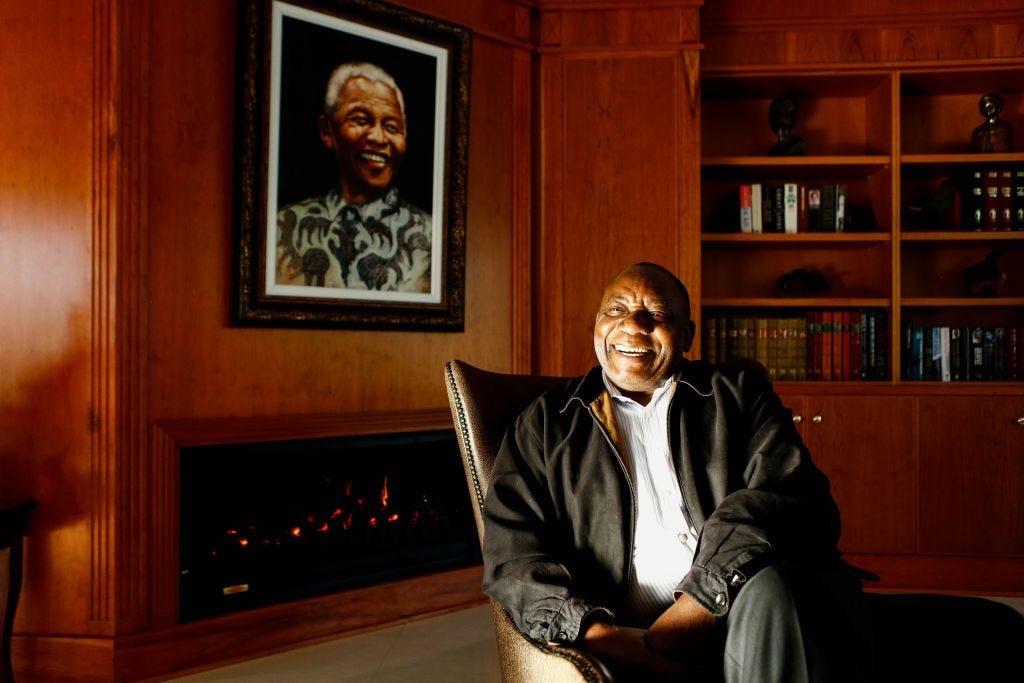
Trapped in an accelerating downward spiral of us/them polarization, it can feel as if there is no way out. In democracies, when things go badly, the prospect of an upcoming election ordinarily can be a source of hope. However, as we learn from country after country, when those who fuel polarization also control the levers of state power, the next election can become empty, trumped by an emerging competitive authoritarian reality.
But experience elsewhere shows that the descent into authoritarianism can be reversed—as in the example of South Africa. In 1948, many centuries of white minority rule culminated in the accession to power of an explicitly ethno-nationalist political party. By the mid-1980s, the country seemed to be hurtling towards a devastating race war. Yet, within a few years, the world witnessed its “miracle” transition to constitutional democracy. A quarter century later, the country became entwined in a very different doom loop—a predatory president increasingly was wielding an ethno-populist political discourse as a weapon for subverting checks and balances, and accelerating state capture. But, again, the country was able to step back from the brink.
While on the surface the two episodes are very different from each other, they share some similar underlying patterns. Leadership mattered in both—indeed South Africa’s transition from apartheid often is depicted as a near-unique leadership-driven miracle. But in both episodes, the ground for change was prepared less by leadership than by the interplay between civic activism on the one hand and, on the other, the willingness of a subset of social and economic elites to look unflinchingly at the abyss opening up ahead. Exploring this interplay offers useful insights into the urgent question of how to break the spell of polarization in the United States.
Resistance to apartheid set the first South African episode in motion. As of the late 1960s, the country’s black majority had been cowed into subservience. Nelson Mandela and others who had campaigned against apartheid in the 1950s and early 1960s were in jail. The African National Congress had been forced into a seemingly ineffectual exile. But a 1976 uprising in the township of Soweto, led by high school students in defiance of their parents’ caution, marked the beginning of a new phase.
By the early 1980s, civil society, trade unions, and religious organizations had coalesced around a mass movement, the United Democratic Front (UDF)—and international clamor against apartheid had evolved from scattered activist initiatives into a broad-based global campaign for corporate divestment from South Africa. Even so, it was not resistance alone but the way in which elites engaged in response that led to apartheid’s demise.
In polarizing environments, elites can respond in radically different ways. One response deepens polarization, hardens lines of opposition, and accelerates the downward spiral. The demise of Weimar Germany is a notorious example of the consequences of elite miscalculation. There, the center did not hold. In the wake of the 1929 economic crisis, street violence between the Communist Party of Germany on the left and Nazi brownshirts intensified. Many right-wing (non-Nazi) political and business leaders—among them Alfred Hugenberg, media and manufacturing magnate and leader of the German National People’s Party (DNVP)—rejected participation in centrist political coalitions. In January 1933, Germany’s conservative political leadership made the fateful decision to appoint Adolf Hitler as Chancellor (even though in November 1932 the Nazi Party had won just 33% of the vote). “I have the confidence of Hindenburg! In two months, we’ll have pushed Hitler so far into the corner that he’ll squeal,” said power-broker Franz von Papen. That is not what happened.
A very different elite response is to look for ways to break the spell of us/them polarization. In both episodes explored here, key segments of South Africa’s elites took this latter course. Rather than avert their eyes, they looked squarely at the unfolding reality, reset their calculus as to the benefits and costs of inaction, and acted boldly to head off disaster.
Polite elite opposition to apartheid had long been part of South Africa’s political landscape, but subsequent to the 1976 Soweto uprising elite opposition increasingly moved beyond the bounds of white politics within which it had been contained. Influential actors within the corporate establishment came out in support of the legalization of trade unions for black workers and the easing of restrictions on urbanization for “undocumented” South Africans. In 1985, a few leaders from the commanding heights of business broke the prohibition on contact with the exiled African National Congress. Some leaders within the influential white Afrikaner Broederbond (an organization that, dating back at least to the 1930s, had played a key role in laying the groundwork for white ethno-nationalism) began questioning the status quo. Subsequently, an increasing stream of Afrikaner intellectuals, technocrats, and independent-minded politicians initiated dialogue with ANC leaders, not only with the still-jailed Nelson Mandela, but also with senior exiled leaders. While each of these was an incremental re-positioning not a decisive break, cumulatively they widened the political space, and made a negotiated transition possible.

A sequence of indelible moments followed: The February 1990 announcement by South African prime minister F.W. de Klerk that all political parties would be unbanned and Nelson Mandela released. Mandela’s 1993 television address to the nation that helped keep the transition to democracy on track in the face of the assassination of a major ANC leader. The joyful scenes that accompanied the country’s first democratic election in 1994. Mandela’s swearing in as president. Each of these offer a vivid display of heroic leadership. But that leadership did not happen in isolation—the interplay between civic mobilization and elite response prepared the ground.
In 2009, a quarter century after South Africa’s inspiring transition from apartheid to democracy, Jacob Zuma became the country’s president. Over the next few years, under the guise of a populist anti-elite agenda, he systematically began dismantling checks on the capricious, personalized use of political authority. He placed loyalists at the heads of the country’s prosecutorial apparatus, tax authorities, and other state-owned entities, used them to manipulate procurement and other decisions—and framed all of this as part of a broader mission to weaken the stranglehold of “white monopoly capital” on the (still massively unequal) economy. Things looked increasingly dire.
But Zuma was stopped in his tracks. What again made the decisive difference was the willingness of a strategically-positioned subset of elites to confront the mounting risks and, at considerable personal and political cost, mobilize to change course.
Senior leaders within the African National Congress, appalled by the direction in which Zuma was taking the country, overrode lifetimes of loyal struggle and party solidarity, spoke out publicly against Zuma, and organized to oppose his attempt to install his preferred candidate as successor. In November 2017, Cyril Ramaphosa, a central protagonist in the crafting of the constitution in the 1990s, won an intra-party electoral contest by a hairs-breadth, and became party leader—and then decisively won the 2019 national elections. Though things haven’t been easy since then, the state capture project was brought to a halt.
In both South African episodes, the spell of us/them polarization was broken via a sequence that began with resistance, and was followed by a reset by a strategically important set of elites—neither early resisters nor unshakably loyal to the incumbents—who saw where things were heading and became increasingly willing to try and move things in a different direction. Then came a hinge moment where the combined efforts of civic mobilization and semi-insider elites unleashed a far-reaching cascade of positive change.
Where is the United States along this trajectory? Civic activism has taken hold—in the courts, in the streets of Minneapolis, in thousands of “No Kings” protests across the country. But the impersonal, rule-based economic and political institutions that have long underpinned America’s thriving economy and free, open, and (mostly) stable society continue to erode—and so far the elite response has fallen short.
America’s elites are, of course, not uniform. At one end of the spectrum, a subset has embraced culture wars as a way of shifting the focus of American political discourse away from questions of economic fairness, with the influence of this group recently being buttressed by tech sector elites chafing at the prospect of greater regulation. At the other end are liberal elites who have long supported progressive economic and social policies, with culture wars of their own. In between is an ambivalent-but-acquiescent middle group of corporate elites, wealthy individuals, and right-of-center political insiders who have chosen to interpret what is unfolding as politics as usual. They risk sleepwalking their way into disaster.
Key to what comes next is the interplay between civic mobilization and the response of ambivalent-but-acquiescent elites. An approach to mobilization that fights fire with fire would almost surely accelerate polarization, further weaken the center, and nudge elites towards acquiescing to so-called “strongmen” promising stability. By contrast (as in the two South African episodes), an approach to civic mobilization that builds alliances and articulates a vision of a thriving inclusive society is more likely to encourage ambivalent elites to resist the lure of us/them polarization. And their speaking out could in turn help set in motion an “ideational cascade” that draws in a critical mass of disengaged voters who had been inclined to dismiss accelerating polarization as political theater.
How far down does the United States’s downward spiral have to go before a turnaround? In South Africa’s struggle against apartheid, it took determined mass mobilization and an imminent threat of implosion for semi-insider elites to recalibrate the costs and benefits of going with the flow. By contrast, South Africa’s 2010 elites had already been primed by their struggle against apartheid to look into the abyss and take action—and could do so by leveraging the authorizing environment provided by the constitutional order they had helped create.
At least for now, the United States’s constitutional rules of the game still hold open the possibility of a rapid turnaround. However, their resilience will imminently be tested by the upcoming midterms—not so much by the results themselves as by the surrounding dynamics. Worryingly, it is easy to envisage an accelerating downward spiral of efforts to subvert access to the polls, disputed results, and street violence, culminating perhaps in the siren song of a call for decisive state action as the way to restore order. But if a critical mass of hitherto ambivalent-but-acquiescent elites put their weight behind free and fair midterm electoral processes—and if voters decisively repudiate us/them politics—then an immediate electoral escape route may still be possible. A presidential election two years later could then provide a platform for a necessary far-reaching conversation about renewal.
The United States’s current crisis did not arise from nowhere—any durable reset will require grappling with the far-reaching imbalances and frontier challenges that have accumulated over decades. These include: rising economic inequality; a widening cultural and social divide between big cities and smaller towns and rural areas; new technologies; transformed geopolitics; and climate change. Added to this is the massive cross-cutting task of reforming the public sector so that it works again.
But before any of the deep-seated structural issues can be addressed, first things must come first. We must break the spell of polarization—and this calls for an inclusive approach to activism, one that skillfully balances urgency and hope. We can pay the price of letting go of comfortable illusions now—or pay a far greater price later. Which is it to be?
Brian Levy teaches at the Luskin School of Public Affairs at the University of California, Los Angeles.
Follow Persuasion on X, Instagram, LinkedIn, and YouTube to keep up with our latest articles, podcasts, and events, as well as updates from excellent writers across our network.
And, to receive pieces like this in your inbox and support our work, subscribe below:
 | A guest post by
|
The analysis of "how to combat polarization" is one aspect of a broader research effort to think through journey from rage to renewal. I explore some of that larger framing in the linked Working with the Grain post below. https://workingwiththegrain.com/2026/05/06/breaking-the-spell-from-polarization-to-renewal/