

Teen Social Media Bans Miss the Point
Don’t expect quick fix solutions to help.

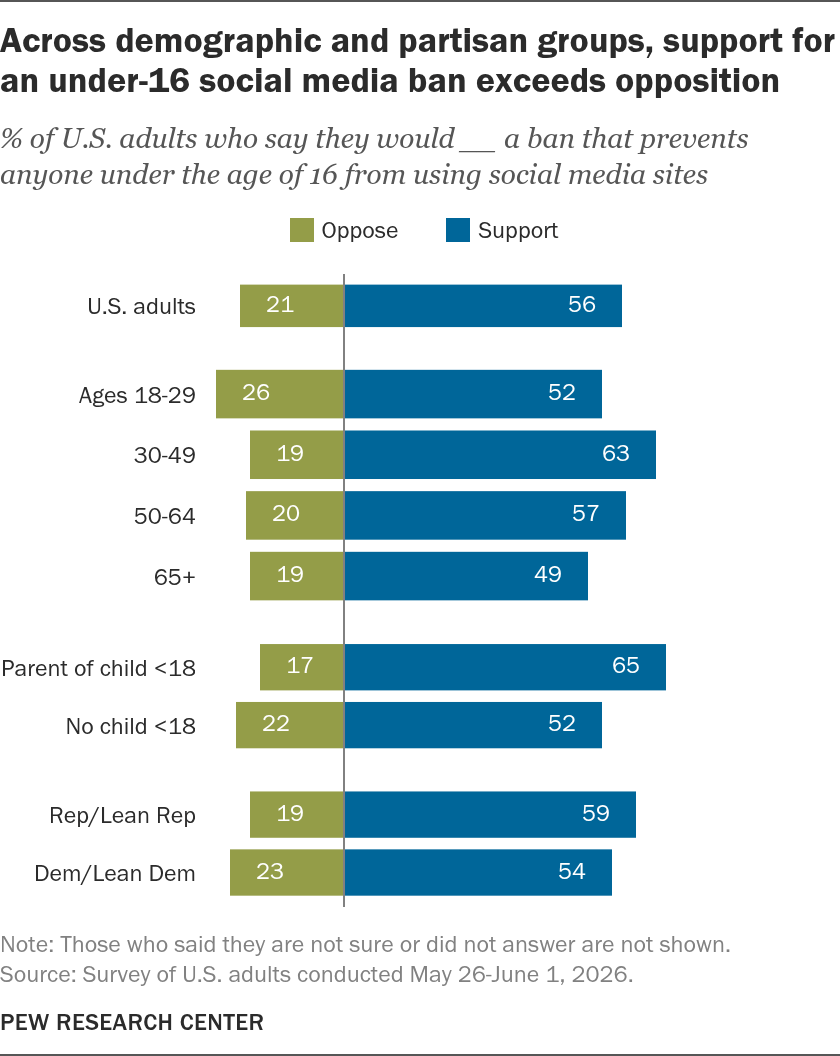
It’s hard to come across a bipartisan issue in America these days, which is why I was surprised to see near-uniform support, across ages and political leanings, for kicking teenagers aged 15 and under off social media:
The United States hasn’t acted yet, but much of the world has. Australia barred under-16s from holding accounts at the end of 2025, the UK announced its own version this June, and France’s National Assembly passed an under-15 ban in January by a vote of 130 to 21, after which Emmanuel Macron declared that “our children’s brains are not for sale.” Denmark, Poland, Spain, and many other countries are close behind. I’m not sure a ban will materialize stateside, but I wouldn’t bet against it either.
A central figure in the wave of bans sweeping the globe is Jonathan Haidt, whose wildly popular book, The Anxious Generation, has been a singular force in mobilizing lawmakers around the world. Haidt’s central claim, and the premise underlying the bans, is that social media use makes teens anxious and depressed, and that keeping kids off them will help. Australia’s prime minister credits Haidt’s book for motivating the world’s first teen social media ban, and Haidt recently shared a stage at Davos with a laudatory Macron a week before France’s bill passed the lower house.
So however these bans fare, regardless of how thoughtfully—or not—they are implemented, they will get read, culturally, as a referendum on Haidt’s agenda. This would be a shame, because whether you agree or disagree with Haidt’s claims about the harms of phones and social media—long disputed in academic circles—tech bans leave out a critical part of the book. And on this, I think Haidt and even his most vocal critics would actually agree: kids need something that the adults in their lives aren’t providing for them, and bans, on their own, won’t be magic cures.
It’s the adults, dummy
One of Haidt’s most vocal critics is Candice Odgers, a developmental psychologist at UC Irvine who has spent 25 years studying how children develop mental illness, and whose reading of the evidence, laid out in Nature, The Atlantic, and a recent TED talk, is that the correlations between social media use and teen distress are small, inconsistent, and hopelessly tangled up with everything else going on in a kid’s life. Adjudicating between Haidt and Odgers would take an article of its own. But set the causation fight aside, and you realize that for a discussion ostensibly about teens, both Haidt and Odgers actually spend a good deal of their time talking about adults.
In the popular consciousness, The Anxious Generation is an anti-screen manifesto. But in reality, it’s not just a book about technology. About half of it is about the unfulfilled needs and desires that push kids to turn to screens in the first place—needs and desires that used to be met by childhood itself, through unsupervised play, independence, risk-taking, and the freedom to fail. Or as Haidt puts it in a mantra he repeats to the press: “We have overprotected our children in the real world while underprotecting them online.”
I keep thinking of a graphic the Daily Mail ran several years ago that captures what Haidt is describing better than any statistic. It traced four generations of a single family, the Thomases of Sheffield, and how far each child was let out to roam at the age of 8. The great-grandfather, in 1919, could go six miles on his own to fish. His great-grandson, in 2007, was allowed about three hundred yards, to the end of the block:

In Haidt’s telling, the order of events is key. The play-based childhood collapsed first, over the 1980s and 1990s, well before the smartphone. The phone arrived around 2010 into a childhood that was already a shell of its former self. Seen from inside a three-hundred-yard radius, Snapchat’s or Instagram’s grip on a teenager is easy to understand. For a kid whose physical range ends at the street corner, social media may be the only unsupervised space available, the last place adults haven’t over-managed. Alongside pulling back phones and social media, Haidt has been adamant that “children raised on screens need more time in the real world.” The book’s argument is that adults made two mistakes at once. They passed out phones like Halloween candy, and they stripped childhood of the playground-and-street apprenticeship that used to build resilience.

Odgers, Haidt’s critic, has made a similar argument. “We’ve already kicked teenagers out of public spaces,” she said, “and now we’re going to take away the spaces where they virtually gather and create community because adults broke that, too?”
But for Odgers, there’s more to the story than an overprotected childhood. She challenges Haidt’s claim that social media is driving the teen mental health crisis, suggesting instead reverse causation: that struggling kids tend to reach for their phones roughly the same way struggling adults do. Odgers’ read is broadly supported by The National Academies of Science, which issued a committee report on the issue in 2024. The committee’s review of the literature “did not support the conclusion that social media causes changes in adolescent health at the population level,” although this may be as much a statement about the nature of the evidence as an assertion of fact.
In Odgers’ view, the real causes of teen mental health distress are unglamorous: the mental health of the teen’s caregivers, early exposure to violence and discrimination, and stress at home and at school. Because the kids struggling most online are the ones with the least support offline, she would channel activist and political energy in the direction of those kids, rather than kicking them off social media. In the United States, she points out, the ratio of school counselors to students in middle and high schools runs about 1 to 500, and for mental-health counselors specifically it is closer to 1 in 1,300. Many schools have none at all. “We need to invest in the adults around children,” she said from the TED main stage. “We need to hire teachers. We need to hire counselors. And we need to pay them well.”
Whatever else they disagree on, Haidt and Odgers both trace the pull of the screen back to the same place: a childhood in which adults aren’t quite meeting the needs of children. Haidt thinks the phones do real damage once kids get their hands on them; Odgers doubts it. But, in my reading at least, neither thinks the screen is where the problem starts.
Hard problems don’t usually have easy solutions
It’s easy to see why teen social media bans are so popular. Most other items on both Haidt’s or Odgers’ wishlists ask something uncomfortable of adults. Some ask parents to let go and accept risk, or at least accept the judgment of other parents. Others ask for a less zealous child-services regime, one that doesn’t charge a parent with a felony for letting a nine-year-old play at a playground alone. Others ask city councils to approve (or at least not disapprove/close) spaces for unsupervised teenagers to gather—which, yes, will come at some cost in real estate and patience and general community orderliness. Other items might require funds to be allocated to cash-strapped schools to pay for counselors.
These things are not easy, I get it. They require real discussions of trade-offs between the sometimes conflicting needs of kids and adults, decisions around funding public programs, and some uncomfortable reflection on whether current parenting practices and school cultures truly serve kids.
As Odgers has bluntly observed: “It’s easier to blame the screens than to ask why are we kicking the teens out of the skatepark where they are active and getting exercise?”
Yet the one policy sweeping the globe grapples with none of these upstream forces weighing on teen mental health. Which reminds me of something a friend recently told me over dinner. We were talking about South Korea’s “Cinderella Law,” which in 2011 started locking kids under sixteen out of online games between midnight and six in the morning. One of the main reasons for this shift was concern that kids weren’t getting enough sleep. My friend, an addiction researcher, told me the law did almost nothing. Kids shifted the hours they played, borrowed a parent’s ID number, or moved to platforms the law didn’t cover. When researchers went looking for effects, they found the average teenager was sleeping about a minute and a half longer. The law was repealed in 2021, remembered mostly as a failure.

I wondered if better implementation would have helped, but my friend didn’t think so. He reminded me that the Cinderella Law was written in a country maniacal about testing, where a single exam at 18, the Suneung, can set the course of a life, and where the government grounds airplanes during the English-listening section so nothing breaks the silence. Meanwhile, it was considered normal for a teenager to be in a “cram school” until late at night. A society that arranged childhood like that decided the problem was the video games. With that diagnosis in hand, the politicians didn’t have to wrestle with the question of why kids reached for the games after midnight to unwind in the first place.
I don’t want to overgeneralize from one law in South Korea 15 years ago to the social media bans today, but I do see a pattern at work. Blame the screen and you never have to look at the life-altering exams, the three-hundred-yard childhood radius, or the schools without mental health counselors.
You also might be giving the companies a bit of a free pass. Another point of agreement between Haidt and Odgers is that they both think algorithmic feeds are designed to be predatory, and that the companies should be forced to build them differently. What Odgers repeatedly emphasizes is that an age ban that leaves the platforms themselves unchanged “lets tech companies off the hook” for their business model. I’d argue an age ban lets the rest of us off the hook as well.
Tim Requarth is director of graduate science writing and research assistant professor of neuroscience at the NYU Grossman School of Medicine. He writes “The Third Hemisphere.”
A version of this article originally appeared at The Third Hemisphere.
Follow Persuasion on X, Instagram, LinkedIn, and YouTube to keep up with our latest articles, podcasts, and events, as well as updates from excellent writers across our network.
And, to receive pieces like this in your inbox and support our work, subscribe below:
 | A guest post by
|