

Why AI Is a Train, Not a Bicycle
And why that’s a very bad thing.

Tomorrow at 6pm ET, we will host a book club with Freya India discussing her book GIRLS: Gen Z and the Commodification of Everything. Please join us on Substack Live—and click here to add it to your calendar!

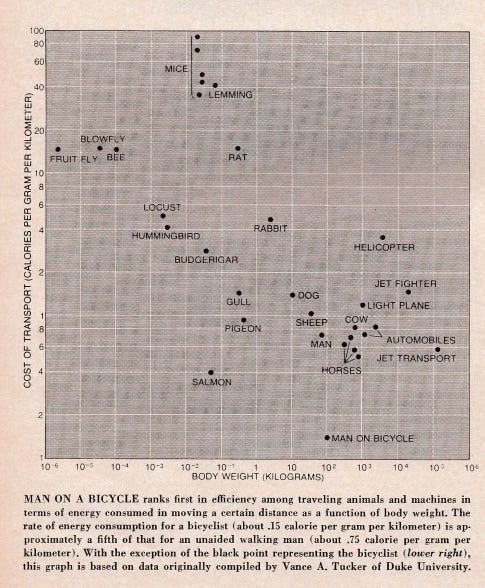
In 1981, a young Steve Jobs—bearded, bespectacled, brown corduroy blazer over an open-collared shirt—sat in front of an Apple II and explained what he thought a personal computer was for. He’d read an article in Scientific American that compared the efficiency of locomotion across species. The condor, he said, came out on top. Humans ranked about a third of the way down, “not too proud a showing for the crown of creation.” But then someone had the insight to test a human on a bicycle, and the cyclist blew the condor away.
“What it really illustrated,” Jobs said, “was man’s ability as a tool maker to fashion a tool that can amplify an inherent ability that he has. And that’s exactly what we think we’re doing.” The computer, he said, was “a 21st century bicycle” for the mind.
In the age of AI, Jobs’ quaint bicycle has received an update from Silicon Valley. With the launch of ChatGPT, gushed Microsoft CEO Satya Nadella in early 2023, “We went from the bicycle to the steam engine.” Reid Hoffman, LinkedIn’s CEO, routinely calls AI a “steam engine of the mind” that will usher in a “cognitive industrial revolution.” In a Time magazine article modestly entitled “A Roadmap to AI Utopia,” venture capitalist Vinod Khosla writes that “AI amplifies and multiplies the human brain, much like steam engines once amplified muscle power.”
I find the shift from bicycle to steam engine instructive for the current AI moment. In invoking the steam engine, there’s something about the bicycle that Jobs’ heirs seem to have forgotten. Like the steam locomotive, the bicycle was a technological revolution. But a train traveler sat back and enjoyed the ride, while a cyclist still had to put in effort. With a bicycle, “you are traveling,” wrote a cycling enthusiast in 1878, “not being traveled.”
I think about this distinction a lot: between traveling and being traveled. Bicycles and trains are both technologies that move us from place to place. In that sense, in the sense of their outward function, it’s fine to lump them together. But the comparison falls apart when you consider their effects on the traveler. In terms of effort, a steam engine doesn’t really “amplify an inherent ability.” It replaces it. You sit back and the coal does the work. You arrive, but you’ve been traveled. So one way to look at a technology is how powerful it is, what it can enable humans to do. But an equally important question is what happens to humans when they use the technology.
I’ve started calling this the mythology of amplification—the assumption, buried so deep in Silicon Valley’s rhetoric that it goes unexamined, that its tools merely add capability without subtracting anything meaningful. Some tools really do work this way, or close enough to it. Perhaps the personal computer, in its early days, was one such tool. A true, literal “computer”—a machine that computes. But general-purpose AI, at least as the tech titans envision it, is not like that. And the difference has nothing to do with how powerful the tool is or how impressive its outputs are. It has to do with what the tool asks of you. Whether you travel with it or are being traveled by it.
The Rifle and the GPS
I was recently reading an ethnographic study by Claudio Aporta and Eric Higgs about GPS adoption among Inuit hunters in Igloolik, a small community in the Canadian Arctic. The Inuit had been navigating that landscape for millennia using methods that took years to learn: reading wind-shaped snowdrifts, tracking animal movements, interpreting tidal patterns, memorizing thousands of place-names passed down through generations. Elders would wake children early and send them outside to report on wind and sky conditions, a practice called anijaaq.
When GPS units arrived in the mid-1990s, the Inuit did what they’d done with other new technology: they assessed it, experimented with it, and adapted. This was a culture that had already adopted rifles and snowmobiles. These technologies weren’t neutral: Rifles made hunting more solitary, more distant; snowmobiles were loud and fast, replacing the slow dog-sled travel that had been an ideal context for teaching younger hunters to read the land. With rifles and snowmobiles, the texture of Inuit culture changed. But neither struck at something that the elders felt was fundamental to cultural knowledge and identity.
GPS was different. The ethnographers put it bluntly: “For the first time in history the navigator can completely rely on technology and travel successfully knowing nothing about navigation and very little about the environment.” The device didn’t amplify the Inuit’s famous wayfinding skills but bypassed them entirely. This skill erosion had consequences: During a search for an overdue traveler in a blizzard, an elder realized the GPS was leading the party directly toward pressure ridges and dangerous ice. He took over and guided the party using traditional knowledge of the wind and snowdrifts. The GPS had given the correct answer to “where is my destination?” while removing any need to understand the journey.

Most of us will never navigate a blizzard in the Canadian Arctic. But you’ve probably experienced a milder version of this when navigating a new city. If you unfold a paper map, you study the streets, trace a route, convert the bird’s-eye abstraction into the first-person POV of actually walking—and by the time you arrived, you’d have a nascent mental model of how the city fits together. Or you could fire up Google Maps: A blue dot, an optimal line from A to B, a reassuring robotic voice telling you when to turn. You follow, you arrive, you have no idea, really, where you are. A paper map demands something from you, and that demand leaves you with knowledge. GPS requires nothing, and leaves you with nothing.
With GPS, the stakes are relatively low for most people. But AI tools are now mediating the same trade-off across far more consequential domains: reasoning, analysis, writing, clinical judgment, scientific thinking. I thought about this after Anthropic recently released a small study that reveals how offloading affects skill formation. Researchers had software developers complete coding tasks using a new Python library—some with AI assistance, some without. The AI group finished slightly faster. But when tested afterward on their understanding of the library, they scored 17 percent lower than the control group. The gap was largest on debugging questions: the very skill required to catch AI errors.
Psychologists Elizabeth and Robert Bjork explain why. They distinguish retrieval strength (how easily you access something now) from storage strength (how durably it’s encoded in the brain). Struggling to generate an answer builds storage strength. Being handed the answer builds nothing. As the Bjorks write: “Any time that you, as a learner, look up an answer or have somebody tell or show you something that you could, drawing on current cues and your past knowledge, generate instead, you rob yourself of a powerful learning opportunity.” Just as the Bjorks would have predicted, the AI group in the Anthropic study bypassed the struggle and thus bypassed the learning that came with it.
What Silicon Valley Is Blind To
The Inuit elders and the Silicon Valley executives are looking at the same phenomenon and seeing different things because they’re asking different questions that come from different sets of values. The executives seem to be asking: what kind of output does this human produce? The elders seem to be asking: what kind of person does using this tool produce?
If output is your only metric, then the steam engine really is just a better bicycle. Both get you from A to B. One gets you there faster with less effort. Case closed. The fact that you arrive having done nothing, learned nothing, built nothing—that’s not a bug, that’s the point. Effort is a cost to be minimized, not a value to be preserved.

But embedded in that worldview is that the journey is merely instrumental. The only thing that matters is arrival. That it doesn’t matter if you travel or are traveled. The Inuit elders seemed to operate on a different premise. Arrival, of course, mattered. These were hunters who needed to find caribou and get home alive. But only through the journey could you acquire deep knowledge of the terrain. You couldn’t separate arriving at the destination from what you learned on the way there.
So when Nadella is rhapsodizing away about steam engines, he’s telling you what he values. He values arrival. The faster and more effortless, the better. The passenger who shows up rested and refreshed is, in his framework, strictly better off than the cyclist who shows up tired and sweaty. What he doesn’t seem to care about—what the output-only frame makes invisible—is what happens to the cyclist along the way. The increase in muscle strength, in cardiovascular fitness. The knowledge of the landscape. And, crucially, the capacity to do it again tomorrow, alone, if necessary.
“To choose Inuit wayfinding,” the ethnographers conclude, “becomes increasingly heroic in the face of wayfinding that depends on an advanced technological system.”
It may be a losing battle to demand that basic acts of competence require heroism. But I still think it’s worth noticing what assumptions that Silicon Valley steam engine metaphor is trying to force us to accept. When bicycles and steam engines get talked about as though they’re the same kind of thing, a concession has already been made: output is all that matters. The cyclist’s legs and lungs and mind are incidental, and the only interesting question is how fast you can get from A to B.
Tim Requarth is director of graduate science writing and research assistant professor of neuroscience at the NYU Grossman School of Medicine. He writes “The Third Hemisphere.”
A version of this article originally appeared at The Third Hemisphere.
Follow Persuasion on X, Instagram, LinkedIn, and YouTube to keep up with our latest articles, podcasts, and events, as well as updates from excellent writers across our network.
And, to receive pieces like this in your inbox and support our work, subscribe below:
 | A guest post by
|
5 ❤️’s if I could. Fantastic articulation and insight regarding my concerns. This problem first occurred to me as a mathematician when students were no longer taught basic computing skills and simply received results from their omnipresent hand held calculators. I would be in meetings and whenever a problem requiring rudimentary math skills was discussed no one could figure out why I calculated the result more quickly mentally than the time it took to retrieve their calculators and enter a few numbers. Results without effort and understanding are why many people will fail to perceive when their AI is hallucinating.
All AI outputs we see, need a superfine awareness based judgement for its usefulness. Not practicing such skills will quickly drown them in problems they or AI output wont know! Much like the clueless fake- traveller through a sand storm... sad