

The Rise and Rise of E-Spirituality
Witches, spells, tarot are taking Gen Z by storm.

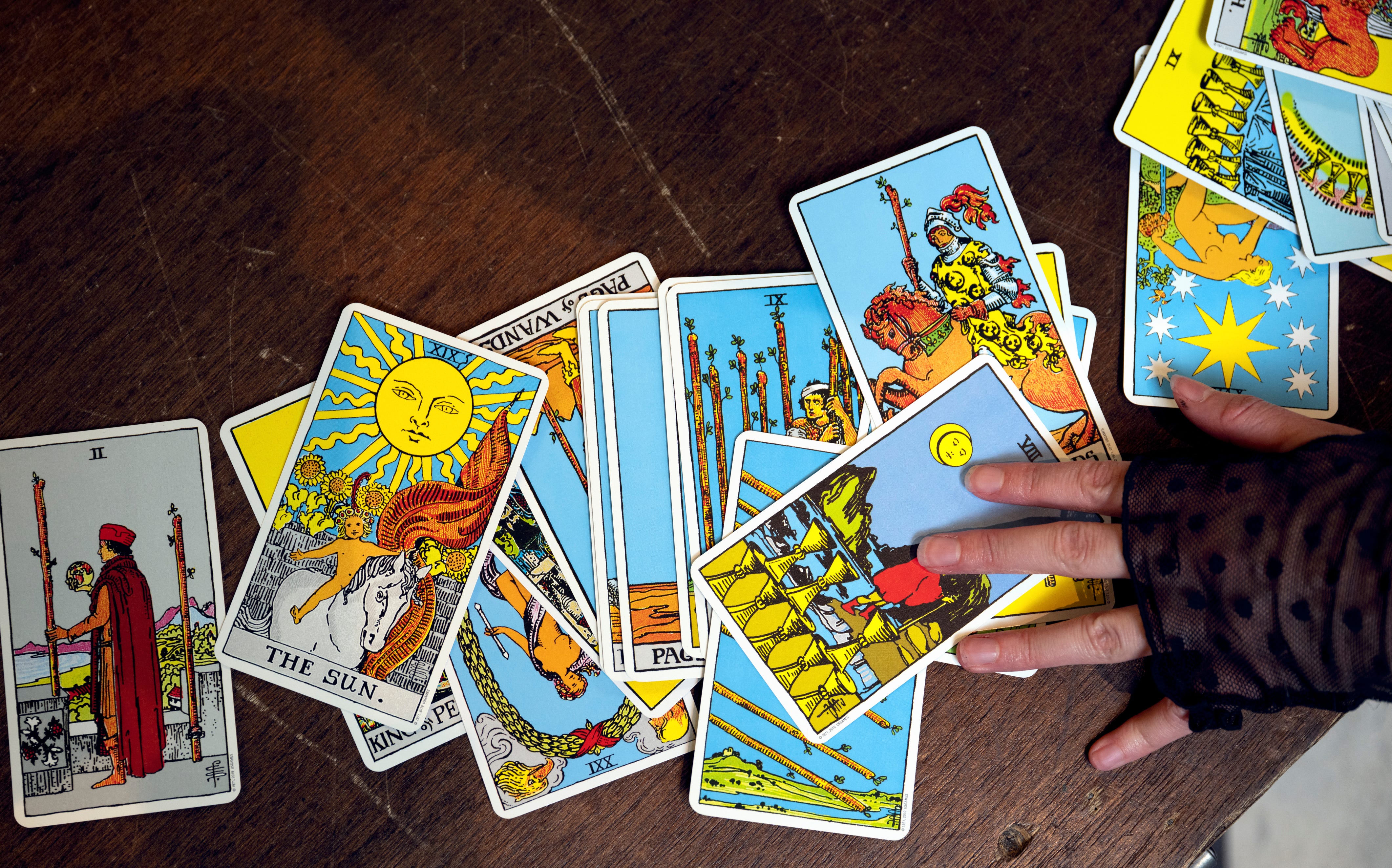
This week, I caved to the advice of my best friend, who, in the spirit of self-help, has long recommended I get a tarot card reading from a “witch” on the online marketplace Etsy. Tarot is a practice that involves drawing and interpreting cards from a 78-card deck. It does not predict the future, but instead aims to provide insights into your psychology and situation in life, making it a more intriguing experience for a skeptic like me than fortune telling. After some resistance, I decided I might as well give it a go—at the very least it would give me an insight into an interesting corner of the internet.
I’d hoped for a flattering insight into my personality and struggles, and I wasn’t disappointed. The “witch” first asked whether I wanted a general reading or help with a specific issue. I opted for a general reading, and within hours I received a message detailing the cards she’d chosen and what they meant: “I instantly connect with the incredibly brilliant, fast-moving, and communicative Air energy of a true Gemini,” she wrote. “You have a beautiful, active mind that processes the world at lightning speed … you are stepping into a beautiful era of victory and deep emotional fulfillment.”
Nice.
The cards didn’t hold all good news, however. “You have been carrying an extreme amount of emotional and mental weight recently. Please, take a step back, prioritize radical self-care, and start setting firm boundaries.”
As an atheist since the age of 11, I expected to be too cynical to be moved by her words. Instead, I found myself to be genuinely touched, especially when she sent me “an immense shield of protective, healing light, deep peace, and the warmest hug!”
Yes, it isn’t a huge leap to guess that someone seeking advice on Etsy might be going through a difficult time. And yes, I’m not entirely sure that she wasn’t a bot—while she admitted to using AI to enhance her messages, she assured me that the cards themselves were chosen by her, a human.
Nevertheless, I was surprised at how easy it was to feel that the cards were fulfilling an emotional need.
Around 80% of young people today identify as spiritual, and many of them are flocking to places like Etsy. Women, in particular, are increasingly looking at non-traditional ways to explore their spiritual side.
Young women have always been curious about spirituality. For decades, teenage girls have been intrigued by Wicca, a pagan religion focusing on connection to the environment and celebrating feminine power. It’s easy to see why girls would be open to such approaches at the age when they may feel most powerless—going through puberty, feeling pressure to be perfect both at school and in appearance, and so on. In previous years, most girls would grow out of this phase. But in recent years, as both social isolation and the pressures on young women increase, interest in spirituality has grown.

As the COVID lockdowns took off in 2020, there was a 600% increase in Google searches for “manifesting”—a belief system based on the Law of Attraction in which you focus your mind on the things you want, and they magically come to you. On Instagram, the hashtags #manifest and #manifestation have been used over 15 million times. In a world with stagnant employment opportunities, and with the need for connection thwarted by the disaster that is modern dating, many young women are using manifestation as a way to feel they’re taking charge of their lives.
The broader categories of witchcraft and astrology, meanwhile, go far beyond my brief encounter on Etsy. My Instagram feed showcases a number of “witches” selling their wares, including love spells, many of which are far cheaper than paying for a dating app. Astrology has likewise taken off, with a staggering 63% of young Americans reporting that consulting the stars has positively impacted their careers. Spirituality is lucrative, too. By 2031, spending on astrology products is projected to rise to $22.8 billion—$10 billion more than in 2021.
This growing curiosity about spirituality is happening in tandem with—and is fed by—another trend: the decline of organized religion, in particular among young women.
For the first time, young women today are less drawn to organized religion than young men. After decades in which women were more religious, men born after 1990 are now more likely to attend weekly religious services than women of the same age. In 2024, 40% of women aged 18-29 in the United States identified as religiously unaffiliated, up from 29% a decade earlier. The percentage of men identifying as such remained at around 35%.
While the difference is currently small, it is increasing. One reason for the divide seems to be that young men are more conservative than young women. 65% of women aged 18-29 say that churches don’t treat men and women equally. 31% of Gen Z women identify as LGBTQ, and nearly half of Americans who left their childhood religion say they did so because of its hostility towards gay people. Many young people, especially women, feel that churches simply don’t match their values—leading them to embark on alternative spiritual journeys.
But as with most social media trends, the spirituality taking Gen Z by storm is more about consumption than anything else. Exploring spirituality today means watching videos on WitchTok (the section of TikTok dedicated to witchcraft), or buying “spells” and “potions” online (no need to actually collect those ingredients at a full moon yourself—as with everything, the internet can sort that out for you!). These activities are fun and, briefly, make young women feel powerful. But by focusing their energy on the next spell, or on manifesting improvements in their lives, young devotees are actually holding themselves back. If all you need to succeed is to manifest your desire or listen to your horoscope, then that’s evidence that you simply didn’t manifest hard enough. This is a sure way to avoid taking responsibility and doing the work needed to actually improve your life.
More fundamentally, Gen Z women are seeking spiritual answers and guidance on platforms that offer shallow titbits rather than genuine wisdom. Social media inherently decontextualizes and flattens the meaning of its content. As part of its dedication to the earth, for example, Wicca celebrates equinoxes and solstices—but experiencing this only by watching WitchTok videos on your phone isn’t going to create the connection or awe that the real-life activity brings. These online communities distill spirituality into just another consumer good.
All of this poses a dilemma for traditional religion. Churches need to examine why young women don’t feel religion is speaking to them, and come up with a more compelling answer than can be found on Instagram. Gen Z women have grown up with strong social values but conflicting ideas about identity. For girls dreaming about exciting careers or living in the big city, the life of a tradwife feels oppressive and restrictive. Similarly, many young women have positive views towards different kinds of love and relationships, and many find traditional values about marriage to be old-fashioned and unrepresentative of their own beliefs. Some churches are taking the need to modernize literally, creating prayer apps and games to keep young people engaged whilst learning about the Bible. But ultimately this is just another version of an Etsy witch—a way to feel like you’re invested in your spiritual growth whilst rotting on your sofa, without building a deeper knowledge either about religion or about yourself.

In a world where being alone is celebrated—where having a boyfriend is embarrassing and influencers are making it big by showing off their lives with no friends—but where, at the same time, connection with other humans is weak, young people are struggling to find a way to build a meaningful life. They’ve learned that many churches won’t give them the answers or sense of fulfillment they’re hungry for.
But neither will the shallow promise of internet spirituality. No matter which path Gen Z chooses, the best way to find meaning remains to go offline, pursue deeper knowledge, and build communities that reflect their values. I, for one, don’t need an Etsy witch to tell me that.
Leonora Barclay is Head of Podcasts at Persuasion.
Follow Persuasion on X, Instagram, LinkedIn, and YouTube to keep up with our latest articles, podcasts, and events, as well as updates from excellent writers across our network.
And, to receive pieces like this in your inbox and support our work, subscribe below: