

How to Save the Planet Without Screwing Over Poor People
A manifesto.


I’m a climate activist, but I don’t think climate is the most important thing. Not really.
I care about climate because I care about human flourishing, and an out-of-control climate makes human flourishing very hard. A stable climate is a really important means, but it’s not in itself an end.
That seems like a pretty milquetoast position, but it’s weirdly divisive in climate circles. Much of the climate left seems to want to prioritize climate stability even at the cost of human flourishing. The recently departed Paul Ehrlich (who infamously predicted that the world was facing a “population bomb”) was probably the paradigmatic example of this brand of anti-humanist environmentalism. Anytime you hear people worry about the climate impacts of having children, you’re face to face with this strand of thinking.
That makes no sense to me. I’m for people first, climate stability second.
If your first concern is for human flourishing, the thing to worry about is poverty. I grew up rich in a poor country. I didn’t live through poverty, but I saw it up close, day after day. If you have a gut level sense of what material deprivation looks like in the developing world, you know it blights human potential in a way nothing else short of war will. I’m interested in the climate mostly because I fear runaway climate change would make it very difficult for the poorest countries to bring people out of poverty. The reason to worry about climate change isn’t that it’ll make some properties on the Florida coastline hard to insure—it’s that millions of people across Africa and South Asia will struggle to survive in a world that is 3 degrees warmer than pre-industrial levels. Climate studies, to me, is a sort of branch of development studies. I realize this is not a mainstream position, but it’s the one that makes sense to me.
That’s my starting point, and it’s different from the starting point of a lot of people in the climate movement.
When I talk to climate people in rich countries, I find a lot of concern about capitalism, about our alienation from nature and the way capitalist consumption unbalances our relationship with the natural world. Which figures: when you talk to first-world people, you hear a lot about first-world problems.
Most climate activists don’t seem very worked up about poverty in the developing world, probably because they just haven’t spent a lot of time with poor people in poor countries, and they just don’t think about them very often.
The results are unsurprising. First-world climate activists tend to favor policies that risk making poverty in the developing world worse, and they don’t seem much troubled by this.

You could cite many examples. The degrowth movement is the most obvious one: as development economists know (or used to know), economic growth is far and away the best way to fight poverty in the poorest countries. Nothing else comes close. To advocate degrowth is to prioritize a stable climate over human flourishing. To me, that’s morally abhorrent.
Of course, degrowthers will push back. They’ll tell you they want degrowth in the rich countries, where people already consume too much, not in the poor countries. But emissions are falling in rich countries—it’s just that they’re rising in the developing world five times faster. Even deep, society-disrupting cuts in developed country emissions (which would not be politically sustainable) could leave emissions still rising for years to come if poverty abatement continues on the path it’s been on.
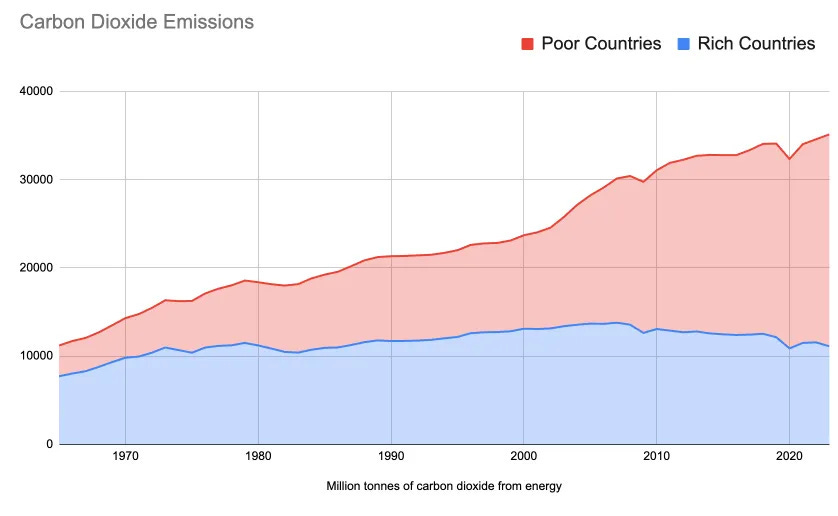
Climate movement people hate this chart, and I can see why. It shows their basic program won’t work. Degrowth in rich countries will not, by itself, bring a stable climate. And degrowth in poor countries implies more poverty.
The inconvenient truth is that poverty abatement and middle class formation in the developing world is really carbon intensive. The data is pretty clear about this.
Take a look at some of the countries that have made the biggest strides in fighting extreme poverty. Places like India, where the proportion of the population living on less than $2.15 a day fell from 48% in 1993 to 5% in 2022. And Vietnam, which cut its extreme poverty rate from 58% to under 2% over the same period. And Bangladesh, which went from 51% in 1991 to 6% in 2022. And Tanzania, where extreme poverty fell from 87% in 2000 to 51% in 2018. And Ethiopia, which managed to halve its extreme poverty rate from 74% in 1995 to 33% in 2015.
Let’s look at these development stars and ask how their carbon emissions have evolved since 1970:
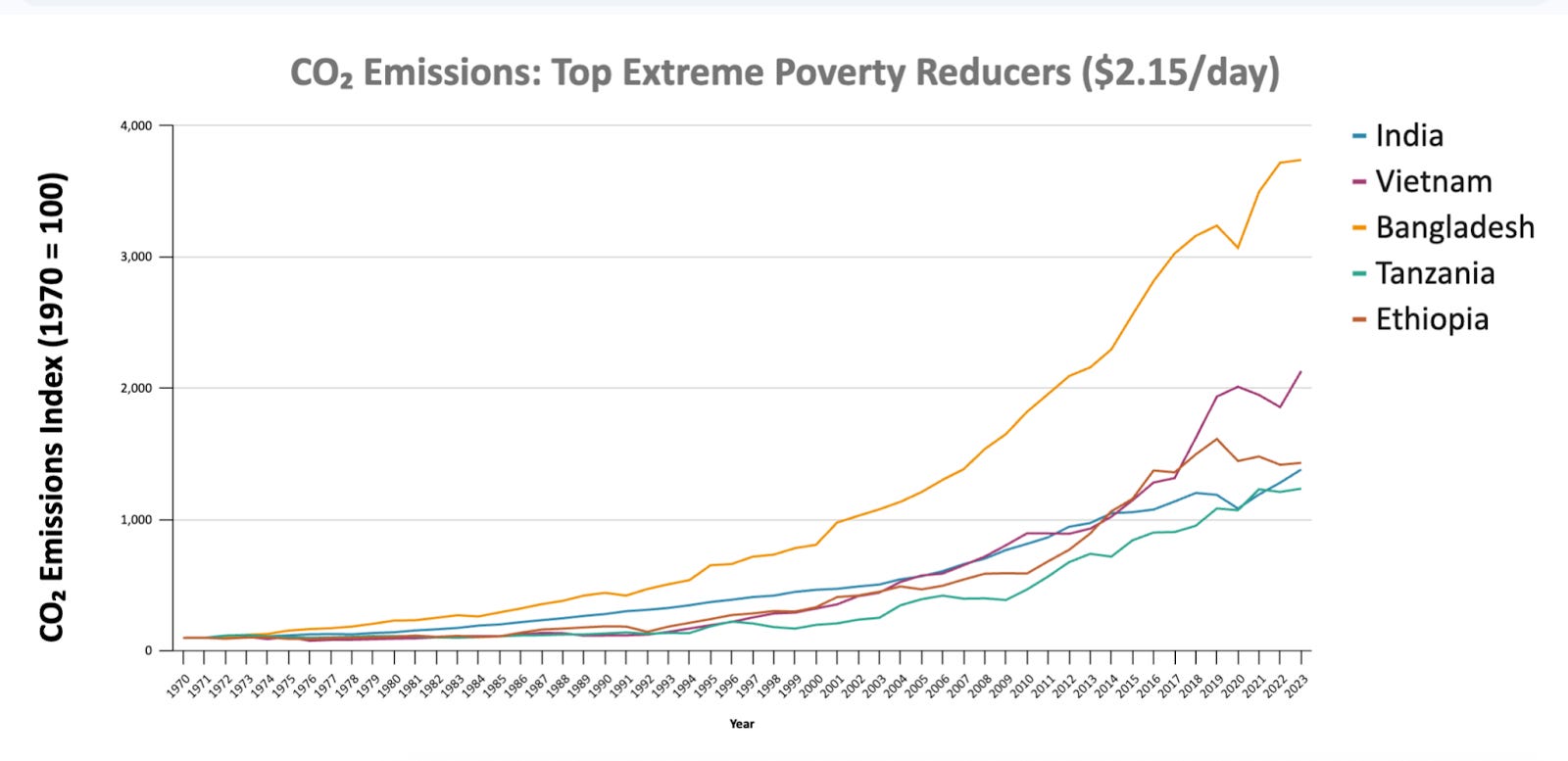
In all these places, emissions have been rising fast. Tanzania now emits 12 times as much CO2 as it did in 1970. Bangladesh emits 37 times as much. It figures: as people get richer, they can suddenly afford the kind of consumption that generates CO2 emissions.
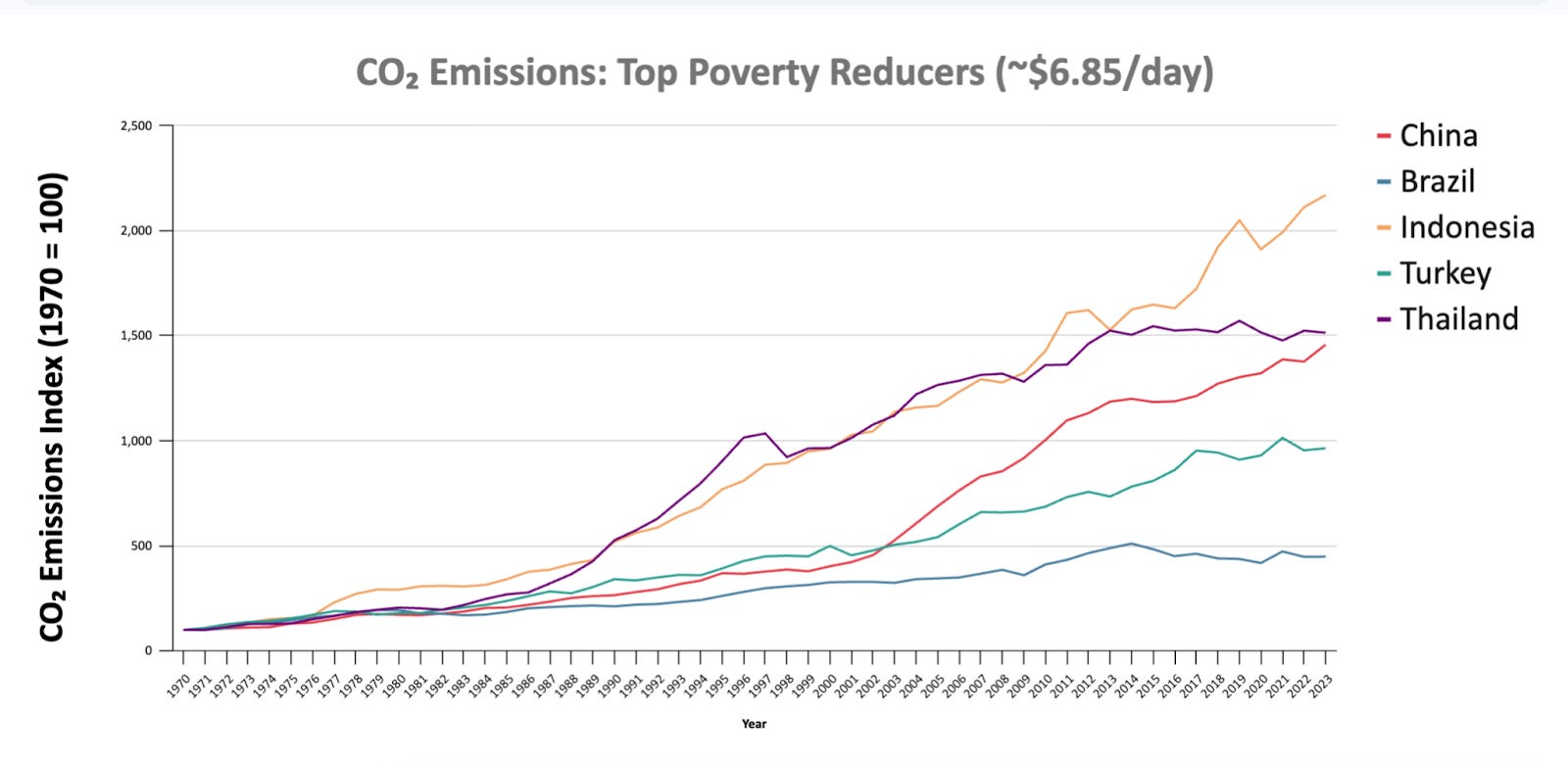
The pattern is roughly similar, though not as marked, when you look at countries that have performed best at getting people above the poverty line. Here, the range is from Brazil, which now generates 4.4 times as much CO2 as it used to, to Indonesia, which now generates 21 times as much as it used to:
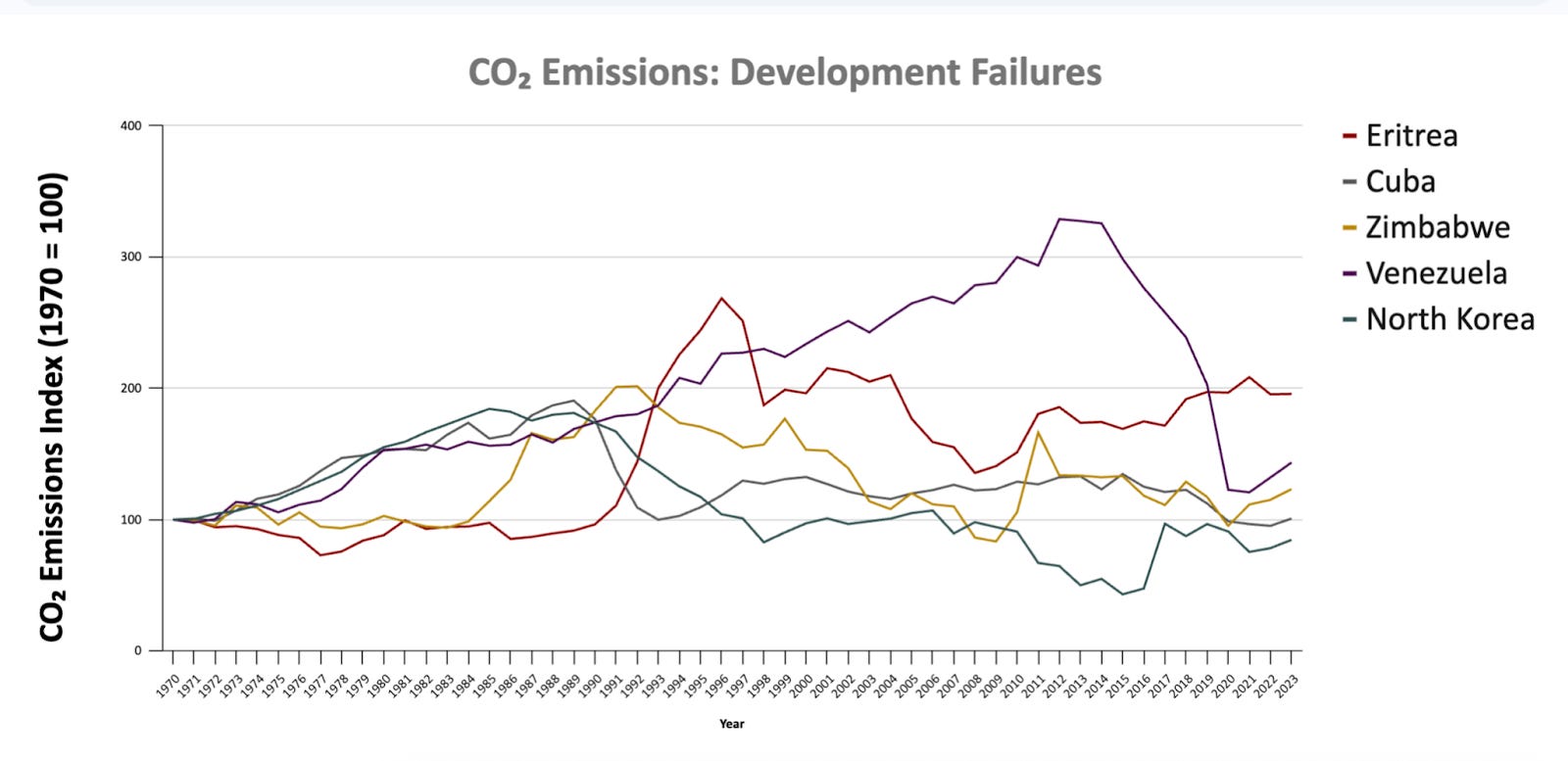
Of course, not all developing countries have seen rising emissions. Some countries have seen them stay stable for two generations, even fall a bit. It’s just that those countries are, without exception, development basketcases—places where people are as poor or poorer now than they were one or two generations ago:
In a way, the point I’m belaboring is headslappingly obvious: poor people in poor countries pollute very little because they consume very little—that’s what it means to be poor. Where economies grow and poverty abates, people consume more. Not just more energy: more water, more steel, more concrete, more transportation services, more medical care, more meat. All of that emits greenhouse gases, and while solar and wind can address some of those emissions, they can’t address all or even most of them.
In the real world, where emissions don’t rise it’s because living standards aren’t rising either.
This has troubling implications.
In positive terms, it means curbing emissions from the developing world is unlikely, because developing country governments are under intense pressure to bring their people out of poverty. But I also don’t think it’s desirable, because given the technology we have today, curbing emissions would imply slowing poverty reduction.
Of all the things the climate movement is in denial about, this is the most consequential.
Trust me, I know how problematic this conclusion is, and how far out of consensus. I realize it puts me in a small minority among people who consider themselves climate activists—though, arguably, Bill Gates does now agree with something not too far from this position.
If you agree that climate goals are a means to the end of human flourishing, and if you agree that poverty is the thing most injurious to human flourishing, then I don’t see how you avoid this conclusion.
A world where we “Just Stop Oil” is a world that cuts off the legitimate aspirations of billions of people. It’s a world of galling absurdities, like the growing European unwillingness to countenance the kinds of energy investments that would allow Sub-Saharan Africa to thrive. It’s the mindset that WePlanet brilliantly sends up in their biting, profound Just Stop Cooking spoof campaign.
Telling poor people in poor countries to just put up with their deprivation for the sake of climate stability is monstrous, a wholly misguided putting of the cart before the horse. If that’s what climate activism means, I want exactly nothing to do with it.
And yet. And yet and yet.
The climate is changing, we are flirting with a terrifying array of potential tipping points that we can only sort of measure and only sort of understand. To say that curbing carbon emissions is not a defensible climate goal is not to say that we have nothing to worry about. We have a lot to worry about, and it’s not fine. We’re creating risks future generations may not be able to handle at all, as well as putting today’s most climate-vulnerable people in an ecologically untenable bind.
The challenge, as I see it, is to find climate solutions that enable rather than impede human flourishing.
This is the Hard Problem of climate change, the genuinely flummoxing bit. The climate movement prefers to just elide these sorts of moral dilemmas altogether.
But the dilemmas are there. They don’t go away just because you refuse to acknowledge them.
The role of intellectuals in society is to try to resolve precisely this sort of dilemma.
Let’s do that.
If you really believe both that rising greenhouse gas concentrations are a world-historical problem and that curbing carbon emissions carries unacceptable development costs, your options for action are limited.
Really, you get to pick between two flavors of response:
You can try to lower the temperature directly by managing how much solar radiation reaches us; or,
You can try to suck carbon dioxide out of the atmosphere faster than we’re putting it in.
Both of these approaches are fairly niche in the climate world, though they’re getting less niche every day.
Of the two, the more widely discussed one is solar radiation management (SMR). This is what people call “solar geoengineering” (though that’s a label I don’t think we should use.) The idea is to make the planet cooler by making it more reflective, thus reducing the amount of the sun’s radiation that reaches us. There are a number of ways you could do this—from the truly fanciful, to ideas that seem more realistic, like releasing reflective particles into the stratosphere and brightening marine clouds.
There’s plenty of discussion out there about these techniques. Mainstream climate movement people are mostly appalled by them. They see it as a “get out of jail free” card—a way of giving licence to polluters to keep polluting.
I think that’s a fairly weak objection, because it rests on a mickey mouse political economy model of why pollution happens in the first place. If you imagine the reason there’s a lot of emissions is that some greedy oil industry fat cat wants a second yacht, it’s easy to see calls to sidestep emissions curbs as just carrying water for those fat cats.
But that’s a child’s mental model of why emissions keep rising. The reality is that emissions keep rising because billions of people in poor countries who used to consume next to nothing now consume a little bit more.
And that’s a good thing.
People who have a more sophisticated understanding of these dynamics tend to find solar radiation management really enticing, and to some extent I do sympathize with their view. It would almost certainly work, and quickly, and cheaply. We should definitely be researching it more, and we should definitely lift the outdated taboo on talking about it.
But I don’t think it should be our main approach to mitigating climate change, for reasons people in the field have discussed pretty extensively: because it tackles symptoms rather than causes, and because it carries genuinely hard-to-abate risks of unintended consequences, not just in terms of the climate but in terms of geopolitics.
The geopolitical question is the one that really gives me pause. Solar Radiation Management will almost certainly produce losers as well as winners. If some of those losers happen to control a well-resourced military, you can just about imagine a solar radiation management program becoming a new flashpoint, maybe even a reason for war.
Imagine a scenario in which some of the losers from solar radiation management are nuclear armed countries—whether it’s Russia, which doesn’t want colder winters, or India, Pakistan and China, all of which could see rain patterns shift in ways that counter their interests. Creating new possible reasons for nuclear powers to fight each other is not the reason I got into this gig. I got into this whole field because I’m concerned about human flourishing, and if there’s one thing that’s worse for human flourishing than extreme poverty, it’s war.
I’m not quite ready to say these geopolitical risks mean SRM should be abandoned, but I do think it’s a reason to look much more closely at the alternative.
The alternative is Carbon Dioxide Removal—CDR to people in the field. As climate responses go, CDR is a niche within a niche, the usually-overlooked little brother in the heterodox-climate-solutions space, which is itself usually overlooked. Which is unfortunate, because CDR is obviously the superior solution: it addresses causes, not symptoms. It gets at the root of the problem. If we could just make it cheaper to implement, it could solve the Hard Problem of climate change.
The problem, of course, is cost. For the most part, existing techniques to suck carbon dioxide out of the atmosphere are far, far too expensive—in the order of hundreds to thousands of dollars per ton. The cheaper techniques that do exist have other drawbacks: they keep carbon dioxide out of the air for just a few decades, say, or they need far too much energy, or they use up too much land, or they require you to physically move billions of tons of physical stuff around.
The holy grail would be a low-cost, ecologically sound way to capture carbon dioxide from the atmosphere. This ought to be the focus. It’s all any of us ought to be thinking about.
About a year ago, the folks at the Anthropocene Institute think tank, who’d been reading my writing on this subject, challenged me to put up or shut up. They hired me to really investigate this field, to actually understand who is doing good work on an avenue that looks like it might really work. Talking to people in this space is what I’ve been doing ever since. What I found is, I think, alternatively infuriating and heartening.

It’s infuriating because the CDR field is small, and a lot of it seems to me to be pursuing avenues that obviously won’t scale. With all respect to the folk working on Direct Air Capture—machines that filter air to capture CO2—unless energy becomes ten times cheaper, their methods will remain very expensive, on the order of many hundreds of dollars per ton of CO2 captured.
A lot of engineering ingenuity has gone into CDR approaches that appear to be dead ends. There’s just not enough energy, or land, or money to bring most of these projects to anything like climate-relevant scale. Too many smart, idealistic people are spending too much energy developing ideas with no credible path to moving the needle. For a field as small as CDR, any funding and any human talent wasted on a dead-end solution is a small tragedy. I’ve seen too many of these tragedies, and wish they would stop.
But I’ve also been heartened because some research avenues are genuinely exciting and look to me to have a very credible chance of solving the Hard Problem of climate change.
They have a few things in common: they work backwards from where we need to be in terms of scale (at least 10 billion tons of CO2 captured by 2035) to the things we would need to do to get there, rather than working forward from the technologies we have today through incremental improvements. They’re smart about targeting free sources of energy and piggybacking on existing natural processes, rather than trying to reinvent them from scratch. And although they’re a niche within a niche within a niche, there are some smart people working on them.
The most promising approaches, to my mind, build on two key insights.
The first key insight is about photosynthesis. We’ve known since the 19th century that plants use the energy from sunlight to absorb carbon dioxide from the air so they can use that carbon to build their own bodies. Human beings are very unlikely to come up with a way of absorbing carbon dioxide from the atmosphere that’s better than the one evolution came up with over a few billion years.
Photosynthesis runs on solar power, which means the main thing that makes so many CDR approaches uneconomic—the cost of energy—just isn’t an issue. And it’s nature-based in the way that matters most: it’s not about replacing nature with something better we thought up in a lab, but about helping nature do what it’s always done—turn sunlight into life—quicker.
The second key insight is about the ocean. Photosynthesis on land is fundamentally limited by the availability of said land. There aren’t that many good places to grow trees able to suck in a lot of carbon dioxide, and those places tend to be in or around farms. Try to scale forest-based approaches to a point where they really start to make a dent on carbon dioxide concentrations, and you just run out of space to grow food.
Displacing a poor farmer in a poor country off of his land defeats the entire point of climate activism. (Shockingly, it happens more than most people realize.) So tree-planting is fundamentally limited in its potential as a CDR technique.
But there’s no good reason to rely on photosynthesis on scarce land when 70% of the planet is covered in oceans that can do the same thing.
Which is how I became obsessed with the field of marine Carbon Dioxide Removal, and the sub-field some of the smartest people in climate are now calling Phytoplankton Carbon Solutions. Because the only mechanism that will allow us to capture carbon dioxide at scale is photosynthesis, and the only place where the planet can host enough photosynthesis to move the needle is… the ocean.

The microscopic marine plants known as phytoplankton are the Earth’s oldest and most reliable carbon dioxide capturers. After they take up carbon dioxide at the surface, they die, and a proportion of them sink, where they can lock away that carbon not for dozens, but for hundreds if not thousands of years. In the vast area of the oceans where nutrients are scarce, a startlingly small amount of essential nutrients could lead to large new areas of plankton growth and large scale carbon dioxide removal at the same time.
In the nutrient-deficient parts of the ocean—the so-called “marine deserts” that cover around half the surface of the Earth—a gentle intervention may turn out to be enough to capture a significant percentage of the carbon emissions humans make each year. And because phytoplankton double as the bottom rung of all marine food webs, growing phytoplankton may help many other marine organisms as well, from krill to fish to whales.
A lot of scientific research remains to be done on how to make this mechanism work. Some of that work is happening as we speak. It may turn out not to work, or not to scale. But it may also turn out that, over the coming four to six years, we develop an ecologically sound, affordable, high-quality means of capturing carbon dioxide at genuinely climate-relevant scale.
Phytoplankton would be an actual solution to the Hard Problem of climate change—the problem of how to find climate solutions that enable rather than impede human flourishing, and that restore the natural world in the process.
It’s a unique opportunity; we’d be mad not to seize it.
Quico Toro is a contributing editor at Persuasion, the founder of Caracas Chronicles, Director of Climate Repair at the Anthropocene Institute, and writes the Substack One Percent Brighter. He lives in Tokyo.
Follow Persuasion on X, Instagram, LinkedIn, and YouTube to keep up with our latest articles, podcasts, and events, as well as updates from excellent writers across our network.
And, to receive pieces like this in your inbox and support our work, subscribe below:
It's because climate is a very real crisis that it's so important to be honest about how the world actually does and doesn't work. Bravo Quico!
Sorry, I don't have any confidence at all in geoengineering solutions like removing carbon from the air or blocking the sun. This is nuts! It would cost a fortune, be ripe for graft, necessarily involve massive private corporations to do these things - who would then become a powerful lobby. There could be terrible secondary effects.
I wish to God that environmentalists could focus on real life solvable environmental problems- that actually effect the daily lives of people- especially in poor countries! How about actually doing something about plastic pollution and water pollution! The developed world has sent many of our most polluting industries- textiles, chemicals- to less developed countries and many of the poorest people are living in toxic soups of pollution. These are solvable problems!