


Our next ASK THE AUTHOR on Substack Live will take place at lunchtime TODAY at 12:30pm ET. We’re delighted that John B. Judis will join us to discuss his recent article “What Hegel Knew About Trump,” and to answer your questions. Please click here to add it to your calendar!
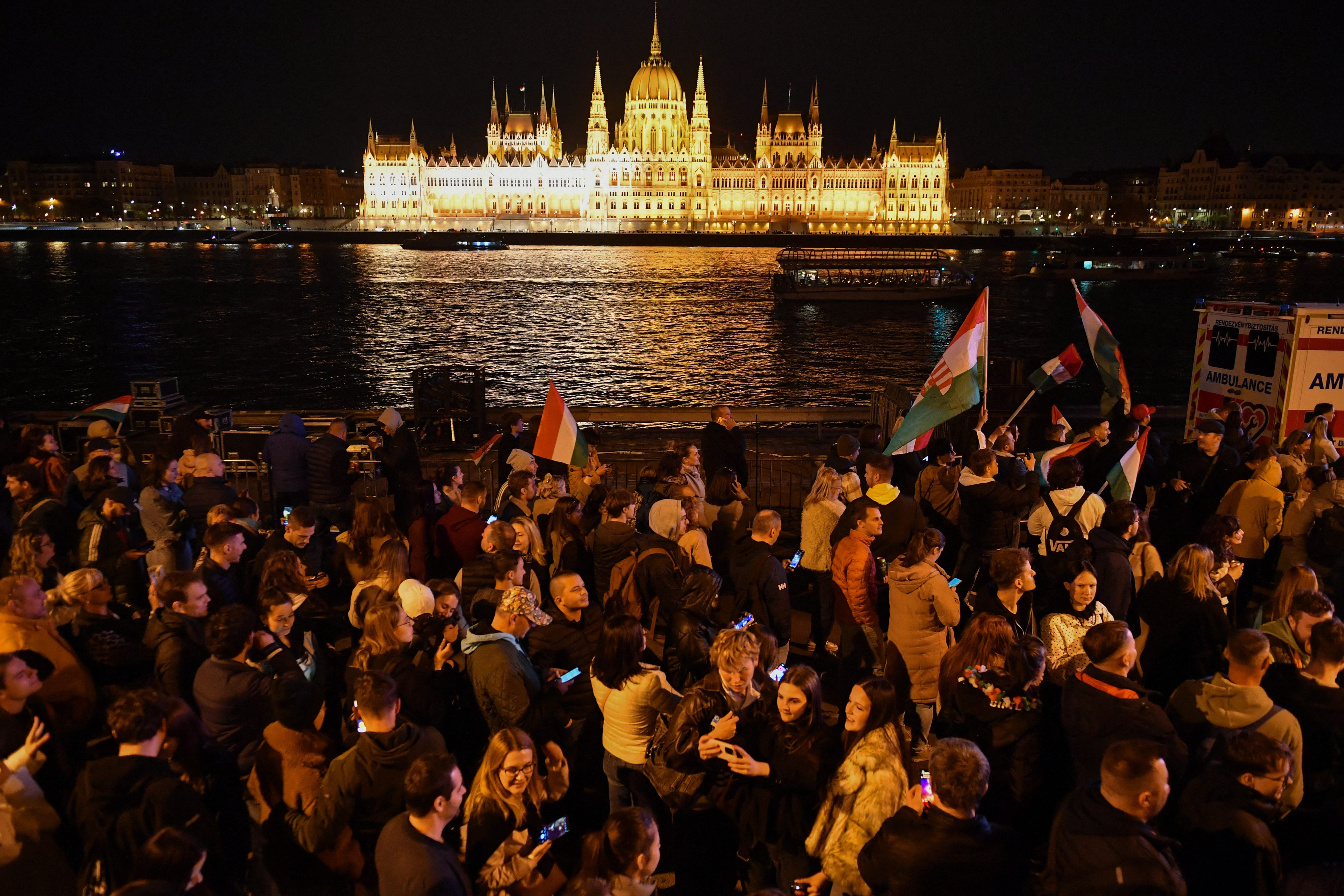
Viktor Orbán, who has governed Hungary for the past 16 years, turning the small Central European country into an international model for (as he himself proudly put it) “illiberal democracy,” just suffered a crushing defeat at the polls. According to preliminary results, the main opposition party, Tisza, will win over two thirds of the seats in the National Assembly. The victory by Péter Magyar is so unequivocal that Orbán conceded his defeat within hours of the polls closing, congratulating his likely successor on his victory.
This victory is such a big achievement in good part because Orbán has for the past decades proven extraordinarily effective at dominating Hungarian public life. He has built up a huge network of clients whose wealth depended on his goodwill. He has anointed himself an effective spokesperson for the conservative values shared by a large part of the country’s voters. And he has proven extremely adept at portraying himself as the only politician who can protect Hungary against its enemies.
These enemies kept changing according to the needs of the moment. They variably included George Soros, who was raised in Hungary and paid for Orbán to attend Oxford University; the European Union, which grew vocal about Orbán’s blatant abuses of power after initially tolerating them for a shamefully long period; and Ukraine, which according to the most extreme claims in the latest election campaign had plans to invade Hungary. What never changed was Orbán’s insistence that the threat was existential, and that he alone was able to protect the Hungarian nation.
But after many years in office, leaders tend to be judged on their record rather than their rhetoric. And Orbán’s record increasingly looked abysmal.
Once one of the most affluent countries in Central Europe, Hungary is now the poorest in the European Union; over the last years, the standard of living of a typical Hungarian has fallen behind that of countries that had historically been much poorer, such as Romania and Bulgaria. Corruption runs so deep in Hungary that it started to affect the lives of ordinary citizens; the evident impunity enjoyed by Orbán allies who broke serious laws was a big part of the reason why erstwhile allies distanced themselves from him in droves over the last months. And on the international stage, a country that suffered brutal domination by the Soviet Union for half a century—most notably in 1956, when a reforming government was violently quashed by tanks sent by the Kremlin—found itself more aligned with Moscow than with Brussels, a development many Hungarians came to resent.
The man who was able to seize upon these failings has himself for most of his adult life been an Orbán loyalist. Magyar rose to prominent political positions, running a public student loan program and sitting on the board of state-owned corporations, thanks to his close ties to the government. His break with Orbán did not come until 2024. When a presidential pardon for an accomplice in a child sex abuse scandal drew widespread outrage, Magyar broke with his political allies by giving an interview to a independent YouTube channel that went hugely viral. Within weeks of the interview, he was leading mass rallies; within months, the new party he put together had won 30 percent of the vote in elections for the European Parliament. Magyar has since positioned himself on the center-right, allying his newly founded party with Christian Democratic parties like Friedrich Merz’s CDU.
The victory of the opposition gives Hungarians a crucial opportunity to heal their ailing democracy and return their country to economic growth. It will make it much easier for the European Union to act with a united voice, especially regarding the ongoing war in Ukraine. And it is a humiliating defeat for the many American conservatives who have over the last years chosen Hungary as the projection screen for their political fantasies. (Evidently, it was so important to JD Vance to boost Orbán’s chances at reelection that he made a remarkable stopover in Budapest amid his negotiations with Iran.)
All of these are reasons for genuine joy. But to this expression of joy, I want to add a few more sober observations from the perspective of a political scientist.
Hungary has such outsized importance in part because it has long been seen as a test case for the stability of democratic institutions. Political scientists once believed that countries which are as affluent and have as long a democratic tradition as Hungary should not be vulnerable to sliding into dictatorship. Orbán’s ability to undermine key democratic institutions like a free press thus seemed to suggest that even countries in the traditional heartlands of democracy might be vulnerable to serious “democratic backsliding.” This makes it remarkable that the opposition was able to oust Orbán at the ballot box, and that he conceded defeat rather than trying to rig the elections. The outcome of Sunday’s vote should thus make us a little more optimistic about the prospects for democratic resilience in other countries in which demagogues are daily attempting to circumvent constitutional limits on their power, including the United States.
The stakes of politics have risen sufficiently high that, from Hungary to the United States, it is widely said about every major election that it is “the most important of our lives.” But the opposition’s success at ousting Orbán on its fourth try reminds us that the process of demagogues trying to win office and consolidating their power is very lengthy. A single election rarely allows them to concentrate power in their own hands. Despite all of his attempts at entrenching his rule, Orbán evidently failed to do so over the last 16 years.
Conversely, a single defeat rarely banishes the danger such movements pose. In the United States, a demagogue who had been widely written off after his first electoral defeat succeeded in returning to power. In Brazil, a demagogue who had been widely written off—and even put in jail—after an electoral defeat could soon help his son ascend to the presidency. The fight for democracy is a marathon, not a sprint.
For similar reasons, it would be premature to conclude that the threat to Hungarian democracy has now been banished. Magyar has won a commanding victory, and the fact that he enjoys a two-thirds majority will make things much easier for him. But the impressive coalition he put together is so diverse that it will struggle to agree on how to govern, and he himself remains in many ways an ideological cipher.
Even if Magyar proves to be sincere in his commitment to govern in a way that is more respectful of the rule of law, he will face what I’ve come to call the “post-populist dilemma.” Orbán has put so many of his own people in so many positions of power that, even with his party reduced to a small rump in parliament, he will retain the ability to torpedo the work of the government in a million ways. This means that Magyar faces two equally unappetizing choices. He can choose to play completely by existing rules; but if he does, he is leaving many of Orbán’s corrupt appointees in key positions in the administration and the state media, making his work all but impossible. Or he can fire anybody who appears more loyal to Orbán than to the constitution; but if he does, he will effectively normalize the idea that each new prime minister simply fires anybody appointed by their predecessor. The difficulty of navigating the post-populist dilemma is one reason why even a big setback for demagogues doesn’t always spell the end of their political career.
Finally, there is a delicious irony to how lop-sided Magyar’s victory is. During his 16 years in power, Orbán repeatedly changed the electoral system to tip the balance in his party’s favor. Because the opposition was divided and he counted on always retaining the most votes of any single party, he adopted an electoral system which strongly boosts parliamentary representation for the numerical victor. Now that Hungarian voters have finally turned on Orbán, he is a victim of his own machinations. Despite winning about 40 percent of the vote, his party will hold less than a third of seats in parliament.
Demagogues always try to manipulate political institutions in their own favor. But as Orbán’s crushing defeat illustrates, doing so successfully is very hard. Again and again, tomorrow’s electoral arithmetic turns out to be vastly different from today’s. And so the frequency with which attempts at manipulating the electoral system backfire is one of the small ways in which democratic institutions have proven to be more resilient than we might have expected a few years ago.
Over a decade into a political era defined in large part by the threat that demagogues pose to democratic institutions, it is time to recognize that some of the simplest narratives conceal more than they reveal. Most countries are neither perfect democracies nor outright dictatorships; they fall on some point along the messy continuum between the two.
For that reason, the most likely threat for most countries is not that they are about to slide into outright dictatorship. It is that incumbents severely tilt the playing field without quite being able to banish the opposition.
This implies an important lesson for those of us worried about the state of democratic institutions in our own country. The real risk for the United States today is not that the country will soon resemble the world’s most extreme dictatorships. It is that America turns into a “dirty democracy,” in which those in power are able to rewrite the rules of the game in their own favor without ever quite rendering democratic elections meaningless.
Whether in Hungary or in the United States, a clear view of the situation requires us to adopt a more messy model of how democracies rise and fall. The fate of longstanding democracies is unlikely to consist either in a full victory or in a full defeat for the forces of freedom; and it is determined by choices made over the course of decades, not days.
But such a refined understanding of the complexities of this political era should not impede our ability to celebrate when there is a rare piece of genuinely good news. And anybody who cares about basic values like the rule of law should welcome Orbán’s defeat as a big step in the right direction. Sunday’s election was a good day for Hungary and a good day for democracy.
Follow Persuasion on X, Instagram, LinkedIn, and YouTube to keep up with our latest articles, podcasts, and events, as well as updates from excellent writers across our network.
And, to receive pieces like this in your inbox and support our work, subscribe below: