


Our next ASK THE AUTHOR on Substack Live will take place at lunchtime on Monday April 13, at 12:30pm ET. We’re delighted that John B. Judis will join us to discuss his recent article “What Hegel Knew About Trump,” and to answer your questions. Please click here to add it to your calendar!
Some thirty years ago, Slovakia’s aspiring authoritarian prime minister, Vladimír Mečiar, hired several international celebrities—Claudia Schiffer, Gérard Depardieu, and Ornella Mutti, among others—to join him on the campaign trail. The photo-ops were invariably “cringe,” as today’s younger generation would say, and the deflated Mečiar was ousted in September 1998.
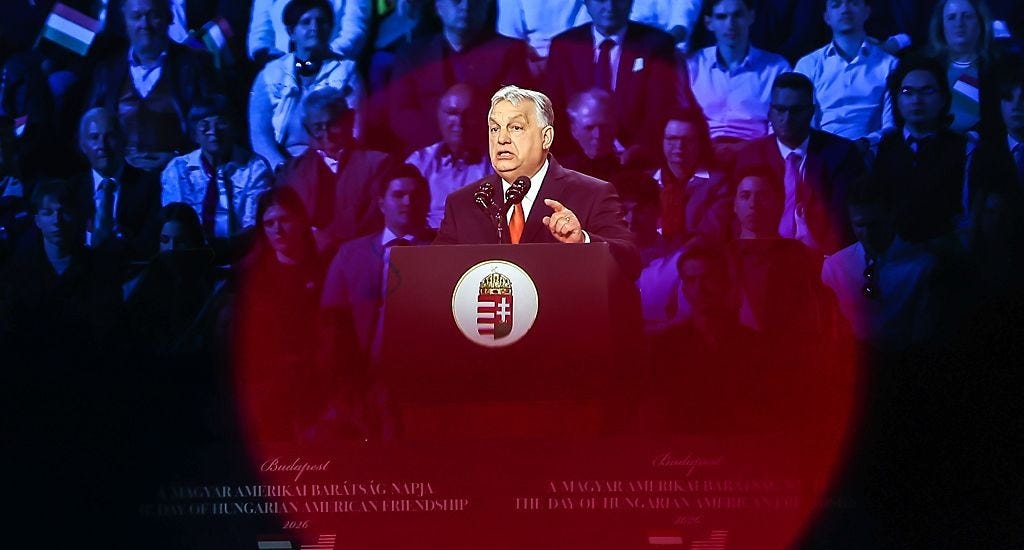
Today, Viktor Orbán’s overwrought re-election campaign in neighboring Hungary brings back some of those memories. For one, I doubt that U.S. Vice President JD Vance’s recent visit to Budapest—including a rally where he made an impromptu on-stage phone call to Donald Trump, and insinuated that Ukrainian intelligence and Brussels bureaucrats are trying to interfere in the election—will turn the tide in Orbán’s favor.
It is not simply that Vance’s appearance was similarly cringe. Rather, it is about political fundamentals. The opposition Tisza Party, led by Orbán’s main challenger, Péter Magyar, has maintained a healthy lead over Fidesz, averaging a 10-point lead on Politico’s poll of polls. It’s the most formidable electoral challenge Orbán has ever faced, and the best chance yet for Hungarians to arrest their country’s descent into authoritarian rule.
Booed at his own rallies, Orbán is doubling down on his anti-Ukrainian rhetoric, blaming Kyiv for everything from high energy prices to supposed threats against his family. Yet it is going to be hard for Orbán to run away from his record in government. What was once a highly successful economy in transition is now the most corrupt country in the EU. Hungarian voters are not blind, and optics like Orbán’s sprawling estate neighboring a safari park owned by his childhood friend, the billionaire Lőrinc Mészáros, have not been lost on them.
Hungary now also appears to be the poorest state in the EU, behind Bulgaria and Romania. Since 2010, Hungary has lost almost half a million people, both to aging and to emigration. Far from being a bulwark against mass immigration and a lab of exciting pro-family policies, as imagined by its ideological allies in the West, Fidesz’s policies have served as a catalyst of stagnation and decline.
There are powerful players who have an interest in keeping Orbán in power. As The Washington Post recently reported, Russia’s intelligence services drew up plans for a false-flag assassination attempt against Orbán, designed to generate a wave of sympathy and rally his base. The Kremlin-linked Social Design Agency—already under U.S. sanctions—has been flooding Hungarian social media with pro-Orbán content while portraying Magyar as a puppet of Brussels. And according to VSquare, a Central European investigative outlet, Russia’s military intelligence is present in Budapest under diplomatic cover to help coordinate Orbán’s re-election effort.

There are many unknowns—including last-minute campaign surprises, and the question of whether Orbán will relinquish power peacefully. In 2011, his government changed Hungary’s already complex electoral system with the aim of entrenching Fidesz in power, generating sizable parliamentary majorities from narrow wins in the popular vote. As a result, Tisza may need to beat Fidesz by 3 to 5 percentage points nationally just to secure a parliamentary majority. A small lead by the opposition could hand Fidesz a majority of seats.
Yet even if the opposition overcomes these obstacles, and the handover of power goes smoothly, we cannot write Orbán off entirely. Nor can we necessarily look forward to Hungary’s return to the family of well-governed, reliable European nations.
For one, if it loses the election, the Fidesz government would be leaving behind a spectacular economic and fiscal mess for its successors to clean up, only amplified by the recent shocks to the global energy supply propagating from the Strait of Hormuz.
In August last year, the International Monetary Fund warned that the Hungarian economy found itself at a challenging juncture with a combination of high inflation and stagnant output. Policy remedies to these two problems are in tension with each other. Short-term stimulus can easily make the inflation problem worse, while a consistent effort to reduce inflation comes at a price of lost output. Meanwhile, the European Commission has projected that Hungary’s fiscal deficit will rise in 2026, with the debt-to-GDP ratio climbing toward 75 percent.
But something will need to be done. It may, in fact, not be completely irrational for Orbán to leave power peacefully after Sunday and allow the opposition to step in with difficult, unpopular measures to consolidate public finances and bring stability. Letting the opposition deal with the economic fallout of the last 16 years might well facilitate Orbán’s return to power in the future—perhaps even before Magyar completes his first term.
But even in opposition, Orbán is unlikely to sit still. Tisza is a catch-all party that includes many former Fidesz officials. Magyar himself is a former Fidesz member and an ex-husband of the now-disgraced justice minister Judit Varga, who resigned in 2024 after countersigning the pardon of a man convicted of covering up sex crimes against children. The scandal, which also triggered the resignation of Hungary’s then-president, was what brought Magyar into politics in the first place.
Given the improvisational nature of Tisza, it is perfectly thinkable that in a year or two from now Orbán will be able to find wedge issues—immigration, gay rights, EU law, Chinese investment, Ukraine—that will split a Magyar government.
There’s another obstacle to a post-Orbán Hungary: Fidesz’s influence across all levels of society. An oligarchic network dominates Hungary’s business landscape. The media ecosystem has been reshaped so thoroughly—through the massive KESMA conglomerate, state broadcasters, and the withdrawal of advertising from independent outlets—that reversing it will take years even under the most favorable political conditions.
The courts have been packed, the public administration stacked with Fidesz appointees, and the country’s universities placed under the control of Fidesz-friendly foundations through legislative maneuvers that will be exceedingly difficult to undo. Attempting a “deep clean,” beyond just changing top government echelons, would certainly be a risky move by Magyar. It would open the new government to charges of illiberalism from Fidesz’s still-formidable media machine.
Yet leaving the existing power structures in place will leave many voters dissatisfied—and will also be a source of vulnerability for the new government.

One study of nearby Poland notes that “there is no easy or obvious course of action for a reforming government to take” after a long period of illiberalism. It goes on to warn that: “Such governments are structurally impeded in their capacity to respond to the consequences of illiberalism, and perhaps also susceptible to the temptations of exploiting illiberal precedents or pretexts for their own benefit.”
Hungary’s friends in the West should wish the country well. A Budapest that is no longer leaking confidential European Council conversations straight to Moscow, as the current foreign minister, Péter Szijjártó, likes to do, will be a massive improvement over the status quo. Yet no one should be under any illusion that even a decisive defeat for Orbán will bring about quick, decisive change for the better.
Democracies seldom emerge healthier from periods of heavy abuse—and Hungary is unlikely to be an exception.
Dalibor Rohac is a senior fellow at the American Enterprise Institute in Washington, D.C. and a contributing editor with American Purpose at Persuasion.
Follow Persuasion on X, Instagram, LinkedIn, and YouTube to keep up with our latest articles, podcasts, and events, as well as updates from excellent writers across our network.
And, to receive pieces like this in your inbox and support our work, subscribe below:


The concluding sentence, one suspects, may apply to more countries than just Hungary or Poland. (And I am not thinking of Slovakia.)
Maybe a title change? One can always pray for a miracle but maybe we shouldn't expect one.