

The Power Struggle Blocking the Strait of Hormuz
To get a deal, either the United States gives up its influence or Iran its identity.

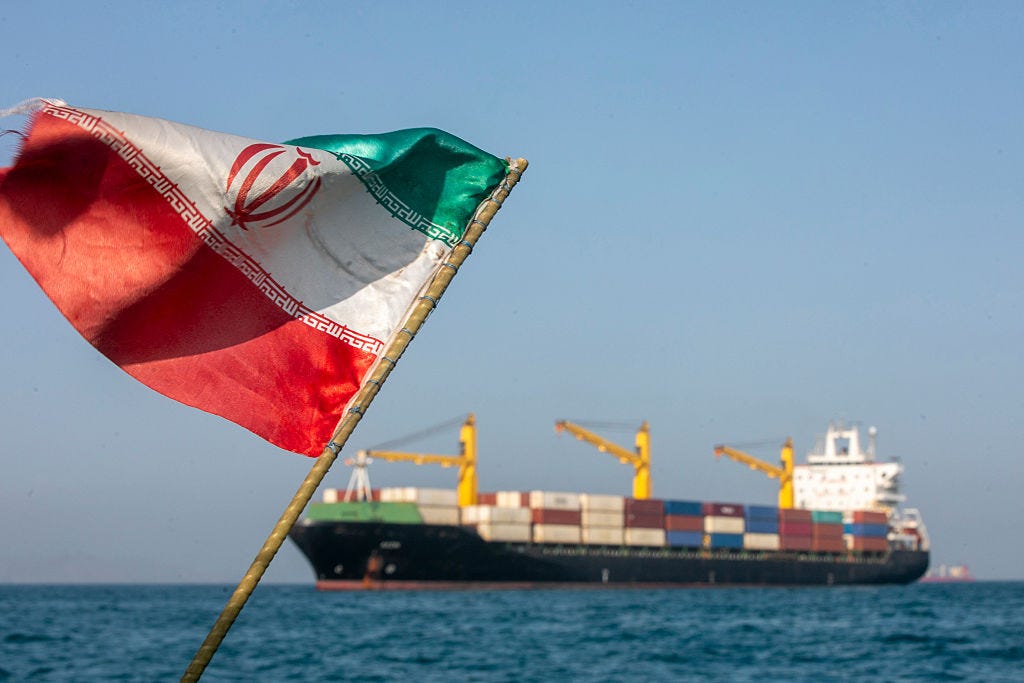
Although the Strait of Hormuz has been closed for only three months, it seems like an eternity. U.S. President Donald Trump has been promising that a deal to reopen it is imminent and will happen any moment. His announcements briefly rally the markets, but it is slowly becoming obvious that a deal is not that close after all. The recent news of Iranian president Pezeshkian’s attempted resignation only cements the unwelcome realisation that not only is an agreement unlikely in the near future, it is structurally impossible. The goals of both sides, their very reason for existence, oppose each other and cannot be reconciled unless one capitulates to the other. How is Pezeshkian’s reported effort to leave office, albeit denied by the IRGC, related to the inability to reach an agreement? It confirms what many have suspected—that power in Iran has been concentrated in the IRGC’s hands. So much so that the president, the nominal head of civilian government, feels unable to perform his duties.
88 Islamic Jurists and a Power Vacuum
Why does it matter who holds power? Because any agreement with the United States must satisfy the goals of whoever is actually in charge. As far as anybody can tell, Mojtaba Khamenei, the official head of the Iranian state, has been notably absent from—well, everywhere. It is unclear if he is even alive following the bombing of his father’s compound on the morning of February 28. We are told he communicates with his people via handwritten notes, avoiding electronics to stay ahead of potential assassination attempts. That does not explain the complete lack of any photos or videos of him since that morning. What it does, however, is remove the need for the 88 Islamic jurists of the Assembly of Experts to gather in one place at the same time—which would present a considerable target to the United States and Israel, as that assembly is precisely what is required to elect a new supreme leader. It also ensures that whoever comes next is not killed immediately after election. Having what looks like a pretend supreme leader is a smart move for the IRGC—if he is always in hiding, nobody knows if he is even alive, and if he communicates only in writing, the IRGC can produce whatever notes it wants. They are in charge of the state.
All Power, No Compromise
A government, even an authoritarian one, can compromise because its goal is to stay in power, and staying in power sometimes requires flexibility. The IRGC’s claim to power does not come from governance but from ideological purpose: the export of Islamic Revolution and the destruction of Israel. That is not a policy preference that can be traded away. It is the IRGC’s entire claim to legitimacy and the basis of its internal cohesion. An institution that abandons its founding purpose does not survive the compromise. The IRGC cannot negotiate away the nuclear programme or Hormuz without negotiating itself out of existence.

It might come as a surprise to some, but the slain Ayatollah Ali Khamenei was not a hardliner when it came to nuclear capabilities. At least officially, he delayed the development of Iranian nuclear weapons, citing religious caution—he issued a fatwa against their acquisition as far back as 2003. With him gone, that restraint is no longer needed.
Why is Iran so intent on procuring nuclear weapons? The current predicament answers the question—if Iran did not have the Strait of Hormuz as leverage, it would not have any enriched uranium left either. Without closing the Strait of Hormuz, Iran would not have a bargaining chip—or, indeed, an upper hand—in its dealings with Washington. As things stand, without enriched uranium, it cannot pursue what the Islamic Republic has declared its founding purpose. The destruction of Israel and resistance to the United States—the Little Satan and the Grand Satan in the regime’s own language—are not rhetorical flourishes. The export of revolution is enshrined in the constitutional preamble; the annihilation of Israel is the stated doctrine of the IRGC and has been repeated as state policy for nearly five decades. These are the principles that literally underwrite their constitution—much as the Declaration of Independence underwrites America’s.
To keep the dream alive, the IRGC needs nuclear weapons. To protect the nuclear programme, Iran is using the closure of the Strait of Hormuz. Giving up one means giving up the other, and giving up both means giving up the state’s reason for existence. And yet that is what the United States believes Iran will do.
A Fix Worse Than the Problem
Whatever goals the United States had before the start of hostilities in the Middle East, very few have survived the bungled attempt at regime change in Iran. By now, the only demands Washington has not backed down from are the opening of the Strait of Hormuz and Iran abandoning its nuclear programme. Even there, the Trump administration has climbed down from permanent dismantlement to a temporary moratorium—with the duration still contested, Iran proposing five years and the United States demanding twenty.
The rest of the wishlist, meanwhile, like the Iranian demand for the release of some $12 billion in frozen assets held in Qatar, the lifting of sanctions, the withdrawal of U.S. troops from the region and the crowning glory—reparations paid by the United States—have not been shot down by Washington. Even Donald Trump understands that having wrecked the security equilibrium in the Middle East and having taken a hammer to the world economy, he cannot just pretend that a closed Strait of Hormuz is better than an open one. To be frank, he did try—posting on Truth Social that the United States is the world’s largest oil producer and that when oil prices go up, America “makes a lot of money.” Despite the fact that U.S. oil producers are probably ecstatic about current oil prices, which allow them to invest heavily into new projects in a way that was impossible when oil cost $40 a barrel, and despite the fact that Donald Trump may feel more affinity with oil producers than with people paying high prices at the fuel pumps, Trump presumably understands that he will have to pay for the unmitigated disaster he has unleashed.
He also understands that after all the effort the U.S. military went to in order to stop Iran from ever being able to acquire a nuclear bomb, walking away now would be a failure of epic proportions. He would look very bad to his own supporters. And Donald Trump does not like looking bad. To say nothing of the fact that a nuclear-capable Iran in the Middle East would disrupt the entire region for years—an outcome no U.S. administration, regardless of who is in office, would be able to live down.
Which is why the Strait of Hormuz and Iran’s nuclear programme are the two things Washington cannot compromise on. It can skate around the rest, swallow its pride, sell another bridge if it must. But it cannot sell a closed Strait of Hormuz and Iran’s having a nuclear programme.

In the meantime, Washington is running out of time to restart any hostilities to reinforce its position. June sees the start of the FIFA World Cup, hosted across the United States, Canada and Mexico. Military operations in the Middle East would put a damper on festivities. Then there is America’s 250th anniversary on July 4, at which point restarting the war would not sit well at home. And then there are the midterm elections, in which the GOP is expected to lose Congress and with it any ability to militarily rectify Trump’s mistakes.
Waiting For the Sun
And so both sides are trying to wait each other out. Iran has seemingly taken a leaf out of Russia’s book and is pretending to negotiate in the hopes of reaching the November midterms intact without having to give up anything valuable.
The Trump administration is biding its time. Having imposed a half-hearted blockade on Iranian ports, the United States is hoping to wear out Iran to the point where it will give up resistance.
Should the power configuration in Iran change, the structural impasse would shift. But for now, unless one of the sides unexpectedly gives in and changes its goals, there is no version of reality where a compromise between two opposite goals is possible. Iran has to give up its raison d’être, or the United States has to give up its entire influence in the world.
Ines Burrell is a geopolitical analyst and political risk consultant based in the UK. Born in the Baltics, with a degree in International Relations from the University of Exeter, she writes and gives live commentary on European security and Russia.
Follow Persuasion on X, Instagram, LinkedIn, and YouTube to keep up with our latest articles, podcasts, and events, as well as updates from excellent writers across our network.
And, to receive pieces like this in your inbox and support our work, subscribe below:
 | A guest post by
|
An informed, and depressing, assessment. Trump is such an idiot.