

The Incels Are Taking Over
Anti-feminism best explains populism.

I watched it because it kept coming up in the queue, and because I have two young boys, but the new Louis Theroux documentary Inside the Manosphere did not reveal very much. The men themselves are tedious, so the entertainment relies mostly on footage of a deadpan Theroux staring at them with a studied blankness as they monologue about alpha maledom.
This is Theroux’s signature move, and it worked for him in the past, with its implicit invitation for the subject to embarrass themselves on camera. But it doesn’t really land here because these people cannot be embarrassed. They are immune to charges of hypocrisy and thrive on all forms of attention, however critical or ironic. François Truffaut said there can be no such thing as an anti-war film, and by a similar rationale there can be no such thing as an anti-influencer documentary.
One detail the movie treats as too obvious to mention is that these men are all Donald Trump supporters. Of course, who else? But this convergence between male grievances and far-right personalist politics is probably the defining element of modern politics, even if it’s not always recognized as such. Among young men who aspired to traditional masculinity but thought they hadn’t achieved it, Trump led by 22 points in 2024. Men who identified as “completely masculine” and scored high on masculine norms favored Trump by a huge 50-point margin.

This is not just an American phenomenon. In South Korea, anti-feminist politics helped fuel the rise of the People Power Party. In Spain and Germany, populist right parties draw disproportionately on male support. In Argentina, Milei built his base largely among young men drawn to his combative and transgressive persona.
For these movements, gender grievance is not a superficial aesthetic layered on top of right-wing populism but one of its key drivers. I’d go even further and argue that the rise of the incel and the rise of the strongman are two linked and mutually reinforcing responses to the perceived evils of modernity.
There are three well-known, and well-trodden, families of explanation for the emergence of right-wing populism. There is the economic story: deindustrialization, stagnant wages, the hollowing out of the working class. The cultural story: immigration, demographic change, the anxiety of losing a familiar world. And the institutional/technological story: declining trust in democratic norms, the fragmentation of media, the algorithmic amplification of outrage.
None of these, however, explain why this moment has coalesced not around a particular program or a set of policies but around a similar character type: the swaggering, transgressive, dominance-performing strongman. Donald Trump, Jair Bolsonaro, Rodrigo Duterte, Viktor Orbán, Recep Tayyip Erdoğan. The question is not necessarily about who votes for these people, since their electorates are large, varied, and often older than the stereotypical manosphere consumer. The question is about form. Why does twenty-first century authoritarianism so consistently perform masculinity as its defining aesthetic across vastly different cultures?
The answer, I think, is that the emergence of far-right personalist rule is not just a symptom but a direct result of the crisis of gender politics: the collision between global gains in women’s status since the 1960s, and the psychological and material displacement of men who had organized their identities around traditional gender hierarchies.

This is sometimes awkward for progressives to admit, but modernity feminizes society. In fact they shouldn’t have to admit it; they should assert it. It’s a good thing. Modernity feminizes society by empowering women to become full participants in economic and political life. The elevation of women is the great achievement of modernity, and probably what makes modern life tolerable compared to much that came before. But it also by definition requires the partial feminization of traditional social structures.
And that partial feminization has produced, across vastly different societies, the same political reaction: a demand for masculine restoration packaged as anti-elite populism. The strongest thread uniting these movements is not economics or immigration or even anti-democratic politics, but a demand for renewing traditional masculinity. As Pippa Norris and Ronald Inglehart argued in Cultural Backlash, authoritarian populism is at its core a reaction against the postmaterialist values of feminism and sexual liberalization. And Birgit Sauer has described far-right populism as a form of “masculinist identity politics,” a project to restore men’s perceived control over a world slipping from their grasp.
Consider what the manosphere actually offers its audience. It does not provide, as the documentary demonstrates, any sort of dating advice, in contrast to the Pick-Up Artistry schtick floating around twenty years ago. In fact, dating is deprecated by some of its members as a feminine activity. Instead, it’s a worldview built on the premise that male dominance is the natural order of things, and the modern world has conspired to overthrow that order. The welfare state, the university, the HR department are all instruments of this emasculation.

This is exactly the story right-wing populists tell about the liberal order. In both cases the natural hierarchy has been overthrown by a corrupt establishment and only the reassertion of dominance, personal or national, can set things right. The manosphere says feminism stole your birthright; MAGA says globalism stole your country. Whether it’s Andrew Tate or Donald Trump, the emotional logic is the same: you’ve been humiliated and I will make you powerful again.
The rise of women’s status has been global, if uneven, and so the rise of male grievances has been global too. Populist radical right parties across Europe and South America are overwhelmingly supported by men and organized around masculine grievance. In Europe, strong gender-traditional attitudes increase the likelihood of voting for populist right-wing parties.
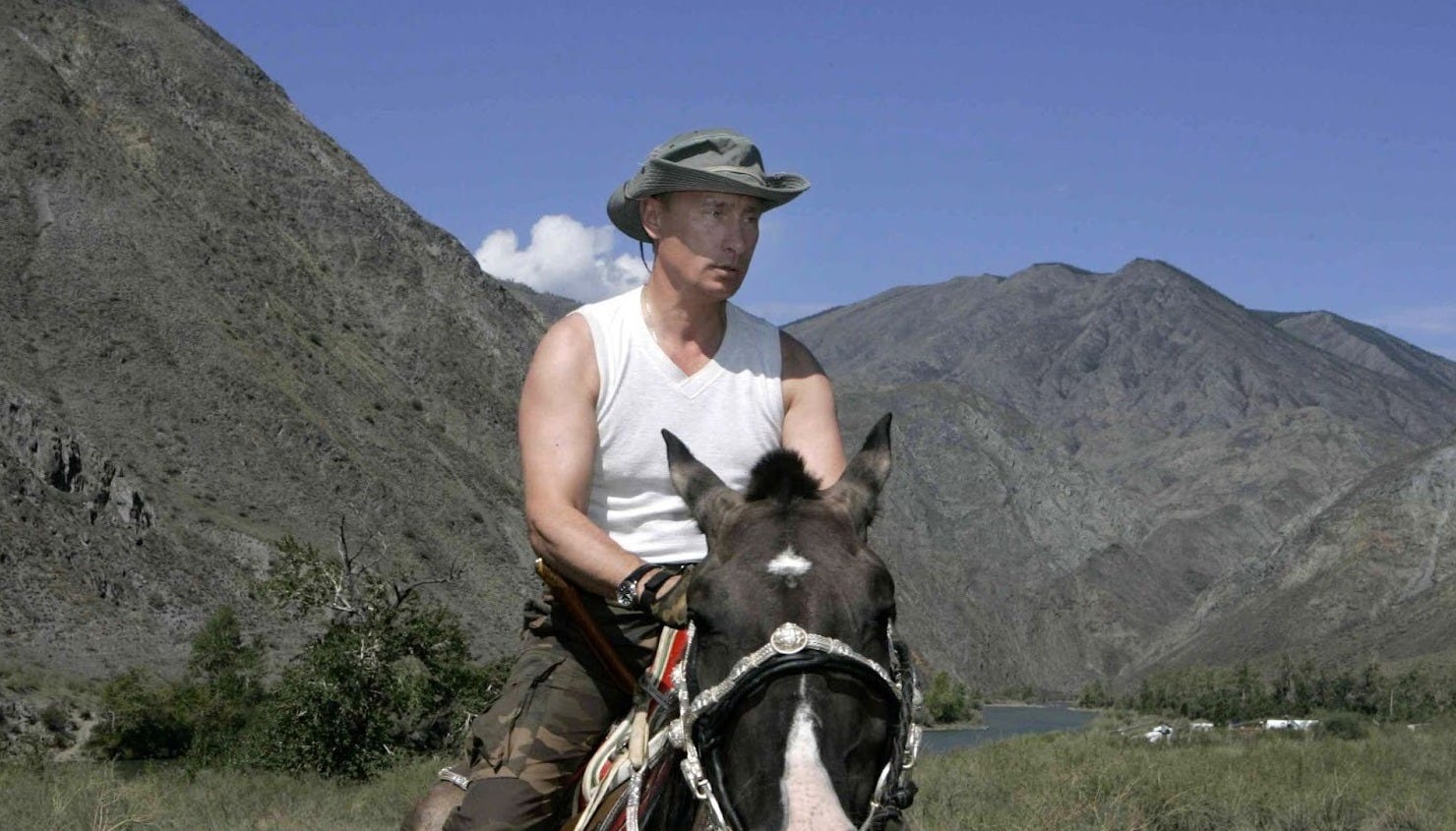
As a result, leaders from Putin to Trump use masculinity performances to shore up legitimacy, distract from failures, and assert dominance. The performances share a few common features: displays of physical strength and virility, contempt for weakness, feminization of enemies, and promises to restore national honor.
Putin is the archetype. He routinely feminizes his enemies to lower their status. When he mocks Western leaders as weak or decadent, he’s positioning Russia as the masculine alternative to an effeminate, declining West. Much of Russia’s post-Soviet identity, in fact, is built around wounded masculinity reasserting itself.
In Brazil, Bolsonaro built his career on hyper-masculine performances like hosting motorcycle rallies, posing with rifles and MMA fighters, mocking feminists, and—between hospital stints—equating physical vigor with political authority. In Hungary, Orbán framed his entire project around demographic anxiety and the defense of the traditional family against the decadence of Western liberalism. His anti-migration narratives define the country’s “masculine” national identity against a “feminized” Western order.
In Turkey, Erdoğan has wielded state-sponsored homophobia as a tool of political consolidation. In India, Modi performs a different but equally gendered role as the ascetic strongman, photographed in poses suggesting spiritual power and physical vigor, the celibate protector of the Hindu nation. In the Philippines, Duterte bragged about sexual assault and framed his drug war in the language of masculine discipline.
The logic of masculine politics extends outward as well. Research consistently shows that individuals with higher “masculine honor beliefs” are more likely to support preemptive military strikes, torture, and aggressive foreign policy, and less likely to support diplomacy, peacebuilding, or multilateral institutions. Men who experience anxiety about whether they measure up to masculine ideals are significantly more likely to support aggressive leaders and policies.
Cynthia Enloe and other international relations scholars have argued for decades that the competition to appear tough distorts threat perception. Hawks are strong, doves are weak. The structure of strongman governance, or the need to perform dominance at all costs, creates bias toward aggression even when that aggression is self-defeating.
The vast literature on populism talks a lot about economic anxiety, cultural backlash, and institutional decline. It’s less likely to ask why the vehicle for all of these resentments takes the form of a masculinity cult. That’s partly because masculinity usually operates as an unmarked category in international politics, its default and invisible norm. And it’s partly because discussions of gender somehow feel more embarrassing or less scientific. It’s easier to talk about trade deficits than about sexual frustration.
But the rise of “strongmen” is at least in part a gendered expression of impotence in the face of modernity. The men in the Theroux documentary don’t have to say anything new or groundbreaking. The feelings they monetize are not going away because their nemesis, female equality, is not going away either. The incel and the strongman are not just allies of convenience but two linked manifestations of the same ineradicable grievance.
Seva Gunitsky is the George Ignatieff Chair of Peace and Conflict Studies at the University of Toronto. He writes at hegemon.substack.com.
This article was originally published in Hegemon.
Follow Persuasion on X, Instagram, LinkedIn, and YouTube to keep up with our latest articles, podcasts, and events, as well as updates from excellent writers across our network.
And, to receive pieces like this in your inbox and support our work, subscribe below:
 | A guest post by
|
This article is fantasy. Populism is best understood as a reaction to the failures of globalization and the corruption and incompetence of the elite class including the experts. Covid put all of that on display. The Epstein files are a marvelous sequel. The president of Harvard and economist big wig! Obama's White House attorney and Goldman Sachs general counsel! Former POTUS and head of Clinton Global initiative! The list is endless.
I am a woman, well educated, feminist and I am a populist. And I know men who are well educated like me, as well as guys with only a high school degree who are all populists. Our populism was inspired by seeing our towns destroyed by globalization, our factories close and move to China. All the while, the elites push an increasingly radical cultural narrative around anti-racism, transgenderism, green virtue signaling, and mass immigration. That was just a cover for their looting of our economy.
No, we dont admire Putin. On the contrary, American populists are mostly anti-authoritarian. We don't like strong and aggressive central government telling us what to do. We saw during covid just how incompetent and corrupt the so called expert class is. We are smart enough to realize that Putin and Orban are authoritarians, just a different flavor from the would be authoritarians in the west.
Poul
I think the author conflates the desire for some men to live like traditional men, and the desire by some men to repress women. The former does not require the latter necessarily. Some aspects of modernity (ie feminism) equate and demonize both, and that is an error. If we want to reconcile society, we need to be nuanced on these matters.