


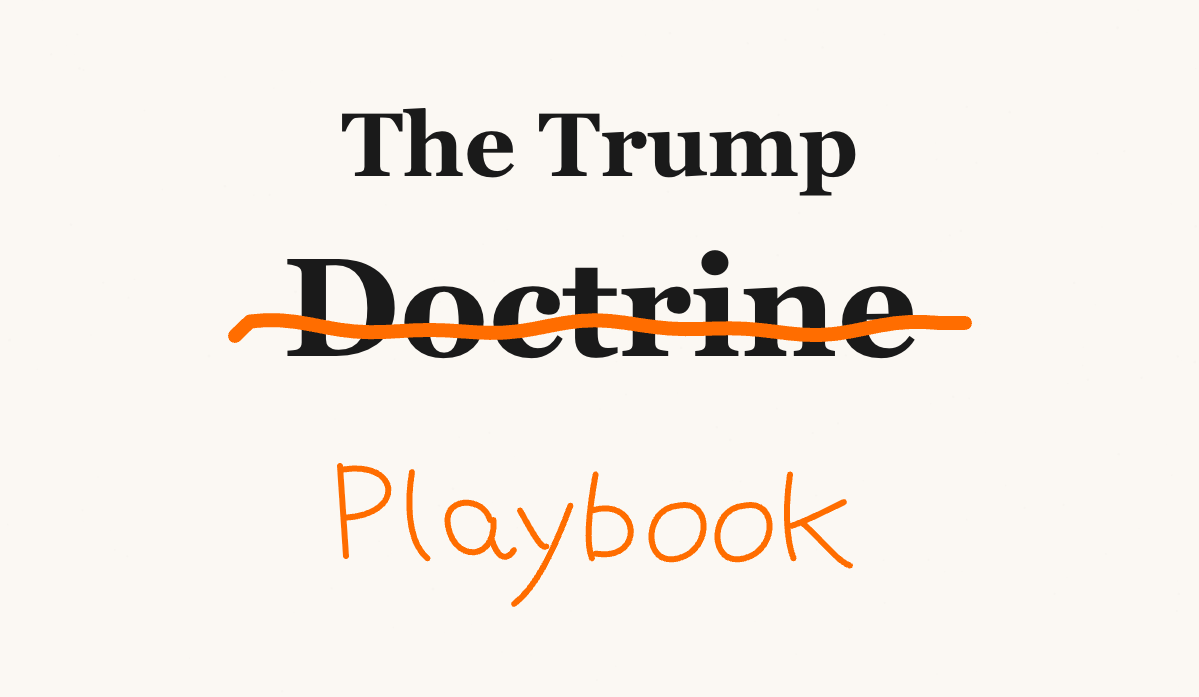
One of my minor gripes about the last decade is that far too many smart people have spent far too much of their lives trying to make sense of the strange psyche and selfish motivations of one single man. As you know, I try to avoid writing too much about the actions of Donald Trump in these pages, and the many of you who have kindly filled out my survey over the holidays seem to like this approach: the number of people who want me to write about big issues like philosophy, technology and culture is much greater than those who want me to focus on the Trump White House or, for that matter, the state of the Democratic Party. (If you haven’t yet had a chance to fill out the survey, you can do so here.)
So the bar for when I decide to write about Trump, and especially for when I try to offer an interpretation of what makes him tick or a guess as to what he might do next, is especially high. But as I have been reflecting on the daring capture of Nicolás Maduro, and the ignominious betrayal of Venezuela’s opposition movement, over the last days, a hunch I have long harbored about Trump’s foreign policy has slowly consolidated into a lightly-held theory.
We tend to analyze foreign policy in terms of doctrines or ideologies. But from The Art of the Deal to his first primary campaign, Trump has always been more defined by a way of doing things than by a firmly held set of commitments or objectives about what to achieve in the world (other than to look out for Number One). That same mindset can help us make sense of Trump’s actions in Venezuela, and perhaps even to get some kind of handle on what kinds of actions the White House might pursue next.
From a traditional foreign policy perspective, it makes little sense that America would stage such a daring operation in Venezuela, only to hand the country over to a close ally of the dictator it just captured. But from the vantage point of Trump’s instincts and interests—from the view, that is, of the Trump Playbook rather than some imaginary Trump Doctrine—the events of the past week start to make a little bit of sense.
For anybody who cares about the fate of Venezuela, it is getting clearer by the day that the country’s future is looking about as bleak as it did before Maduro was forcibly relocated to Brooklyn. And while Trump’s evident disregard for the democratic aspirations of the Venezuelan people is a key reason for that, the more profound explanation stems from the fact that the United States now faces two horns of a gnarly dilemma.
One horn is for America to effect regime change by putting boots on the ground. This might actually help to topple a brutal regime that has arguably done more to worsen the prospects of a nation than any other ruling clique in any other country over the past two decades. But it would also involve enormous costs. Going roughly in order of most to least important consideration for the White House, it would be hugely unpopular, both among Trump’s political base and among the general public; potentially get the country stuck in a years-long quagmire, risking the lives of many American soldiers and costing enormous amounts of money; and kill a lot of Venezuelans.
Another option is for America to accept that the Venezuelan regime stays in place essentially unchanged. In this scenario, Trump would keep touting the capture of Nicolás Maduro as a great accomplishment; come to some kind of minimum understanding with the new president, Delcy Rodríguez, that allows both sides to save face; and then turn a blind eye as the country continues to get poorer, many dissidents continue to languish in jail, and new victims of political repression join their ranks. It would have the advantage of avoiding all of the pitfalls of real regime change operations—and the small little downside of doing virtually nothing to lastingly defang the malign influence of the Venezuelan regime, either at home or abroad.
For anybody who primarily cares about outcomes in foreign policy, this suggests that the operation is likely to turn into a terrible failure. And that likely failure makes the course of action chosen by the Trump administration puzzling. Are they so amateurish that they had no plan at all for what to do after Maduro’s capture? Did Trump feel he had to go after Maduro because the latter had taunted him by imitating his dancing? Was the real reason he betrayed María Corina Machado, the leader of the Venezuelan opposition, that she refused to hand him her Nobel Peace Prize?
This way of looking at the matter has the advantage, which a lot of people understandably find to be emotionally satisfying, of portraying the Trump administration in the most venal and incompetent manner imaginable. But it also has the disadvantage of failing to understand what makes the administration tick, and therefore being unable to guide our imagination as to what might come next.
There is, I suspect, a better analytical alternative. For while I don’t believe that Trump has a coherent foreign policy doctrine, it increasingly looks to me as though he has a somewhat predictable playbook. And the trick to understanding that playbook is to recognize the commonalities between the capture of Nicolás Maduro a few days ago and the bombing of Iran a few months ago.
The first element of the Trump Playbook is a set of views about where America should project its force. As I have argued in the past, Trump clearly views the world in terms of spheres of influence. Whereas his predecessors saw themselves as the leaders of the free world, and wanted to project American strength around the globe, Trump is perfectly happy to carve it up into different fiefdoms. That is why he does not mind that Russia feels entitled to impose its will on Eastern Europe, and China increasingly claims dominion over East Asia. No wonder that his administration is deeply enamored with its bizarro version of the Monroe Doctrine. Where President James Monroe once vowed that European powers should desist from colonizing countries within the Western Hemisphere, the newly christened “Donroe Doctrine” holds that America is, by the eternal law of the stronger, entitled to do whatever it wants within its own sphere of influence.
The second, and more important, element of the Trump Playbook is a set of instincts and tactical rules of thumb about how America should project its force. These rules are relatively easy to summarize: Look for the element of surprise. Deploy America’s superior military strength to overpower the enemy. Design daring missions that risk the lives of few American soldiers and are effectively over by the time anybody learns about them. Make it spectacular, headline-grabbing, attention-commandeering. And don’t worry too much about what happens to the world in the weeks and months after the attack—for the general public will in any case have moved on to the next issue.
The capture of Maduro is hardly the only instance of the Trump Playbook in action. Take the attack on Iran’s nuclear facilities last June: It made clever use of America’s air superiority and its ability to deploy bunker-busting ammunition that weighs 13.5 tons. It probably put no more than a couple of hundred American servicemembers in harm’s way. It delivered beautiful images of explosions. By the time Americans were waking up on the morning of June 22, the mission was already over. Trump characterized it as a spectacular success—and while members of the security community soon suggested that the damage to Iran’s nuclear program had likely been rather limited, the American public had moved on to debating other things by then.
From this vantage point, the capture of Maduro, the purpose of which might otherwise elude a seasoned foreign policy analyst, has been just as big a success. This operation too made use of the enormous skill and might of the American armed forces, from the aircraft carrier parked in the Caribbean to the bravery of the elite special forces. It too took Americans by surprise, with the bulk of the action over by the time most of us woke up to the astonishing news that Maduro was in American hands. It too delivered incredible images that showcase the strength of the administration, such as the remarkable picture of Maduro aboard an American military vessel, sporting a Nike track suit, oversized protective headphones, and what looked like some kind of large sleep mask. And while this action is, sadly, unlikely to prove any more effective in fixing the underlying foreign policy challenges, Trump has probably once again been right to count on the American public to shift its attention to the next topic, from ICE killing an American citizen in Minneapolis to whatever horrors tomorrow’s news may have in store for us.
One question journalists keep asking me when I am giving interviews about Trump’s foreign policy is whether Trump’s base is going to turn on him because of his use of force abroad.
It is certainly possible that Trump will miscalculate and go on some ill-advised military adventure that grows to be deeply unpopular back home, even among his own supporters. As George W. Bush and Barack Obama—both of whom had ascended to the presidency in part on a promise to restrain the use of American power abroad—learned to their chagrin, any president who has access to so formidable a war machine will at times be seduced into using it in irrational ways.
But if the president is clever enough to stick to the Trump Playbook, it is far from clear to me that this is going to happen. The objections to the wars in Iraq and Afghanistan have always been born of self-interest more than of ideology. Members of the MAGA Movement don’t have some principled problem with America using its power abroad; they simply thought that the enormous costs, human and financial, that these wars imposed on America were far too high.
Some of these same voters may also dislike the idea of Trump bombing Iranian nuclear facilities or capturing Venezuelan dictators. But I suspect that most of them are cheering on his actions. He is, in their minds, living up to his promise of being strong and smart; in both cases, Trump showcased the country’s resolve to the world at little cost and with minimal risk to American lives.
Early polling supports this hunch. The Economist just reported that only about half of MAGA supporters supported removing Maduro from office just before the invasion, with most of the rest likely fearing a major operation resembling that in Iraq. But in the wake of the operation, the vast majority are cheering on the operation. Eighty percent expressed a favorable position, with only 9 percent opposing it.1
Recent events in Venezuela support this interpretation of the Trump administration.
Over the past week, Trump has kept claiming that the United States would run, or somehow is running, Venezuela. Even while I remained skeptical that Trump had any desire to put boots on the ground, this raised the specter of an imminent invasion—and made me wonder whether I had really chosen the right frame for understanding the administration’s actions.
But an invasion has become even less likely over the last 24 hours. Venezuela has started to liberate a significant number of political prisoners, one of the few good pieces of news in the country since Maduro’s capture. Trump used this as an occasion to claim that the Venezuelan government was fully cooperating, and to call off a second wave of attacks that had supposedly been planned. It looks increasingly as though he will let Rodríguez stay in power and rule much as before as long as she minimally pretends to play ball.
Even so, I’m well aware that much could change. Trump is impulsive and he is deeply status-conscious. I would never want to rule out the possibility of him getting dragged into a major confrontation somewhere in the world. The Trump Playbook is neither a doctrine nor a rigid ideology. But while it can always be put back on the shelf, it is Trump’s go-to way of operating in foreign policy—and, for now, I find it to be a more useful frame for understanding and predicting his actions than any of the available alternatives.
The question, then, becomes what target Trump is likely to pick for the next operation inspired by his playbook. Invading Canada is far too costly; Canada does have a real army, after all, and the resistance from the local population would likely be fierce and long-lasting.
Annexing Greenland might be more tempting. Doing so would likely lead to a fundamental break with America’s European partners, and it is clear that Greenlanders themselves would be deeply opposed to such a move. But Greenland does not have a real army defending it; last I checked, a main component of the Danish military presence on the island consisted of a (no-doubt adorable) unit of elite sled dogs. And the Trump administration might wager on the idea that it is much easier to bring 56,000 Greenlanders dispersed across a landmass of 836,000 square miles under control than it was to bring 25 million Iraqis concentrated on 169,000 square miles under control.
Occupying the Panama Canal might be even more tempting. The United States controlled the Canal Zone for most of the twentieth century. Panama does not (at least officially) have an army at all. And the goal of the operation would be to seize an economically valuable asset rather than to rule a country.
Leaders of other countries would be foolish to rule out any such actions. Europeans, in particular, have talked a lot over the past year about how unpredictable the United States has become without truly internalizing the lesson. Do Friedrich Merz and Emmanuel Macron and Ursula von der Leyen and Mette Frederiksen know what they would do if American troops marched into Nuuk tomorrow? I suspect they don’t, and that is a big problem.
But the truth of it is that it’s likely impossible to predict the next move of the Trump administration. For the Trump Playbook thrives on the element of surprise. And the strategic purpose is often less important than the headlines it generates. In that sense, the next big American foreign policy adventure will probably share some of the characteristics often ascribed to the ending of a good story: it will be surprising but, at least in retrospect, feel inevitable.
On the day before it happens, none of us will have predicted it. But after we wake up to hear the news, many of us will say: but of course this is the kind of thing that the Trump administration would come up with!
Follow Persuasion on X, Instagram, LinkedIn, and YouTube to keep up with our latest articles, podcasts, and events, as well as updates from excellent writers across our network.
And, to receive pieces like this in your inbox and support our work, subscribe below:
To be sure, one reason for this change in attitude may be simple loyalty. Before the invasion the question was about the wisdom of a particular policy; now the question is about whether they still approve of their leader. But another reason is that the operation, as carried out, does not activate the reasons why many conservatives have come to oppose proactive uses of U.S. military force since Iraq and Afghanistan: they weren’t against America imposing its will on the world; they were against the cost that these military adventures imposed on America.
The playbook is based on WWE entertainment. Something Trump has experience of.
That is exactly it. You miss an important point though, and that is the opportunities for graft. The “oil deal” with Venezuela is ridiculous from an economical and geopolitical perspective (not even 4 days of US oil production) but it is going to handsomely line the pockets of a select few minions, and possibly those of the man himself.
The biggest downside of the Greenland operation from Trump’s perspective is that it would result in the closing of the US bases in Europe, which would very significantly hinder US military capabilities, including in the Middle East. And possibly mean the end of American Big Tech’s activities in Europe.