

France’s TikTok Populist
How a 30-year-old university dropout became the far right's great hope.

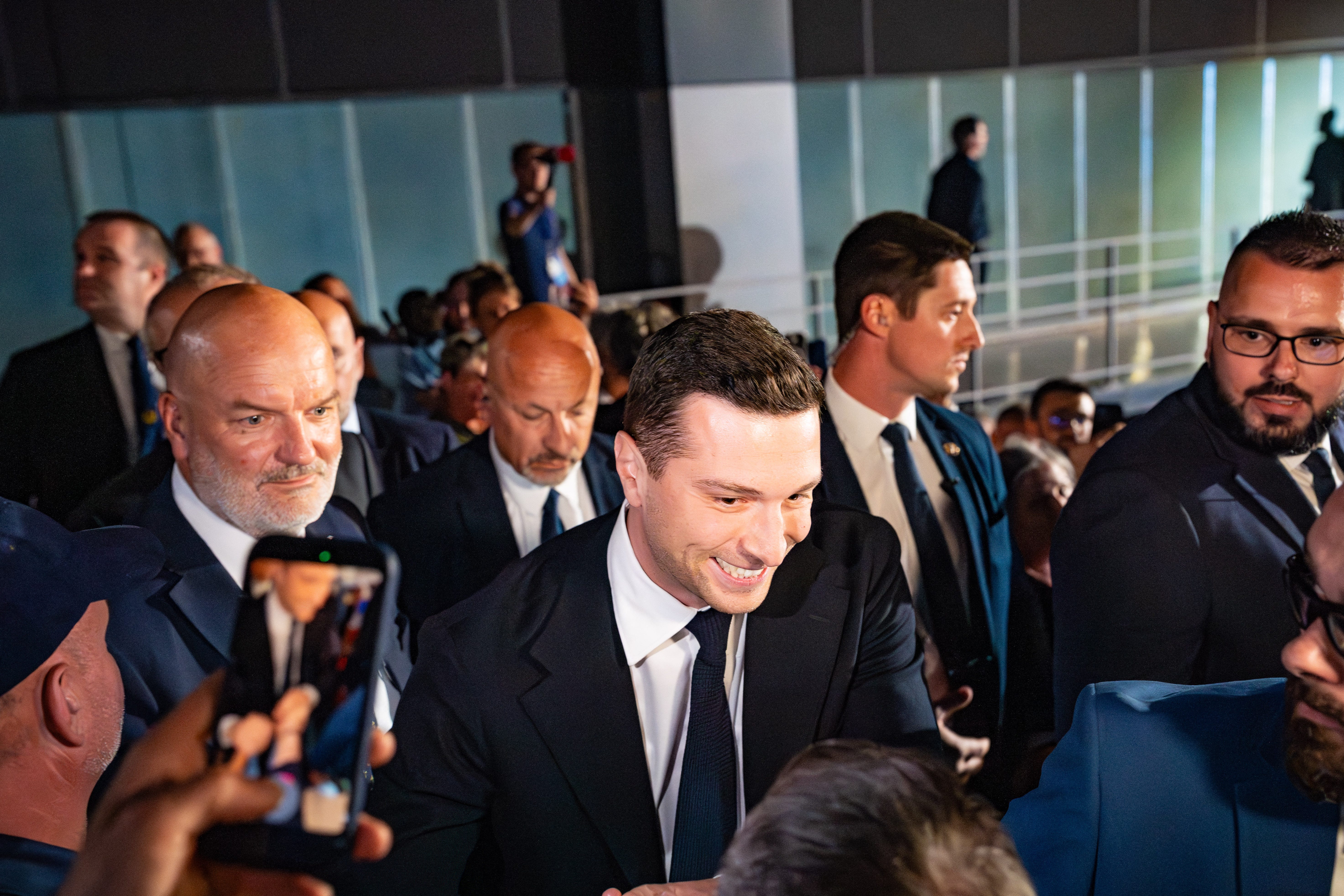
Jordan Bardella is often described as France’s answer to Donald Trump. Like the U.S. president, the leader of the hard-right National Rally (RN) has ridden a wave of anti-immigration sentiment, anger at globalized elites, and mistrust of multilateral institutions. He’s France’s most popular politician and looks the favorite to win the presidency next year. And he’s only 30 years old.
Born in 1995, Bardella was raised by a single mother in Saint-Denis, a bleak northern suburb of Paris. He is almost entirely of Italian stock, with an Algerian great-grandfather on his father’s side. He is also, like his party, firmly anti-immigration. But to those who cite his ancestry against him, Bardella has a pointed answer: his European forebears fully assimilated; when the cultural distance is greater, the journey is harder.
He became politically active at age 16, drawn to far-right leader Marine Le Pen, whom he felt spoke to people like him living in France’s gang-ridden banlieues and other areas the establishment had forgotten. Le Pen was then engaged in turning the rabble-rousing National Front—founded by her father, Jean-Marie Le Pen—into a true governing force by expelling its openly racist and antisemitic elements, and eventually Jean-Marie himself.
After dropping out of Paris-Sorbonne University to focus on politics, Bardella rose rapidly through the ranks and caught Marine’s eye. A smooth talker, he became party spokesman. His big break came in 2019, when she picked the 23-year-old to lead the National Front—now rebranded the National Rally—into the European Parliament election. The gamble paid off: Bardella’s list narrowly beat the centrist bloc supporting President Emmanuel Macron. The RN was not just the main opposition: it was France’s largest party.
2022 was another pivotal year. After a second consecutive defeat to Macron in the presidential run-off, Le Pen decided to prepare more rigorously for the 2027 election by stepping back from day-to-day party business. She needed a loyalist to take over as RN president. No prizes for guessing who got the job. The division of labor suited both: he had the title and the platform, while she retained her position as head of the parliamentary group and overall strategic leader.
A series of twists over the past two years have turned Bardella into clear presidential material. In European elections in 2024, Bardella’s list achieved double the vote of Macron’s centrists. A humiliated Macron immediately called a snap general election and paid dearly for it. The RN and its allies made historic gains, placing it in a position to help topple governments in a hung parliament—which it has since done, twice.
Then came the legal shock. In March 2025, Marine Le Pen was convicted of embezzling EU funds, and judges declared her ineligible to run for president for five years. Although an appeal verdict is expected in July, the party has been preparing an alternative candidate. “Plan B for Bardella” became the inevitable shorthand.
Bardella rejects the phrase, insisting that “plan A has not yet run its course.” But his evident electoral appeal has already placed him on a presidential trajectory. In 2024, his autobiography became the political best-seller of the year. Book signings in towns up and down France drew long lines, confirming his star status. By the end of the year, his approval ratings had overtaken Le Pen’s.
Bardella’s politics can best be described as populism with French characteristics. In this sense, the comparison with Trump is appealing but misleading. They took opposite routes to the top: while Trump radicalized a mainstream party, Bardella helped moderate a once-pariah movement. Last year he withdrew from an American conservative event after Steve Bannon appeared to make a Nazi salute. Since then, Bardella has been at pains to condemn Trump’s trade offensive against Europe (“blackmail”) and Middle East policy (“totally erratic”).
This speaks to Bardella’s main asset—his ability to expand the RN’s reach into territory where it has historically been weak, starting with younger voters from working-class backgrounds with little prior engagement with politics. His social media presence—2.3 million followers on TikTok—reinforces the image of a man who grew up in the same suburban France as his audience. In behind-the-scenes footage, he is shown relaxed, sipping pastis, nervously preparing for a rally, or compulsively snacking on candy. It may be manufactured authenticity, but it hits home. As one young voter told Le Monde: “The others are a different world, they don’t speak the same language.”
More broadly, a recent IFOP survey suggests that among lower-income voters, Le Pen and Bardella perform equally well. But in richer categories, where the RN has struggled, he pulls markedly ahead of her. IFOP also asked respondents whether they would like various politicians to run in the next presidential election—a different question from voting intention, but still a measure of how they feel toward various figures. Among centrist and center-right voters, approval for a Bardella candidacy significantly outstrips that for Le Pen.
The lesson is clear: where Marine Le Pen consolidated the RN’s electorate, Bardella is expanding it upward—toward wealthier voters and what remains of the mainstream right. That, in essence, is the Bardella effect.
Another key part of Bardellism has been wooing corporate France, which has long shunned the RN. The party’s 2024 program included lower taxes for companies and a bonfire of regulations. But the finances were far from sufficiently broken down, and the plan piled on new spending by scrapping a planned pension reform.
Against this backdrop, Bardella worked hard to arrange meetings with France’s main employers’ federation. The bosses, on their side, were eager to inject some fiscal reality into a program that, as it stands, would alarm the bond markets. After a private lunch, a besuited Bardella struck a reassuring note: “I believe in freedom of enterprise; we need to give back freedom to those who create and innovate.”
This charm offensive towards big business sits uneasily with Marine Le Pen’s more traditionalist line. Catering to RN voters who peeled away from the left, notably in France’s northern rust belt, she is not afraid of striking redistributive poses. Her party’s program still contains a “tax on financial fortune.” More recently, her deputies in France’s assembly backed a levy on “unproductive” assets—an attempt to revive an old wealth tax—and an equally controversial tax on multinationals’ profits in France. Neither was retained in the final budget, but both confirmed where Le Pen’s instincts lie when it comes to big business.

The tension with Bardellism extends to the taxation of oil company windfall profits during supply shocks such as the current conflict in the Gulf, a measure also championed by the left. Le Pen embraces it as “a matter of social justice.” Bardella, characteristically, cultivates strategic ambiguity: when pressed on the question, he simply said, “Why not?” The two-word answer sums up the studied vagueness he has developed into an art form.
None of this is easy to read. Are the two playing a double act to maximize their electoral reach? Both Bardella and Le Pen insist there is no daylight between them. But even if genuine divergence exists, the question remains: does Bardella have the weight, or the will, to reshape a party the Le Pen family has spent half a century building?
Whatever happens, the RN’s core principles remain. And they still put the party on a collision course not only with France’s need for fiscal stability, but with European realities. The RN’s flagship policy of “préférence nationale”—reserving jobs, housing and welfare for French nationals—runs against the EU’s foundational principle of equal treatment for all citizens of member states. Its suspicion of free trade and Bardella’s talk of “intelligent protectionism” jar with France’s deep integration into global supply chains. And the RN’s vision of a “Europe of nations” rests on the illusion that French companies can enjoy the benefits of the European single market while Paris picks and chooses which rules to follow.
Bardella is no Trump. But neither is he Italy’s Giorgia Meloni, who set out to make a pragmatic peace with EU rules and multilateral institutions. Populism with French characteristics represents something new and untested: a burst of utopian nationalism in the place that invented the European project. In a country traditionally run by high-flying graduates, a university drop-out with no government experience in the Elysée would be just as disruptive as a Trump White House has been in the United States.
It is sure to send shock waves well beyond France’s borders.
Henri Astier is a London-based journalist who writes for French- and English-language publications. He writes the Substack Out of France.
Follow Persuasion on X, Instagram, LinkedIn, and YouTube to keep up with our latest articles, podcasts, and events, as well as updates from excellent writers across our network.
And, to receive pieces like this in your inbox and support our work, subscribe below:
 | A guest post by
|
Good article. I appreciate the objective and factual tone. I lived in France for 20 years and still have family and a house in a rural area. The small city near to where I live has profoundly changed over the past 25 years. It has become sadder, poorer, and with more social dysfunction including drugs. But whereas the population was about 95% French ( white) 25 years ago, today the actual city must be something like 25% immigrants.
There is high employment in our area, around 10% at least. Many of the elderly French are living on tiny government pensions, 1000 euros a month or so- after working for 40 years. Yet people see immigrants from Africa and elsewhere welcomed, given money for rent, free French lessons, help to get drivers license, and free healthcare. I met a 75 year old African lady ( very sweet) who had recently arrived. But I couldn't help thinking that this woman will never work, and will have free healthcare and housing for the rest of her life.
The public schools are not great in rural France, the universities are dingy, the government is always saying that the healthcare system is broke. So people wonder( reasonably), Why are they accepting so many immigrants who cost the system money? If you want to know why Le Pen is popular, this is why.
As an American, I appreciate these dispatches on populism from around the world. It helps put some context into the trend beyond just Trump (and increasingly, versions here from the left as well).