

Trump’s Health Is… Complicated
He isn’t as decrepit as Democrats pretend. But Republicans are slowly imagining a post-Trump world.

It’s a big week for Persuasion in DC! On Wednesday July 15, Yascha Mounk sits down with Francis Fukuyama to discuss how liberalism should respond to postliberal critiques. Find out more and get tickets here!
And on Friday July 17, we’re hosting drinks in the aftermath of the Liberalism for the 21st Century conference! This is your ideal chance to socialize with the Persuasion team and other readers. Note that you do not need to have attended the conference to come to this event. Join us from 9:30pm at Hive Rooftop, Hotel Hive. Just make sure to RSVP here!
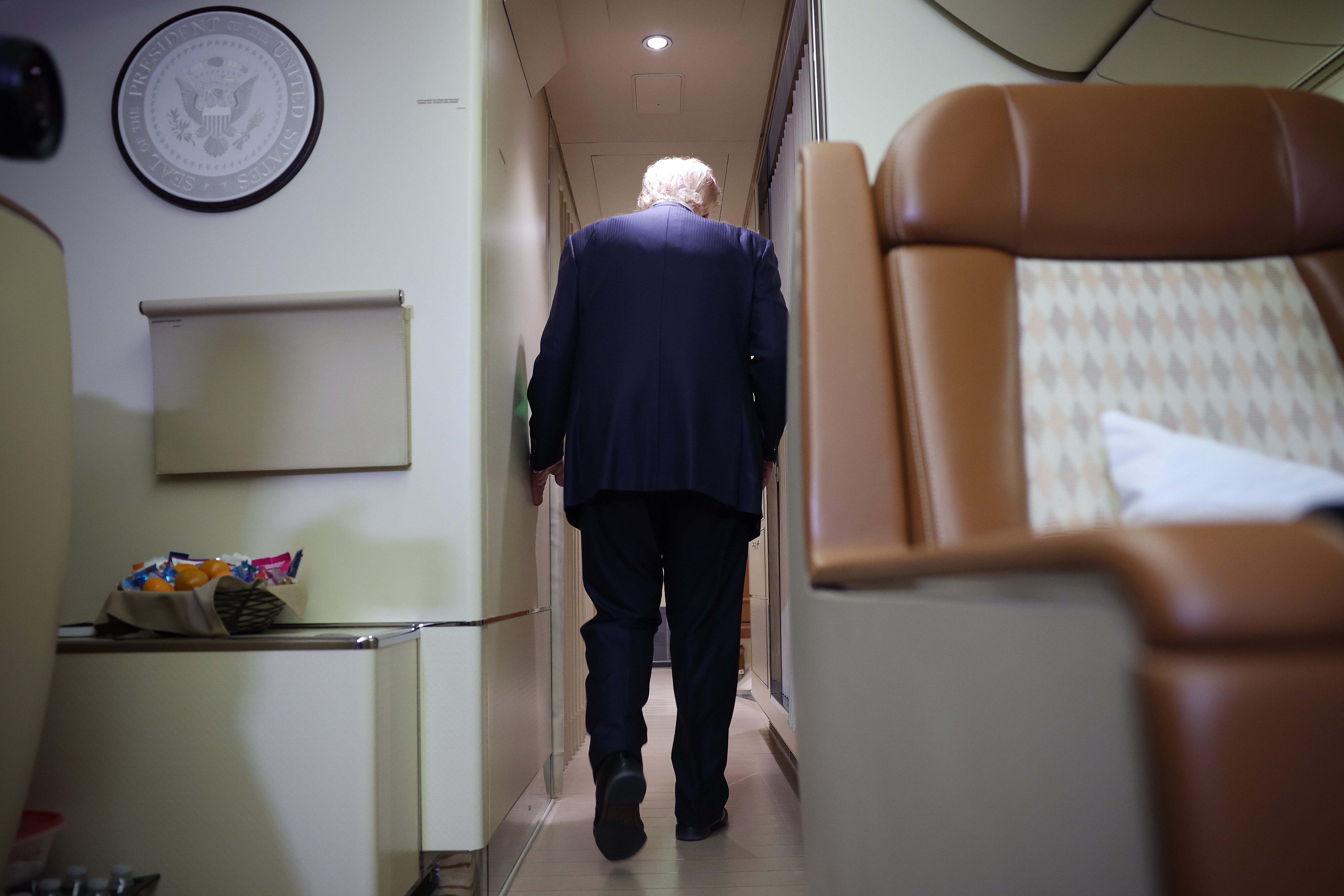
The President of the United States falls asleep in cabinet meetings and basketball games. He mixes up Greenland with Iceland and Iran with Japan. He sometimes slurs his words and gets lost wandering across a stage during a state event.
If our last president succumbed to age while in office, there’s some reason to believe that Donald Trump may not be fully with it all the way through his term.
But don’t count on it.
I watched several hours of Trump speaking at different points in his political career, focusing in particular on his gaffes. What I found is that he is older and slower, that his voice lacks the command it once had, that he does tend to ramble more than he did, but also that he is still basically himself. If, for long swathes of his term, Joe Biden made no public appearances at all, spoke only when reading from a teleprompter, and kept his appearances to short and scripted exchanges, Trump continues to interact with the press and to speak off the cuff. There’s some slender evidence that he might have suffered a neurological episode, but in his most recent speeches he is voluble and pugnacious and speaks without evident difficulty.
That’s not to deny that Trump’s age—he just turned 80—may well be a significant factor in the remainder of his second term and that a succession battle could soon emerge in the Republican Party. But Democrats who have a persistent fantasy of an imminent decline in Trump’s ability to lead are, based on the videos I watched, likely to be disappointed.
In 2015 and 2016, when first running for the presidency, Trump, more than anything else, hinged his candidacy on vitality—he was in his 70s but made over 300 rally appearances. He shouts and bellows in his 2015 speech announcing his run. The impression he gives is of barely being able to contain his energy and rage. In his 2016 and 2020 debates with Hillary Clinton and Joe Biden, respectively, he is a snarling presence on stage, quick to interrupt both his rival candidates and the debate moderators—interrupting Clinton 106 times across three debates, according to a PBS breakdown, and interrupting Biden somewhere between 70 and 120 times during their first debate. To critics, he came across as a bully—CNN commentator Dana Bash called the Biden debate a “shitshow” immediately after it ended. But Trump’s demeanor in the debates was clearly calculated—as commentators acknowledged, he appeared “pugilistic” in contrast to the far more sedate Clinton and Biden.

In his period out of power, Trump was spotted sleeping in the courtroom during the Stormy Daniels trial. And in the 2024 presidential race, mental lapses and speaking slips became almost routine for him. He confused Nikki Haley for Nancy Pelosi, claimed he was running against Barack Obama, and his speech was characterized by more tangents and repetition than before. In a discussion during the election, Fred Trump, Donald’s nephew, described a family history of dementia and speculated that Donald might have signs of the same dementia that afflicted his father, Fred Sr. “He just can’t stick to a message. And he used to be able to stick to a message,” Fred Trump III said. The conservative pundit Megyn Kelly noted, “He goes on too long at his rallies … to where you get kind of bored, you lose the thread, you lose interest, which is not something you’re used to with Trump.” And Joe Rogan, in their famous podcast interview, complained to Trump at one point during the conversation that “your weave is getting wide.”
The age question was a liability for Trump all through the election, and particularly when Kamala Harris replaced Biden on the Democratic ticket—an ABC News poll in July 2024 found that a full 60% of voters believed Trump was “too old for a second term.” The New York Times noted that Trump held only 61 rallies before November 2024, about five times fewer than in 2016. Watching Trump during the 2024 election it’s clear that he had slowed down but was still sharp. His voice was softer than in 2015/16. The tangents, as Kelly noted, often made him dull to listen to. But he engaged with interlocutors in a way that Biden seemed to struggle with and was able to stay focused for long interviews and events. Certainly, the contrast between the two candidates was on vivid display in the June 2024 debate.
The most intriguing analysis of Trump’s health is that he suffered a serious decline somewhere towards the summer of 2025. In August, the release of an older photo of himself playing golf, initially passed off as being more recent, raised widespread speculation—alongside his largely empty public schedule—that something had gone seriously wrong with the president’s health. The Hill, a bellwether of Washington political opinion, ran a piece headlined “Trump’s mental decline is unavoidable—so what now?”
And several of Trump’s public appearances into the winter of 2025/26 raised questions about his fitness. The video of his state visit to Japan in October, when he several times had to be guided by Japanese prime minister Sanae Takaichi, was reminiscent of moments when Biden wandered aimlessly across a stage and the clip was widely interpreted as Trump losing it in public. I find the video inconclusive. Trump does seem lost, but the sequence of bowing and saluting is actually pretty complicated and Trump’s errors may be more attributable to his not knowing his blocking and being bored out of his mind during a state ceremony than to cognitive decline.
Meanwhile, videos of him apparently sleeping during cabinet meetings are more conclusive. It definitely looks like he’s sleeping—no matter that Secretary of State Marco Rubio found himself swearing under oath to Congress that “I’ve never seen him fall asleep, on the contrary the guy doesn’t sleep.”
Trump’s speeches at the coal event in February and at Davos in March raise more difficult questions about his neurological state. He slurs his words, lisping the word “undisputed” in the coal speech and then muttering unintelligibly for a few seconds before regaining composure. His voice lacks its usual timbre. He seems low-energy and ill-at-ease and sometimes has trouble returning from tangents, to the extent that the rumor of a neurological episode of some kind doesn’t seem far-fetched. At Davos, he also four times confuses “Iceland” with “Greeland.”
By contrast, at NATO in July, he seems to be more in control of himself. There are still moments of verbal tics like when he cuts himself off in the middle of the word “jobs.” And in a panel discussion with Volodymyr Zelenskyy he swaps the name of “Iran” with “Japan.” In general, his voice doesn’t fill up a room in the way it used to. But the slurring of his words as at Davos is largely absent. The Iran/Japan gaffe occurred during a 40-minute unscripted discussion in which Trump seemed in control of his faculties. And he was animated in delivering his speech at the end of the summit.
What’s striking in all of these speeches—maybe Davos in particular—is the way that Trump is still highly incendiary, railing against environmentalism and the European Union and agitating for the United States to take Greenland (unless maybe it’s Iceland) without having any particular conviction in his voice. It’s possible to read that not just as routine but as age—with age, people tend to become the purest distillations of their personalities, and it wouldn’t be a surprise if the pure distillation of Trump turns out to be showmanship. The content of what he’s saying often, increasingly, seems to not matter to him—whether the missiles are being fired by Japan or Iran, whether it’s Iceland or Greenland that’s to be invaded, whether he’s seated next to Zelenskyy or Putin—but the “weave,” as he describes his speech, always widens out before holding together.
Even with his voice weaker and his presence diminished, there’s the same patter—the certainty of being at the center of attention, the litanies of enemies and grievances, the not-always-entirely plausible record of his own accomplishments, the firehose of falsehoods. An episode from last year in which Trump confabulated a wholly imaginary relationship between his uncle and Ted Kaczynski, as well as a conversation between Trump and his uncle, has been cited by several outlets as evidence of Trump losing his marbles, but that somehow seems more par for the course for him—there was something that he liked about the story, something in the glimpse of Kaczynski as a young know-it-all, and he was perfectly happy to swap in a mass of wholly unlikely details and to pass it off as a fact. A story like that, by itself, doesn’t suggest much of a deviation for a figure who was documented by The Washington Post as making 30,000 false or misleading claims across his first term, at a rate of 21 a day.

If Trump’s public appearances show him to be older and slower but basically still himself, the possibility of his decline is nonetheless significant. He is not pure virality, as he often seemed to be even during the 2024 campaign—the iconic photo of him following the Butler assassination attempt spoke, more than anything else, to his perceived indestructibility. If, early in his second term, his most fervent supporters were already thinking about 2028—Steve Bannon claiming that there was a “plan” for Trump to stay in power and arguing that “a guy like this comes around once in a century and we’ve got to get everything out of Trump we can get”—that kind of fanaticism seems largely to have left even the MAGA movement. Simon Tisdall argued, in late 2025, that “we’re seeing the first signs of the battle over Trump’s succession,” with JD Vance and Marco Rubio, the two most likely heirs, carving out their separate lanes, Vance something closer to Christian nationalism and Rubio to a more neocon foreign policy.
The sense that Trump is diminished is starting to run through the conservative world. Even thinking about a succession is a far cry from what the Republican Party looked like in the lead-up to 2024 when no serious threat to Trump emerged. The impression of the administration is that it has fiefdoms within it, with Rubio, for instance, having an extensive foreign policy brief and Stephen Miller pushing an aggressive domestic agenda without obvious signs of direct control by Trump.
Democrats are fantasizing about an imminent collapse by Trump. If you watch his speeches and public appearances, that doesn’t seem likely. But, at the same time, he is not the force of nature that he was. And, as he celebrates his 80th birthday, it becomes possible—for the first time in a decade, really—to conceive of a world after Trump.
Sam Kahn is staff editor at Persuasion, writes the Substack Castalia, and edits The Republic of Letters.
Follow Persuasion on X, Instagram, LinkedIn, and YouTube to keep up with our latest articles, podcasts, and events, as well as updates from excellent writers across our network.
And, to receive pieces like this in your inbox and support our work, subscribe below:
Weak. Very weak. Trump is a man that works constantly. Gets little sleep. He is accessible, open, direct, authentic... you have hours and hours of records of him speaking and you cherry pick moments when he is tired. Contrast to that with basement-dwelling sleepy Joe Biden kept out of the public eye... very limited press access... very few press meetings and speeches. Copious videos of Biden walking off stage the wrong way... confused... not knowing where he is and where he should go. Obama comes to town and the entire Democrat power establishment ignores old Joe who is pathetically walking around attempting to get attention.
These attempts to brand Trump cognitive health as being anything close to what we experienced with Biden is a YUGE swing and miss.