

Why Trump Seems Confused By His Own War
The president is attempting cold hard realism. He’s quickly discovering the limits to that approach.

Will you be in Washington, D.C. on Friday, July 17? Join the Persuasion team and friends for drinks from 9:30pm at Hive Rooftop. If you’re planning to join us, please RSVP here. Hope to see you there!
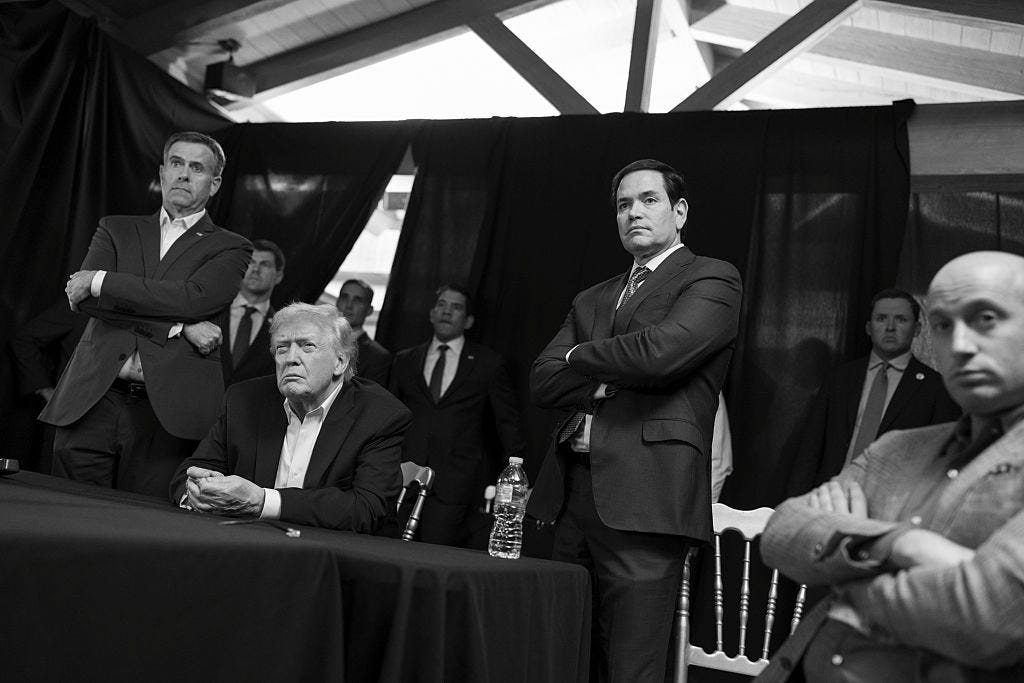
With all the bravado that tends to accompany Donald Trump, something else has been striking me recently—when faced with major decisions, there’s a way in which he carries himself like a wise fool in a Shakespeare play, bemused by all the tumult that’s going on around him. In a revealing moment, on March 17, when asked to explain why the United States was at war with Iran, Trump said, “You could say we did it out of habit”—as if the war was just a bit of noise going on in the background and had nothing really to do with him.
Just this morning, after the fragile ceasefire appeared to shatter with a fresh exchange of fire from Iran, followed by retaliation from Israel, Trump took to social media to limply declare: “Israel and Iran must immediately stop ‘shooting.’ President DONALD J. TRUMP.”
Even more pivotally, in the decisive meeting between Netanyahu and Trump in the White House on February 11, Netanyahu delivered his “hard sell” on the need for engagement, according to reporting by The New York Times, arguing that there was a window for regime change. Trump’s reply, according to the reporting, was notably cheerful and notably passive. “Sounds good to me,” he apparently told Netanyahu.

So what is this storm that sweeps Trump along, this force that he can only bemusedly watch? I would argue that it’s political realism—the doctrine that’s taken over the second Trump administration, maybe not entirely with Trump willing it, but which marks a fundamentally different era in international relations.
That tone surfaced also in the exchange between Stephen Miller, one of Trump’s leading advisors, and Jake Tapper on CNN on January 6 when Miller, discussing the state of play in Venezuela, swerved into a bit of unsolicited political theory. “But we live in a world, in the real world, Jake, that is governed by strength, that is governed by force, that is governed by power. These are the iron laws of the world since the beginning of time.”
That remark deservedly attracted a great deal of attention—in large part because no one expects a politician to say anything so interesting on cable television and also because it seemed like the declaration of a new Thucydidean direction for American foreign policy. But I think what got me most was Miller’s shrugging tone—this is just the way it is, Jake, and you can pretend differently all you want.
Political realism is a perfectly respectable discipline of political theory. As media commentators discovered when, in the wake of Miller’s comments, they had to hurriedly dust off their Plato, it traces itself back to Thrasymachus’ comment in The Republic that “justice is nothing other than the advantage of the stronger,” and to the corollary, articulated by an Athenian general in Thucydides’ Peloponnesian War, that “the strong do what they can and the weak suffer what they must.” Realism, which per Miller may in fact stretch back to the beginning of time, wends its way through Machiavelli and Hobbes, and has its fullest modern exposition in Hans Morgenthau, a pioneer of international relations.
Writing in the immediate aftermath of World War II, Morgenthau was faced with the question of why citizens within a state tend to refrain from using violence to get what they want while international politics so often appears to follow the law of the jungle. The idealists of the time were preoccupied with constructing international entities to prevent the horrors of World War II from recurring. Morgenthau, fully conscious of the failures of the liberal democracies to head Hitler off in time in the 1930s, argued that the international entities had no chance of succeeding, that in the absence of a world army a world state could not survive, and that, as Campbell Craig, an interpreter of Morgenthau, put it, “a weak global entity would be worse, much worse, than nothing at all.”
The premise of liberal cooperation would tend, just as had occurred with the League of Nations and the various inter-war treaties, for the rational actors to let their guard down and the irrational, malevolent actors to steal a march on them. This was what Morgenthau called “the tragedy of scientific man.” As Craig paraphrased Morgenthau, “A modern nation can do two things: seize power or eschew that power in favor of a rationalistic plan to change the world. Choosing the latter always means defeat, no matter the intentions, political system, or moral stature of the nation in question.”
With Morgenthau what you get is an upside-down world where conventional morality is weakness and where the only viable, one could even say moral, action is to maximize one’s own power position. “Moral behavior is to engage in power politics, of apparently any sort,” writes Craig.
What’s difficult with Morgenthau is that you sense, reading him, that he’s basically right—a tougher power politics was certainly called for in the ‘30s to contend with Hitler; and the more idealistic political approaches of the mid-‘40s seemed to prove inadequate to contending with the Soviet Union. Morgenthau-esque “containment,” on the other hand, did generate a balance of powers that provided a measure of security in an extraordinarily difficult international situation.
If the last 80 years have also had their share of liberal internationalist politics, the suspicion is that those are always a fig leaf—a means for great powers to cloak their actions in legitimacy, just as Morgenthau analyzed it, while, when push comes to shove, always acting in ways that benefit their own self-interest. Until quite recently, even fairly direct imperialist acts, like the U.S. invasion of Iraq in 2003, tended to be lathered in multilateralism. What’s striking with an exchange like that between Miller and Tapper is the forgoing of any sort of liberal justifications, of Miller, on national television, removing the fig leaf and… well… sorry for the image.
In policy documents the Trump administration has more or less explicitly confirmed that realism is now the law of the land. In its 2026 National Defense Strategy, released days after the intervention in Venezuela, the Department of War was slightly less than clear-cut in declaring that “President Trump’s foreign policy is pragmatic without being ‘pragmatist,’ realistic without being ‘realist,’” etc, but the NDS was also evidently a realist document. “Out with utopian idealism; in with hard-nosed realism,” it stated. It reiterated the “flexible realism” of the 2025 National Security Strategy claiming that the turn to naked self-interest will “entail a sharp shift in approach, focus, and tone.”
A favorable—one could say fawning—article in The National Interest by Ludovic Hood lauds Miller in particular for “channeling Hans Morgenthau.” Hood writes, “Miller’s approach is a return to this historical truth … The lightning strike in Caracas to apprehend Maduro was not a crusade for global ‘democracy promotion,’ rather a cold, Westphalian calculation of national interest within our own hemisphere.”
Not so surprisingly, The New York Times wasn’t so quick to wrap the mantle of Hans Morgenthau around Trump or the un-fig-leafed Miller. “Scholars generally view realism as a theory for describing the world as it is; Trump and his team are using the term in an effort to redraw the world map,” wrote Linda Kinstler for The Times. She cited political science professor Patrick Porter, who differentiated true realism from Machtpolitik, its “corrupt cousin,” which is defined by a “sort of violent exhilaration of destruction, nihilism and vengeance.”
But let’s not be so quick—just because it’s Trump—to assume that there can’t be some intellectual bedrock to his foreign policy. In Morgenthau’s conception, there’s no particular distinction between “describing the world as it is” and “redraw[ing] the world map.” Actually, at least in Morgenthau’s early work, there is almost a moral obligation to be proactive, without even stopping to think about whether one is more “morally right” than one’s adversaries.
What does the imposition of realism in international politics actually look like?
The past four years have given us a glimpse. Almost certainly, the decisive turn in the realist direction in international affairs occurred on February 24, 2022, when 150,000 Russian troops surged into Ukraine. If Putin tended in his justifications for the invasion to emphasize the “historical unity” of Russia and Ukraine, the International Relations scholar John Mearsheimer offered a more directly realist view, that “this is great-power politics,” as Mearsheimer put it in an interview with The New Yorker, and that by trying to “peel Ukraine away from Russia,” the United States and NATO had violated the implicit contracts of great-power politics and invited Putin’s response.
Putin’s expansionism was soon followed by a turn in Israel’s foreign policy. As far back as 1996, in the “Clean Break” memo prepared for him when he was prime minister, Benjamin Netanyahu evinced an interest in a more directly realist approach. Foreign policy directives advised a “clean break from the slogan, ‘comprehensive peace’ to a traditional concept of strategy based on balance of power.” Throughout his longer period as prime minister from 2009 to 2021, Netanyahu emphasized “peace through strength” as the way to handle foreign relations in the Middle East.

But in the aftermath of the October 7 attacks, Netanyahu took a turn. Since then, in addition to the Gaza War, Netanyahu has initiated a ground invasion of Lebanon, strikes against the Houthis in Yemen, and the joint Israeli-American attacks against Iran. “When we become a regional power, and in certain fields even a global power, we have the ability to push dangers away from us and secure our future,” Netanyahu said in March.
It’s a little hard, at this point, to remember what a deviation this kind of “hardnosed realism” is from the political era that preceded it. As recently as 2020, a “concert of nations” seemed to prevail in the response to the pandemic. By 2022, Putin had decisively pulled himself out of any such international confederation with the full-scale invasion of Ukraine, in the process getting Russia sanctioned by 49 countries and excluded from the SWIFT banking system. Netanyahu’s post-2023 program clearly attempted to redraw the balance of power across the Middle East by striking at enemies from Iran to Yemen to Lebanon to Gaza, although at the cost of the ICC issuing an arrest warrant for Netanyahu over alleged war crimes in Gaza, of 12 states issuing sanctions against Israel, and of several G7 nations for the first time recognizing Palestinian statehood.
Hood’s article in The National Interest is paradigmatic of how the realist doctrine has taken root in the United States as well. Hood argues, “While many … proponents of a rules-based international order spent the last two decades heralding the end of history, Russia and China were busy proving that the Nietzschean ‘will to power’ remains the primary engine of global politics.” Hood, doing his own channeling of Morgenthau, claims that “if Morgenthau were alive today, he would recognize Vladimir Putin’s Russia not as an anomaly, but as an exemplar of the realist state.” In other words, he is saying, Russia and China have shrewdly led the exodus from the rules-based liberal international order. It’s high time for the United States to do the same.
And Hood and his ilk are of course more than pleased that the United States has now started to dance the Death Star dos-à-dos, engaging in regime change in Venezuela in January, attempting the same in Iran in February, and then deploying military resources around Cuba with enough saber-rattling to indicate that an attack might be imminent. That seems to be the “flexible realism” that the NSS and NDS are talking about—going after America’s enemies and leaving it to the likes of Jake Tapper to worry about what Miller calls “the niceties of international law.”
It’s worth asking, of course, what unbridled realism actually gets you. Russia has been bogged down for four years in a war of choice. As many as 500,000 Russians have died. Ukraine, which has proved itself capable of launching drones at Moscow, has become a stronger and more implacable foe of Russia certainly than it was prior to 2022. Putin actually had nothing to worry about domestically at the time of the invasion, and it’s far from clear what he’s gained in his turn as “an exemplar of the realist state.”
Israel, meanwhile, has lost allies around the world, and has to rely for its arms and external support on the most mercurial president in American history. Within weeks of the attack on Iran, Israel found itself demoted from “co-pilot” to “mere passenger” in the operation and thoroughly cut out of the truce talks, according to The New York Times. And the United States, currently facing the vicissitudes of war in the struggle with Iran—with the strikes of the past twenty-four hours proving that Trump has much less control over events than he thought—may be discovering that they have badly misunderstood Morgenthau.
Morgenthau wasn’t actually arguing for a Lord of the Flies approach to international politics. He made the case for an “international morality,” which is different from everyday morality but calls for a balance of power between nations. There is a distinction to be made between “satisfied” and “less-satisfied” nations, with the satisfied nations having a moral burden, according to the peculiar logic of “international morality,” to, out of their own strategic interest, curb the ambitions of the “less-satisfied” nations and to adopt a predominantly status quo policy.
In the passivity of Trump towards the launching of his own war, and in the gleeful amorality of Stephen Miller—doing his best impression of a teenager who has just read Thus Spoke Zarathustra for the very first time—there is the sense of a wave, of a doctrine of “realism” passing like a baton from Putin to Netanyahu to Trump. The shrug is that that’s just the way it is.
But Miller and Trump and Hood aren’t reading their Morgenthau all that deeply. Realism isn’t just the strong pummeling the weak. Realism is about being very clear-eyed about one’s strategic position, and that takes place over multiple dimensions, in diplomacy and in the struggle to justify oneself ideologically—a step that the contemporary proponents of so-called realism are almost entirely forgoing.
So, yes, Morgenthau’s critique of idealistic views of international relations is compelling—international entities, certainly at present, don’t have anything like the power to contend with the realpolitik of nation states. And it is possible, in one’s darker moods, to argue that liberal internationalism is just a fig leaf for brute power relations.
But that’s only half of what Morgenthau is saying and half of what liberal internationalism can offer—which is alliances, shared purposes, legitimacy, a balance of power, and (in the current status quo) American hegemony. So, yes Stephen, it’s a fig leaf, but it’s an important fig leaf. Honestly, you look better with it on.
Sam Kahn is associate editor at Persuasion, writes the Substack Castalia, and edits The Republic of Letters.
Follow Persuasion on X, Instagram, LinkedIn, and YouTube to keep up with our latest articles, podcasts, and events, as well as updates from excellent writers across our network.
And, to receive pieces like this in your inbox and support our work, subscribe below:
I struggle to see Putin's invasion of Ukraine as a realist initiative. If anything, it was fueled by a romantic notion of Russkiy Mir and (in hindsight) ludicrously over-optimistic assessments of the ability of Russian military forces to trigger regime change.
Quite apart from the charnel house of the ossifying front line, the huge cost of sanctions and the unhealthy Russian dependence on China, it has led to Sweden and Finland joining NATO and an unprecedented buildup in European defense spending. Hardly a strategic win. The idea that the West somehow pushed Vladimir over the edge seems like the weirdest form of gaslighting.
Realism at its best doesn't preclude the development of win-win alliances or interdependence through economic collaboration. It doesn't ignore the importance of public opinion or idealism in determining the policies of democratic societies. It simply recognizes that nations have interests and actions have consequences. When we don't have a diplomat like George Kennan to lay out a strategy with sufficient clarity, we can become increasingly unrealistic in our military adventures.
It's not just foreign policy, Trump also sees domestic politics as an amoral struggle for power. Though his current approval ratings don't exactly suggest "being very clear-eyed about one's strategic position."