

Wealth Taxes Are Slopulism
A viral proposal makes no economic sense.

When the decline and fall of the American empire is chronicled by future historians, the role played by a small cabal of radicalized multi-billionaires, taking control of the media to spew disinformation, unlawfully interfering in government operations, raving about the anti-Christ, and buying pardons from a corrupt president to avoid punishment for their criminality, will figure centrally in the account. Even among those who don’t begrudge these men their wealth, many would still be relieved if they could behave themselves somewhat better.
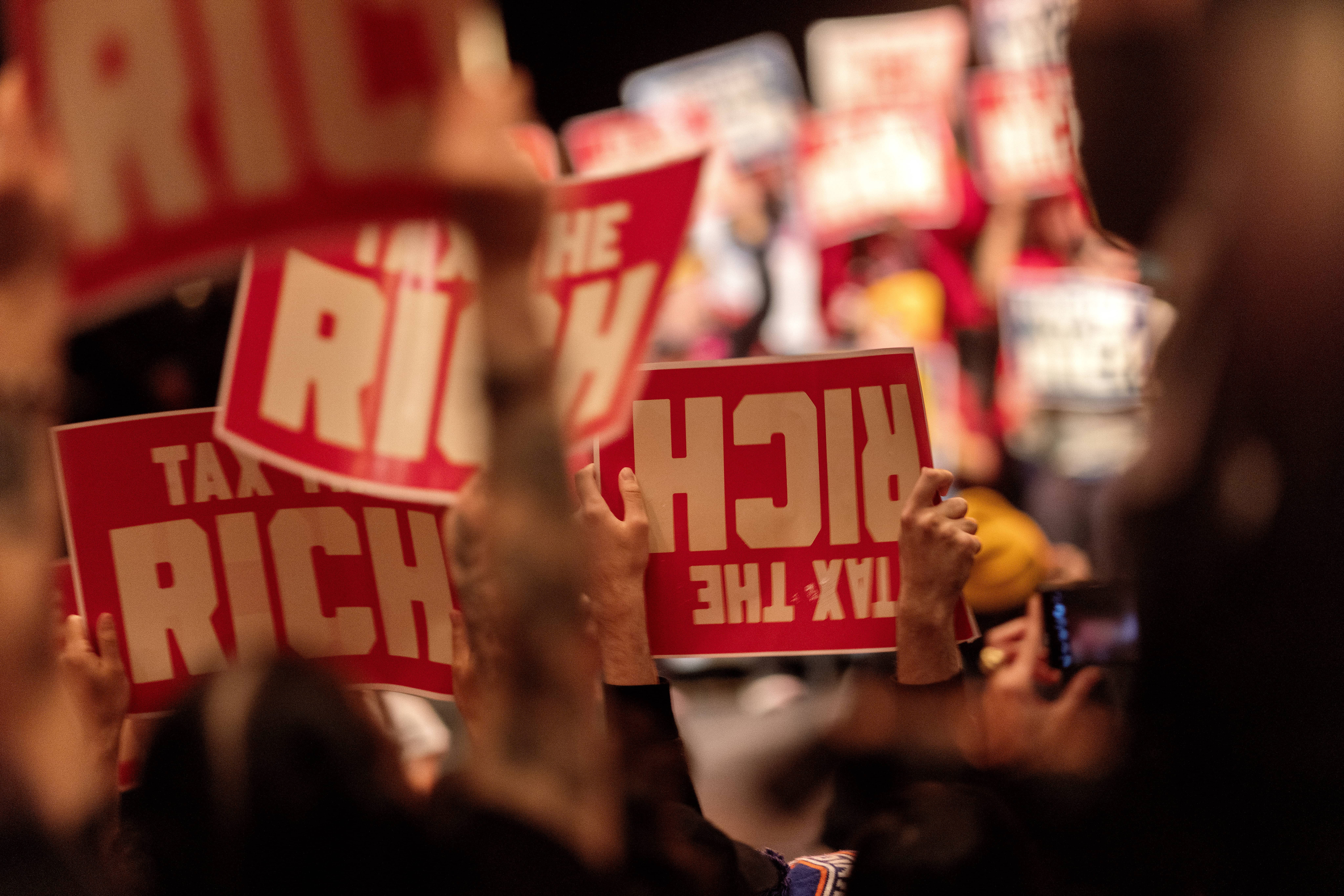
Luckily, there are at least a half-dozen sensible reforms that could be undertaken in the United States that would significantly reduce the severity of the problem. Unfortunately, these sensible reforms require at least five minutes to explain, as a result of which they have no chance of being adopted in the current political environment. Progressives have therefore begun to rally around a much simpler plan: wealth taxes. On the merits this is a terrible idea, but it has the advantage of being extremely easy to explain: billionaires are bad, so let’s take away their money!
Wealth taxes are in fact a perfect example of slopulism—policy ideas that make for quick, effective sound-bites, but that are almost universally rejected by experts. The reason that tax experts disdain wealth taxes is, unfortunately, a bit difficult to explain. The main problem is not that billionaires will pick up stakes and leave. The problem is that wealth taxes are redundant. There is nothing that can be accomplished by taxing wealth that cannot also be accomplished by taxing capital income. And yet we already have a tax on capital income. So instead of creating a new, administratively complex tax on wealth, involving completely new reporting requirements, we should just modify the existing income tax system to accomplish whatever objectives we might like to achieve with a wealth tax. Specifically, calibrated changes to the treatment of capital income and/or inheritance taxes in the United States would be sufficient to address many of the problems that have been highlighted by proponents of wealth taxes.
One of the reasons that public opinion on the subject is so poorly informed is that most people don’t understand what wealth is, or what it would mean to tax it. Part of the reason it’s confusing is that we are accustomed to thinking about taxation in terms of the income tax, and income is a flow, whereas wealth is a stock. In order to illustrate the distinction, economists typically use the analogy of a bathtub being filled, where the water coming out of the faucet constitutes the flow into the tub (and must be measured in terms of its rate, quantity over time), whereas the water that has accumulated in the tub constitutes the stock (which can be measured as a simple quantity).
The bathtub analogy makes it easy to see how wealth is already subject to taxation in our society. It appears otherwise only because we tax the flow of capital, not the stock. When you earn income, you must pay taxes on it, regardless of whether you spend it or not. This means that all savings are taxed (i.e. the water is taxed as it flows into the bathtub). What proponents of wealth taxes are saying is that, in addition to taxing the flow of water into the bathtub, we should perform an additional calculation, every year, of the water level in the bathtub, so that we can impose a tax on that. The big question is, why? What additional objective could be achieved by taxing the stock directly that could not be achieved indirectly by taxing the flow into the tub?
There is, I will grant, an important disanalogy between wealth and water in a bathtub, which is that wealth grows over time, without any additional input of savings, unlike the water level in a tub, which cannot increase unless you specifically add more water to it. In some cases this is because an asset earns a return, in other cases because its market value increases. One might think that this factor provides an argument for taxing the stock of money, rather than just the flow. In reality, however, what it provides is just an argument for treating the increase as income and taxing it appropriately. This is why, under the existing system, all of the income derived from wealth (dividends, interest payments, and capital gains) must be declared as income, which generates a tax liability. Again, we tax the flow, not the stock—any increase in the water level is taxed as income.

This treatment of capital income provides one of the most long-standing points of contention about the income tax, which is that it has the effect of subjecting savings to double taxation. Progressives generally regard this as a feature of the system, not a bug, because it discourages large concentrations of wealth. Unfortunately, it also has the unwanted effect of penalizing ordinary people who choose to save—not to get rich but just to maintain their standard of living during retirement, to purchase a home, and so on. In order to avoid this problem, various modifications to the income tax system have been made that exempt ordinary savings from one of the two rounds of taxation. (In the United States, the selective exemption from one round of taxation can be seen most clearly in the difference between an ordinary IRA, which allows one to avoid paying the upfront tax on savings, but commits one to paying tax on the accumulated capital income, and a Roth IRA, which requires one to pay the upfront tax, but exempts one from tax on the capital income.)
Because of this, middle-class Americans who use their savings to accumulate home equity and build a nest egg for retirement are essentially exempt from one of the two rounds of taxation on savings. By contrast, Americans who are rich enough to pay off their house and max out their retirement accounts, leaving them with excess financial assets, wind up having their capital taxed twice, once when the income is earned and again on the flow of income that it generates. What proponents of a wealth tax are now suggesting is that these assets be subject to a third round of taxation.
One might be tempted to question the fairness of such an imposition. But it doesn’t even matter, because whatever the effects of this third round of taxation, they can easily be undone just by changing the rates of taxation on the previous rounds. It’s the same goose being plucked at each stage, so it doesn’t really matter how much gets taken in any particular round. The most important objection to wealth taxes is that they impose very complex reporting requirements involving often difficult-to-value assets (e.g. how should Jeff Bezos’s new yacht be treated? Or to pick a famous European example, what is control of IKEA worth?), while not accomplishing anything that is not already being done by the income tax. No one in their right mind has ever looked at the U.S. tax system and said, “What this thing needs is more administrative complexity.”

There is one further issue that should be mentioned. In recent years, many proponents of wealth taxes have pointed to limitations of the capital gains tax as an argument in favor of taxing the stock of wealth directly. My discussion so far has been based on the assumption that the only way to derive a benefit from wealth is to spend it, which triggers capital gains taxes on assets that have appreciated in value. But what if one could use one’s stock of wealth to produce a benefit without spending it (and thus without triggering capital gains taxes)? Would that not provide an argument for taxing the stock itself, and not just the flow? As it turns out, there is such a benefit. An accumulation of relatively-liquid assets can be used as collateral, in order to obtain credit, which can in turn be used to finance consumption. And because the income tax system completely ignores debt, in principle a rich person could use this as a way to avoid paying taxes.
This basic idea underlies the recent conviction, popularized by ProPublica, that American billionaires use the so-called “buy-borrow-die” strategy to avoid paying income taxes. The idea, roughly, is that unlike dividends and interest payments generated by an asset, capital gains taxes do not need to be paid on an annual basis, but only when the item is sold. As a result, it is possible for an asset to appreciate in value quite significantly without generating any immediate tax liability. Furthermore, since corporations know this, they often use stock buybacks, rather than dividend payments, to disburse profits, because this allows their investors to take the benefit as a capital gain (i.e. appreciation in the value of the stock), rather than ordinary income, so that they can defer payment of taxes.

Deferring tax, of course, is not the same as avoiding tax. One might think that the state, being patient, should be indifferent between being paid now and being paid later, so long as the effective sum is the same. Furthermore, the unrealized capital gains are not really of any use to the owner, because you can’t spend the money without selling the asset, which then triggers the tax obligation. This is where the second part of the strategy comes in. Instead of selling the asset, the owner can instead borrow against it, using the loan to finance current consumption without incurring any tax liability. (Of course, you have to pay interest on the loan, but the cost of doing that may be lower than the taxes you would have to pay for cashing in the asset.)
Again, one might think, who cares? Anyone with a home equity line of credit is basically doing the same thing. This is where the third part of the strategy comes in. When you die in America, the value of your financial assets gets “stepped up,” so that their base value in the hands of your heirs becomes the value on the date of your death. This means that they can sell them without paying any tax on the capital gains accumulated during your lifetime, which allows them to avoid the second round of taxation on the asset. The state is robbed of the money that it has been patiently awaiting.
Sophisticated proponents of wealth taxes usually defend the idea on the grounds that it plugs this loophole. This has given rise to debate about how common the “buy-borrow-die” strategy is. (Social media chatter might lead one to think that everyone is doing it, but a recent empirical estimate by Edward Fox and Zachary Liscow suggests that it is not as widespread as many have thought.) The more important observation, however, is that there are much easier ways to plug the loophole—as witnessed by the fact that the United States is the only Western country in which people can get away with this strategy.

There are actually three different ways that one could eliminate the strategy without taxing wealth. At each stage—buy, borrow, and die—it relies on specific features of the U.S. tax system for its effect. First of all, on the “buy” side, the fact that growth in the value of one’s assets does not immediately trigger a tax liability is due to the fact that taxation of capital gains in the United States is realization-based not accrual-based. This means that the tax is owed, not when the asset goes up in value, but when it is sold, i.e. when the gain is realized. (My colleague Robin Morgan has a nice paper attempting to clarify this point—what people who argue for wealth taxes usually want is just accrual-based taxation of capital, which can be accomplished without creating a literal wealth tax.) One could, however, change this feature of the income tax code; several European countries have accrual-based taxation of capital income.
Second, on the “borrow” step, the United States is unusual in the extent to which it relies on income taxes to finance the public sector. One of the little secrets of European welfare states is that they rely very heavily on “value added taxes” (VATs), at rates of around 20%, to complement their income taxes. An important feature of a VAT is that it is applied to consumption, which means that it exempts savings and taxes debt. This helps to balance out the treatment of capital in the tax code, but it also means that a person who borrows in order to finance consumption in Europe is not evading taxes to the same degree that an American is. Imposition of a VAT, while a significant step, is by far the biggest improvement that could be made to American federal tax policy—it would increase efficiency, promote fairness, and allow the income tax to be lowered.
Finally, there is the most outrageous feature of the U.S. tax code, which is the “stepped-up” valuation of inherited assets. You don’t need to implement complex, accrual-based taxation of capital to avoid the “die” component of the strategy; all you need to do is treat death as a realization event (e.g. the way Canada does) and the loophole is closed. The state would still need to be patient, when it comes to taxing capital gains, but eventually it would get the money, paid by the dead billionaire’s estate.
None of these fixes are politically easy. A complex coalition of forces conspired to gut the U.S. estate tax and obviously it cannot be restored without a struggle. Creating a VAT is something that in principle should attract bipartisan support, but this would require a higher degree of rationality and seriousness than American politicians currently seem able to summon. And shifting the capital income tax to an accrual basis would be complicated and probably not advisable. The important point is that any of these changes would be superior to a direct tax on wealth.
The only significant virtue of a wealth tax is its expressive quality. For people who are angry about the Elon Musks and Peter Thiels of the world, a wealth tax offers the most immediate and intuitive way of channeling that anger. Unfortunately, the desire to punish one’s enemies is not a sound basis for tax policy. There are major problems with the way that the U.S. tax code has dealt with runaway income among the ultra-rich over the past several decades. The preferred solution, however, is not to create complicated new taxes, but to fix the existing ones (and, importantly, to complete the transition to digital record-keeping at the IRS, to make it capable of administering those taxes). A serious nation, or at least a serious political party, would focus on this task, rather than chasing after shiny objects.
Joseph Heath, a contributing writer at Persuasion, is a Professor in the Department of Philosophy at the University of Toronto and writes the Substack In Due Course.
Follow Persuasion on X, Instagram, LinkedIn, and YouTube to keep up with our latest articles, podcasts, and events, as well as updates from excellent writers across our network.
And, to receive pieces like this in your inbox and support our work, subscribe below:
 | A guest post by
|
I suppose that Gabriel Zucman and Paul Krugman are "expressive slopulists" and not experts in understanding tax policy, right? Or perhaps they are crypto-Leninists dressed up as Keynesian sheep. More sneering anti-democratic liberalism from the sneering anti-democratic liberal site par-excellence, Persuasion.