


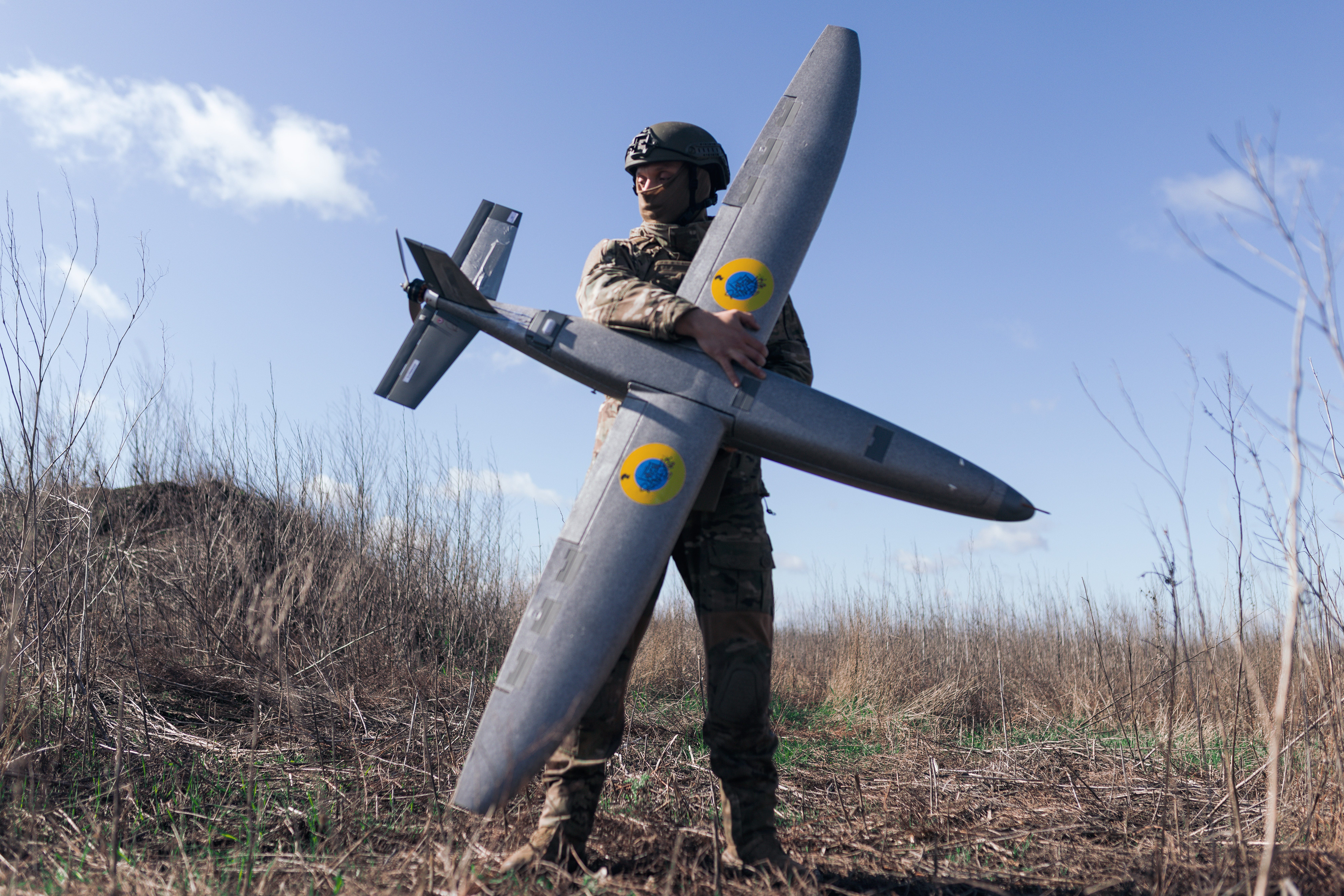
It is clear that we are living through a dramatic revolution in warfare brought about by changes in technology. Classic airpower, manned by human pilots, is increasingly being displaced by pilotless drones and ballistic missiles. This has led to surprising developments, as seemingly weaker powers like Ukraine and Iran have been able to stymie larger ones like Russia and the United States.
Over the last several weeks, the mainstream media has begun picking up on the fact that Ukraine has been doing much better on the battlefield, and that the war with Russia may at long last be turning in its favor. But some of the claims about the underlying technological revolution have been exaggerated, and we need to understand the precise ways in which warfare is changing.
Airpower by itself has always had great difficulties in achieving political objectives, something aptly demonstrated by the ongoing Iran war and Operation Epic Fury. What I want to investigate here is how airpower affects the land battle, which remains the main way that war influences political outcomes. In this realm, there are three main domains in which it has been used historically.
The first is strategic: the destruction of large targets deep in the enemy rear that have important roles sustaining the enemy’s war effort, like factories, railroad junctions, power grids, and the like.
The second use of airpower is operational: hitting military targets closer to the battlefield, perhaps 10 to 100 kilometers behind the front lines, including supply lines, air defenses, troops massing for an attack, communications facilities, command posts, barracks, or fuel storage needed by mobile armored forces. Such attacks are critical in “shaping” the land battle by disrupting communications and resupply.
The third mission is close air support: that is, attacking enemy forces that are actively engaged in battle on the front lines.
The first and the third of these have already been greatly impacted by new technologies, and we are about to witness big changes in the second category. Let’s see what recent wars have demonstrated.

A lot of recent media coverage concerns the Ukrainian campaign of long-range drone strikes that have targeted Russian oil and gas facilities, in some cases thousands of kilometers from the Ukrainian border. Observers have noted the lack of military hardware at this year’s May 9 Victory Day celebrations in Red Square for fear of Ukrainian strikes during the ceremony, and Vladimir Putin’s reported fear of assassination by drone.
Technology has made a huge difference in this realm. During World War II, the British Bomber Command and U.S. Eighth Air Force attempted to hit strategic targets like ball bearing factories in Germany. But Nazi air defenses forced bombers to fly at night, when their accuracy was atrocious. This led to the Allied decision to indiscriminately bomb urban civilian targets, leading to the flattening of cities like Dresden, Hamburg, and Tokyo, with accompanying civilian casualties in the hundreds of thousands. Despite the armchair strategizing of people like Lindsey Graham, these kinds of civilian attacks are both morally repugnant and have a poor track record in changing the political calculations of targeted countries. The Russians have been hitting Ukrainian civilian targets throughout the war; though they have made life miserable for its citizens, they have not brought about the country’s capitulation.
It is in the realm of close air support that drone technology has had the most revolutionary effects. This mission has historically been very difficult to carry out: until the advent of precision-guided munitions in the late 20th century, like the Maverick missile or guided GBU 10 and 12 bombs, it was hard to hit point targets from the air. Even so, “low and slow” aircraft like AC-130 gunships or the beloved A-10 Warthog were vulnerable to air defenses, and ran the risk of fratricide, where the aircraft would mistakenly hit a friendly target.

Inexpensive FPV drones, which are now being produced by Ukraine in the millions per year, have changed this calculus completely. Classic combined arms maneuver warfare—that is, rapid breakthroughs by armored vehicles that can drive deep into the enemy rear, cut supply lines, and capture territory—has been made virtually impossible. FPV drones have made the battlefield completely visible; they can see everything and strike everything they see, not just tanks and surface-to-air batteries, but individual foot soldiers. FPV drones are not, at least for now, vulnerable to modern air defenses, and are much more precise than earlier munitions.
The one mission that remains the domain of airpower is the operational one, beginning with the establishment of air superiority in the early stages of a campaign. By neutralizing SAM batteries and destroying the enemy’s aircraft, either on the ground or in the air, airplanes remain very useful. Airplanes are also necessary for certain kinds of strategic missions such as delivering heavy “bunker buster” bombs like those the United States used against Iran’s Fordow enrichment plant last summer.
But operational missions are now being transformed as well. Early in the war, the Ukrainians used American HIMARS rockets, with ranges in the tens or low hundreds of kilometers, to great effect. While these have been largely neutralized by Russian countermeasures, the Ukrainians are developing a new generation of drones and rockets that can strike at operational distances.
We see this unfolding as we speak in Russian-occupied Crimea. The Ukrainians have been systematically taking out Russian air defenses with medium-range drones and missiles. The peninsula has very constricted supply lines, with a road and rail connection through the narrow isthmus to the north, and the Kerch Strait bridge connecting it to the Russian mainland. The Ukrainians reportedly now control the isthmus route from the air, and have attacked the bridge repeatedly over the past three years.
Under these circumstances, it would not be at all surprising if the Russian command decided at some point in the coming year that its position in Crimea was untenable, and began to withdraw its forces there, just as it has already withdrawn the bulk of its navy. Such a withdrawal would, of course, mean an enormous political defeat for Vladimir Putin.
Airpower is not obsolete yet. Success in war still depends on layered defenses and systems that are capable of operating within each of the layers. In judging the future of drones versus legacy airpower, however, the question is not one of pure capabilities, since airpower will remain superior in certain operational and strategic missions. Rather, the issue is one of relative cost.
While a Patriot missile can shoot down a Shahed drone, the Patriot costs north of $4 million, while the Shahed is produced for less than $40,000, and in much larger quantities. In the future, countries like Ukraine will be able to unleash swarms of low-cost drones, controlled autonomously by AI systems. Operation Epic Fury in the Middle East, meanwhile, has demonstrated that the sophisticated air defenses provided to America’s friends in the Gulf have been unable to prevent serious damage to their facilities from Iran’s drones and missiles. This balance of capabilities will persist until someone comes up with a cheap and effective anti-drone system. Many countries and companies are working on that today, but we are not there yet.
Francis Fukuyama is the Olivier Nomellini Senior Fellow at Stanford University. His latest book is Liberalism and Its Discontents. He is also the author of the “Frankly Fukuyama” column, carried forward from American Purpose, at Persuasion.
Follow Persuasion on X, Instagram, LinkedIn, and YouTube to keep up with our latest articles, podcasts, and events, as well as updates from excellent writers across our network.
And, to receive pieces like this in your inbox and support our work, subscribe below:
The key takeaway from Frank's analysis is that the U.S. military needs a different mix of high-cost and low-cost weapons. The president's $1.5 trillion budget proposal makes clear that the Pentagon has no interest in any trade-offs between the two. More of everything is the name of the game. The military establishment is chalking up the weaknesses exposed by the Iran conflict as a valuable learning experience whose price will be paid by crowding out other spending priorities. That's what I'd call a troubling mindset.
This article contains several serious errors. The burning of Japan's cities in WWII was vital. Many homes contributed to the war effort with tools in the homes. Of course, the firebombing destroyed these tools. The burning of Japan's cities also set the stage for Hiroshima and Nagasaki (both cities burned). To be blunt, firebombing helped persuade Japan to surrender in WWII. The A-10 has long (since 1970, at least) been capable of precision strikes. The main gun of the A-10 could hit a Soviet tank at a range of 1,200 meters. The A-10 can also drop dumb bombs with great accuracy using its 'death dot' (CCIP) capability. The A-10 can also fire the Maverick missile. Long before drones, JDAM was so accurate that operators could pick which pane of glass they wanted a bomb to go through.