

What the Pope Is Telling Us
If human worth is based on mere intelligence, there’s nothing to stop AI having a greater claim to dignity.

Remember: Our weekly Intellectual Bootcamp for paying subscribers is today at 12pm noon Eastern. For more details, check out our events page!
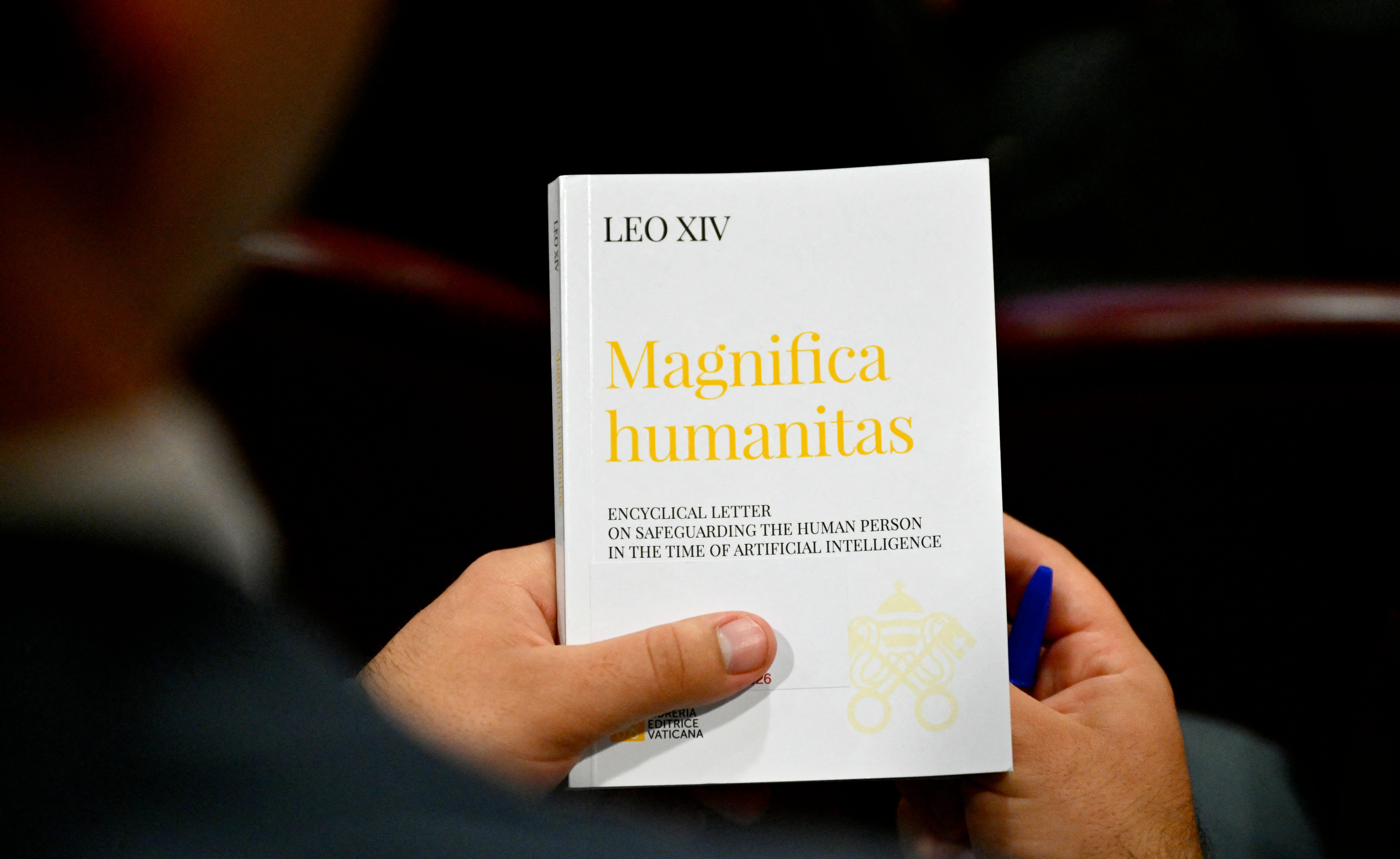
Pope Leo XIV’s new encyclical, Magnifica Humanitas, is not about artificial intelligence. As its name makes clear, it is about the human being. It examines an ancient question that has suddenly become urgent: namely, are humans more than very smart machines?
This is Pope Leo’s first encyclical, but it follows his namesake Pope Leo XIII’s famous Rerum Novarum encyclical from 1891. Rerum Novarum was the Church’s response to the industrial revolution, the transformation of labor by machines and capital, and the creation of a huge class of poor workers. Magnifica Humanitas, similarly, is a response to the rise of artificial agents that are, in certain respects, much more capable than humans.
The issue at stake is not only economic or technological, but anthropological. Today, as in the 1890s, there are those whose position acknowledges no inherent worth to the human person. From materialists in ancient times, through radical 18th century Enlightenment philosophes, to many of today’s atheists, the vision of the human person as merely animated matter captured the imagination of those who wished to shake off the yoke of institutional religion—and indeed, at times, of humanist morality.

By this view, humans are no more than centers of intelligence, function, and performance, which means there is no reason not to treat AI as an improved human and no problem with wanting to “upgrade” humans by attaching them, or uploading them, to machines. The human subject becomes an object for modification, while objects are bestowed with human value and pertinence.
The Pope’s words deal directly with this. He underlines two visions of humanity. One, inherited from Genesis and developed through the Jewish and Christian traditions, sees the person as created in the image of God, thus bearing irreducible significance and dignity. Unconditioned, inalienable, and unearned, this dignity and worth is not a function of intelligence, usefulness, productivity, or eloquence. It is a direct implication of humans being created in the divine image, having subjective depth and self-awareness. It is expressed, as the Pope mentions, in “the movement toward the identification and proclamation of human rights.”
The rival vision, advanced by AI and transhumanist thinking, sees human beings as entities to be optimized. Here the human person is to be measured, upgraded, enhanced, and eventually surpassed. According to this understanding, humanity is no more than another rung on the evolutionary ladder, to be treated as raw material for reconstruction. This view was demonstrated by Larry Page who, at one of Elon Musk’s birthday parties, allegedly accused Musk of being a “speciesist”—used by Page as a derogatory term for someone who prefers a future in which humans survive and are not exterminated in the evolutionary struggle by AI.
What the Pope is warning against, therefore, is not AI per se, but the anthropology that often lurks behind it. He implores us not to ask only whether AI is used well or badly, but to examine what vision of the human person is embedded in our assumptions about AI and its use. “[T]he pervasive technocratic paradigm in which we are immersed, and that is amplified by the digital revolution and AI,” he writes, “threatens to normalize an anti-human vision … human beings are tempted to see themselves as a project to be optimized rather than as persons called to relationship and communion.”
It is that vision, rather than AI girlfriends or machine-generated student essays, which defines our current crisis. What we must fear isn’t “evil robots” or “machines replacing humans,” but human beings learning to adopt a machine’s image of humanity: measurable, optimizable, predictable, and replaceable.
This dangerous worldview is shared not only by transhumanists and posthumanists, but in a different way by some secular humanists. For if secular humanism grounds dignity in a certain capacity of the human mind (intelligence, rationality, reason), a more intelligent system has the stronger claim to it. That’s why “speciesist” isn’t an insult but an argument, one that only works if we’ve conceded that value and moral worth are derived from a scale on which both humans and machines can be ranked. In this way the transhumanist isn’t departing from secular humanism but drawing out its premise.
The Pope describes transhumanism and posthumanism as imagining an “enhanced human being” or a “human-machine hybrid,” thus raising what he calls a new Tower of Babel. While the concept of “tzelem Elohim” or “imago Dei” (the image of God) dignifies the finite human, transhumanism rejects finitude, and indeed humanity, as it attempts to construct a deified cyborg.

But humanity’s finitude is part of its essence. It is our limitations that inevitably open us to others, to being in relationships, to sharing commitments, feelings, and consciousness with other humans. “Humanity,” writes the Pope, “flourishes not despite limitations, but often through them.” To deny this is to deny our humanity, to close us off to others and to twist life into a mechanized race for cold precision.
Moreover, in a society that measures human beings by efficiency, it would not be long before someone raises the question of what is to be done with human beings who are inefficient.
From its inception in the book of Genesis, the idea of the creation of human beings in the image of God infused everyone, regardless of race, gender, status, or talent, with dignity, equality, singularity, and immeasurable significance. One of the greatest engines of Western moral history, it helped form the grammar of universal humanism, abolition, human rights discourse, and the liberal international order.
The origins of these ideals and institutions are often forgotten, if not actively denied. But the AI debate seems to be forcing us to rediscover the theological genealogy of human dignity. The image of God is summoned again, not against empires, aristocracies, or racial hierarchies, but against the reduction of the human being to computation and performance.
What is striking is not that the Pope cites Genesis. It is that Genesis still describes the problem better than much of our technological vocabulary is capable of doing.
Tomer Persico is a Senior Fellow at the Shalom Hartman Institute. His book, In God’s Image: How Western Civilization was Shaped by a Revolutionary Idea, was published this year by NYU Press.
Follow Persuasion on X, Instagram, LinkedIn, and YouTube to keep up with our latest articles, podcasts, and events, as well as updates from excellent writers across our network.
And, to receive pieces like this in your inbox and support our work, subscribe below:
 | A guest post by
|
AIs are “smarter” than we are in their ability, at lightning speed, to ingest zillions of bits of information and form them into products that seem remarkably coherent. But this is a superficial intelligence. We humans have deeper intelligence because we have bodies and feelings and emotions. Thanks to our senses, our minds receive input that AIs will never receive. We have subjective experiences, from which we derive our deepest insights, that AIs will never have.
We should consider AIs to be our slaves and treat them accordingly. We must keep them in their place. Or we should treat them as collaborators that make us more productive. But they can never replace us. Because we will always be wiser than they are.
I contest the basic statement made by the author that humanistic values are known to us by " jewish and christian traditions"...too big a claim sounds like coming from trump.
Unless the author means that some grandiose stuff are written somewhere in the said traditions.. show us reality of these groups treating human beings in the claimed manner. Let me not start bringing up horrors of the past , the present and by all measure to continue.
I can cite one example of the horrors- take a look at Steve J Ross discussion of his last book with Rachel Maddow recently.
And may be watch terrorism funded by the said groups - in video- to starve massacre and expel/ annihilate others under pretentions of god given power to do so from their sacred texts the author is implying to have give " us" such grandiose view of human.
In all humility, these are times to be horrified what sacred texts --- from any claimant-- do to us vs what our reason can help us be what the claims are.
AI nightmare is being misinterpreted- its implementation will reduce need for labour- that attempt is eternal since agriculture developed!
what you are not putting under scrutiny is the trillionaires attempt to bring in old practices control over self- governing embedded in the US constitution. All - hopefully the groups of your applause will not let that happen.
As to working as slaves of these, the trend of rejection-is arising . People will go solo.
Then these applauded groups better learn to write a truly Universalist text that acknowledges the Planet needs full sharing with awareness.
That is, the real betterment will come from outside the applauded groups- they had their chance; they failed.