

How Trans Activism Became So Radical
The trans movement won the lottery. Then they lost it all.

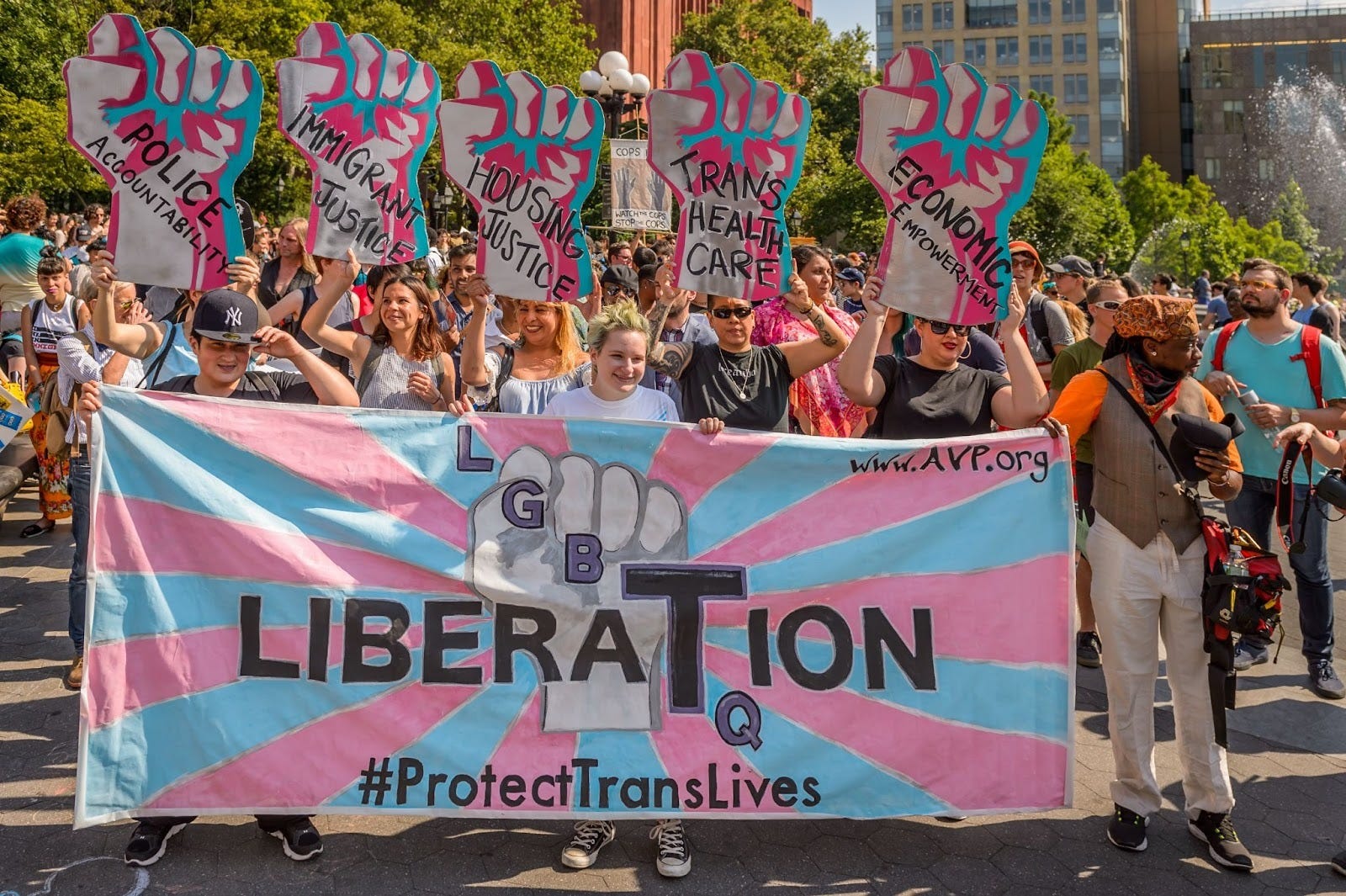
As the backlash to transgender activism went mainstream in the United States, so have postmortems of the movement. A sharp decline in public support now has large majorities of Americans rejecting policies such as trans women in female sports, which a 2025 New York Times/Ipsos survey found 79% of Americans and 67% of Democrats opposed. In 2025, the Supreme Court ruled in United States v. Skrmetti that states had the right to ban youth gender medicine. And in 2024, President Donald Trump soared to electoral victory on the wings of his “Kamala is for They/Them” ad campaign, which, according to an analysis by the super PAC Future Forward, shifted the race 2.7 points in his favor among voters who saw it. With progressives’ iron grip on the culture loosened, and trans politics definitively revealed as a losing political issue for Democrats, commentators have fallen over themselves to criticize the counterproductive aspects of trans activism, or to suggest alternative policy approaches. But when writers and talking heads assess “what went wrong,” they usually do so through the lens of “what did the trans movement do that caused such a fierce backlash?” The question that often goes unasked is: “How and why did the trans movement become so radical in the first place?”
The answer is layered and multifactorial, but it also boils down to human nature: trans activists tried to bully their way to progress because they believed they could—there was a moment of opportunity where the movement had the wind at its back and there was a tendency (which proved disastrous) to be as ambitious as possible. Any accurate analysis has to start and end there.
Many observers have grasped at the mainstreamization of queer theory or the LGBT movement’s reorientation of priorities after the 2015 Obergefell v. Hodges Supreme Court case as the main culprits. (Andrew Sullivan wrote a highly influential op-ed making the latter argument.) But these narratives don’t explain quite as much as they purport to. It’s hardly as if young, otherwise liberal-minded people were suddenly radicalized by narcolepsy-inducing tomes of queer theory written decades before they were born. And it’s not as if the LGBT movement moved money in a different direction and, with that, suddenly changed all of their values. As so often, politics lies downstream from culture. Once we understand the cultural trends of a particular moment in time, the ruinous decisions of a small number of activists—who could have followed the consensus-building, coalition-expanding playbook of the gay rights movement but instead embraced extremism—begin to make sense.
The first thing to recognize is that trans rights was poised to become a major issue almost no matter what happened within a more narrowly political sphere. Trans visibility in popular culture and in online discourse had been steadily increasing throughout the 2000s and early 2010s. In June 2014, a full year before the landmark Obergefell Supreme Court decision ensured constitutional protection for same-sex marriage, Time ran the cover story “The Transgender Tipping Point,” declaring trans “America’s next civil rights frontier.” Recall also that Caitlyn Jenner came out as a trans woman prior to Obergefell. The movement was always going to assume public centrality. Facile theories that pin the blame for the movement’s radicalization on a shift in resource allocation following Obergefell don’t fully explain the illiberal turn—most of the groups in this space had been decidedly liberal up to that point. But at this moment in the 2010s, social media pushed a more radical turn in the discourse all across the society. And dynamics within the trans movement itself broadened the definition of trans in a way that became purely political—and that had a pronounced radicalizing tendency.

What mattered most was a shift from a medicalized conception of what it meant to be trans, which previously had been predominant. Trans, which was short for transsexual, originally referred to people diagnosed with gender dysphoria who transitioned both socially and medically to live and “pass” as the opposite sex. In the early-to-mid-2010s, a sea change occurred within trans circles, abetted by the movement’s newfound popularity and the catalyst of social media. Old-school transsexuals—who came to be known as “transmedicalists”—were quickly outnumbered by a growing cohort of people with a radically different view of trans. For this latter group, medical diagnoses were not only unnecessary; the requirement to obtain them was also dehumanizing. Medical transition, for them, was no determinant of one’s transness. To this emerging generation of trans people and allies, to be trans one merely had to identify as trans, nothing more.
It’s not difficult to see why many found the view of trans as an identity to be affirmed less demeaning and more uplifting than viewing it as a disorder to be treated or a condition to be managed. In practice, however, this rejection of “gatekeeping” opened a Pandora’s box that dramatically expanded the trans community with an influx of people who were, for lack of a better term, politically trans.
In the span of about a decade, trans people went from being 0.3% of U.S. adults in 2011 to 1.6% (and 5.1% among young adults) in 2022. A 2022 survey also found that just 31% of trans-identified adults had used hormone treatments or puberty blockers, and only 16% had surgically transitioned. Transsexualism had been displaced by a new group of people—often identifying as non-binary, and sometimes for overtly political reasons—some of whom may not have changed anything in their lives other than their pronouns. As trans evolved away from a psychological condition and toward a political identity, the nature of the movement’s ideology and activism couldn’t help but change too. (A tragic irony here is that this eschewal of medicalization did not stop activists from making youth gender medicine integral to their policy agenda.)
Those shifts within the trans movement coincided with a broader cultural sea change that exacerbated all possible tendencies towards radicalization. By the mid-2010s, political polarization was on the rise in the United States, with members of both parties displaying steadily greater antipathy to one another. The arrival and chaotic reign of the country’s most polarizing president only kicked this trend into overdrive.
In 2016 and 2017, amid the raging culture wars between MAGA and the #Resistance, negative partisanship became the political north star for finding “the right side of history” on every political issue. For Democrats, or those left of center, one simply needed to observe whatever animated Republicans, and then automatically take the opposite stance. The more vehement one team became, the more vehement the other had to be in response, no thinking required. When Republicans in North Carolina passed the first statewide law barring trans people from using the public restrooms of their choice in 2016, followed by dozens of other states, trans issues were officially sucked into the culture wars and thus the #Resistance. Blue-team America and the institutions they controlled had already been pro-LGBT, to be sure, but it wasn’t until the flood of GOP “bathroom bills” that liberal normies the country over adopted trans rights as one of the central planks of what it meant to oppose Donald Trump. What specifically this entailed, which ideas and policies were being advocated, and who was being empowered—those were insignificant details.

In the span of three years, trans activism became not only the beneficiary of an infusion of cash and support from gay rights groups, but it was also handed a level of cultural and institutional power unprecedented for a movement barely out of its infancy.1 From 2018 to 2023, the trans movement held considerable sway in virtually every avenue of culture and information, from universities to government agencies to nonprofits, entertainment companies, streaming services, social media platforms, publishing houses, media outlets, major corporations, professional associations, and even K-12 schools. In 2014, trans issues were hardly a blip on the public’s radar. By the end of the decade, institutional America marched in lockstep with trans activism while the mainstream press covered its most contested edge cases as though they were settled issues.
Even in deep red states, trans activism flexed its muscle. For example, the controversial policy adopted in many K-12 schools in which faculty were instructed to actively conceal students’ trans identities from their parents was not merely a phenomenon in the urban power centers of coastal progressive cities. These policies were also adopted in schools in states like Alaska, Arizona, Idaho, Iowa, Kansas, Nebraska, North Dakota, and Texas.
It is difficult to overstate just how historically unusual this meteoric ascension was, and how completely it changed the perceptions and incentives of activists.
Nearly every prominent social movement of the past few hundred years, from abolitionism to women’s rights to civil rights, spent generations raising awareness, laying groundwork, planting seeds, organizing, and changing hearts and minds before they gained anything like the power the trans movement was gifted. At every step in their slow climb toward progress, these previous movements were keenly aware of how precarious their gains were and how easily a severe misstep could undo many years of patient labor. The trans movement had no need for such considerations.
Whereas the lesbian, gay, and bi rights movement was a rags-to-riches story of long decades spent toiling to shift attitudes, trans activism had everything handed to it—the movement was the beneficiary of decades of hard work from the LGB struggle and all it had to do, really, was to not snatch defeat from the jaws of victory.
Instead, flush with newfound cultural power and a sense of invincibility, the trans movement regarded public opinion, persuasion, civility, incrementalism, and even winning elections as irrelevant. Trans activists’ experience was not one of clawing their way into relevance by playing the long game like the gay and bi activists of yesteryear. Rather, it was, as I wrote in 2023, the understanding that they could “bypass politics altogether and simply seize progress and carry it off like an unprosecuted shoplifter in a San Francisco Walgreens.” And so they did, wielding accusations of transphobia like a cudgel and watching the professional classes fold like cheap suits. Why bother trying to convince dissenters when you can circumvent or steamroll them? Why worry about protecting past gains when new ones come so effortlessly?
Why did so many trans activists behave like authoritarian bullies, or try to force through the most uncompromising and maximalist version of their ideas, including hormone therapy and surgery for minors, against the will of an ever-skeptical public? Because they could. Why did they think it would work? Because, for a solid five years, it did. But it was a mirage.
Given the right conditions, like the sudden popularity of trans causes in the mid-2010s, a minority can forget that they are, in fact, in the minority. But eventually, reality asserts itself. In a free society, policies and ideas that are wildly unpopular are eventually repudiated, however spellbound the majority might be for a time. The rise and fall of trans activism is a cautionary tale about the dangers of too much power suddenly falling into one’s lap. One need only look at the horror stories of far too many lottery winners to see an eerily similar dynamic—being handed winnings without a proper foundation can result in losing everything.
Somewhere in the multiverse, there’s an alternate timeline in which trans activism grew more slowly and steadily, pushed and pulled by the tidal tensions of democratic pressures, forcing it to smooth over the extreme edges, engage skeptics, and hear out the moderate, concerned, or dissenting voices within the community. There’s a world out there in which the trans movement followed in the footsteps of previous campaigns for human rights by building durable liberal progress. Sadly, that’s not how things played out in our timeline. But it’s never too late to, well, do better.
Jamie Paul is a writer based in Greater Philadelphia, founder of American Dreaming, managing editor at Queer Majority, and contributing editor at Bi.org.
Some trans activists, especially those from older generations, take umbrage at the characterization of the late 2000s or early 2010s as the beginning of the trans movement. They point to activists from generations prior, even going back to the famed German sexologist and LGBT pioneer Magnus Hirschfeld in the early decades of the 20th century. It is certainly true that there were people who advocated for trans rights prior to the modern era, but that does not constitute a proper “movement.”
 | A guest post by
|
There isn't quite as tidy a distinction between "old-school" "medical" transsexuals and new-school "political trans" as you've argued. Social media was indeed behind the recent explosion of the trans phenomenon. But I've been around this movement since the '90s, and things were far from hunky-dory in the tiny old village of transsexual culture long before it exploded into the modern Megalopolis of teens with bespoke pronouns and waves of fully-intact men rushing into women's sports leagues, spas, shelters and anywhere else communal female nudity might be involved.
There was always resistance to "medical gatekeeping" among transsexual males, and there was always a desire to push further into women's spaces than they had so-far achieved. (Females with trans identities were virtually nonexistent until the Internet.) The ultimate political objectives of the trans movement were always, right from the start, total and complete erasure of any distinction whatsoever between males who *wanted badly to be female* and actual females. And the movement always sought to achieve these goals through a combination of both medical and political means.
With dumb luck, as you said ("they won the lottery"), the stars aligned around a number of factors (the Obergefell Supreme Court ruling; social media and smartphones; the culture war and tribal polarization in the US; etc) and the trans movement suddenly came into massive political capital incredibly quickly.
But in your framing, it's just the political acceleration that was the problem, not the fundamental objectives. You seem to be arguing that, if the movement had taken its work towards its objectives more slowly, things would have been fine, perhaps even socially good:
"Nearly every prominent social movement of the past few hundred years, from abolitionism to women’s rights to civil rights, spent generations raising awareness, laying groundwork, planting seeds, organizing, and changing hearts and minds before they gained anything like the power the trans movement was gifted. ...[T]he trans movement regarded public opinion, persuasion, civility, incrementalism, and even winning elections as irrelevant."
I would counter that that's because trans *wasn't much of a social justice movement in the first place*.
Trans really is not a legitimate social movement in the sense of a fight for equality for a fundamental, rightful, material category of people. And it should never have been framed as that kind of thing. Your mistake is even comparing it to women's rights and civil rights when it's better off being compared to other categories of things, such as, say, the right for people with anorexia to have access to compassionate, proper medical treatment for their condition (with the optimal outcome for all anorexics being *CURING them of it*), or the right of Scientologists to believe whatever cockamamie theories they want *about themselves*, but at the same time recognizing that their religion is cult-like and extreme and not to be taken at face-value in the secular sphere (with, again, the optimal outcome for Sceintologists being for them all to *ESCAPE from it*).
Humans cannot change sex, and the desire to do so is almost entirely rooted in sexual paraphilia, internalized homophobia ("ego-dystonic" homosexuality, or gays & lesbians who badly want to escape the label "homosexual", usually for cultural reasons), and other maladaptive, socially and psychiatrically un-ideal reasons.
Many (though not all) of the movement's fundamental objectives were illiberal and unethical right from their dubious foundations, which lay in a kind of gray area between fantasy and reality, and between appeasing mental health disorders and holistically treating them.
I really do like a lot of your writing on this topic, but I end up posting criticism of it more than praise, simply because I believe you are failing, consistently, to reckon with the deepest, lowest, first-principles problems with trans, with the philosophical, abstract ideas right at the core of it. The behavioural, psychological phenomena that cause it, and the real-world consequences of its demands are never addressed in your writing. That frustrates me as a fellow gay and a fellow North American liberal who is extremely knowledgeable in this subject.
This avoidance of the core, base-level problems with "trans" is a consistent problem I have seen, particularly and acutely in American liberal media circles. The specifically-American psychological concept of progressivism just cannot swallow the hard pill that transgender ideation is a mental disorder for which social awareness and enlightenment campaigns are not the appropriate tools to address it.
It's as if that's a step too far from the Overton-window comfort zone for liberal Americans whose psyches have been battered by decades of polarized Red-state/Blue-state struggles. But free from the American cognitive mess, it's clear: trans is not the new gay. At all. And I'm frankly tired of the cowardice of the liberal media to talk real, frank talk about this catastrophic wrong turn, espeically when it's the liberal media that's largely responsible for steering progressivism into it.
That said, framing transsexualism differently can bring benefits and balance. Let's look at trans as a medical thing, and *strictly* as a medical thing. Let's see transsexuals as a *medically challenged minority* and not a *socially oppressed* one. Transwomen are *men* with disorders, not *women* who have been socially wronged.
For adult men and women who struggle with sex dysphoria or debilitating autogynephilia or such deep, self-hating homosexuality that they just can't shake it via therapy, perhaps in limited cases, surgeries might help, as a palliative treatment (which means, it's not a cure but it helps them get on with their lives, and nothing more than that).
But we must always maintain that this doesn't necessitate that the rest of society has any obligation forced upon it, legally or culturally, to pretend not to see their true sex. If a guy wants to get a fake vajayjay, and he's been thoroughly vetted psychiatrically, that's one thing. If women and girls are then told they're obligated to let him shower naked alongside them at the YWCA, that's not remotely the same thing. Not even close.
We can all tell the true sex of each others' human bodies, and they affect us all fundamentally.
(For those who protest that they don't believe that, to them I say: try having sex with a transwoman or a transman and see if you were really convinced it felt exactly the same as having sex with a true male or female. I'll bet even the thought of doing so gets your mind on the defensive.)
That there, in non-abstract, non-euphemistic terms, but rather with concrete and blunt examples, is the difference between rational, true "old school" trans and the new kind. But I never see you venturing into such blunt, clear, plainspoken territory about it.
I suspect that's because such bluntness about what trans is only serves to highlight that it's not analagous to homosexuality or other civil rights categories, and that makes many dysphoria sufferers themselves not just uncomfortable, but combative.
Too bad. That's reality. Liberals need to face the hard truths of reality, now more than ever. Strange, then, that as a fellow liberal and gay rights advocate, that you're too chicken to talk about it like that.
I agree with this. I am basically a coastal elite and I should be a democrat voter as I used to be. Trans extremism is one major issue that made me believe that the democratic party had gone over to the dark side. And I don't believe that because I watch Fox News ( I don't watch it).
In my own community there were THREE drag queen story hour programs for toddlers over a 12 month period. Why for toddlers? A woman I know who was a democratic candidate for office told me that every book her kids in elementary school read during the year was about a trans kid.
Like most Americans, I have absolutely no problem with trans adults. I think they are colorful and interesting. Of course I believe they should not be victims of discrimination and of course they should have full civil rights. Just like hetero ladies with boob jobs, they are adults who should do whatever they wish. Whether they should be a privileged class under DEI, and get favored in certain situations, is another question.