

The End of “Legitimacy”
The United States has forfeited its moral high ground.

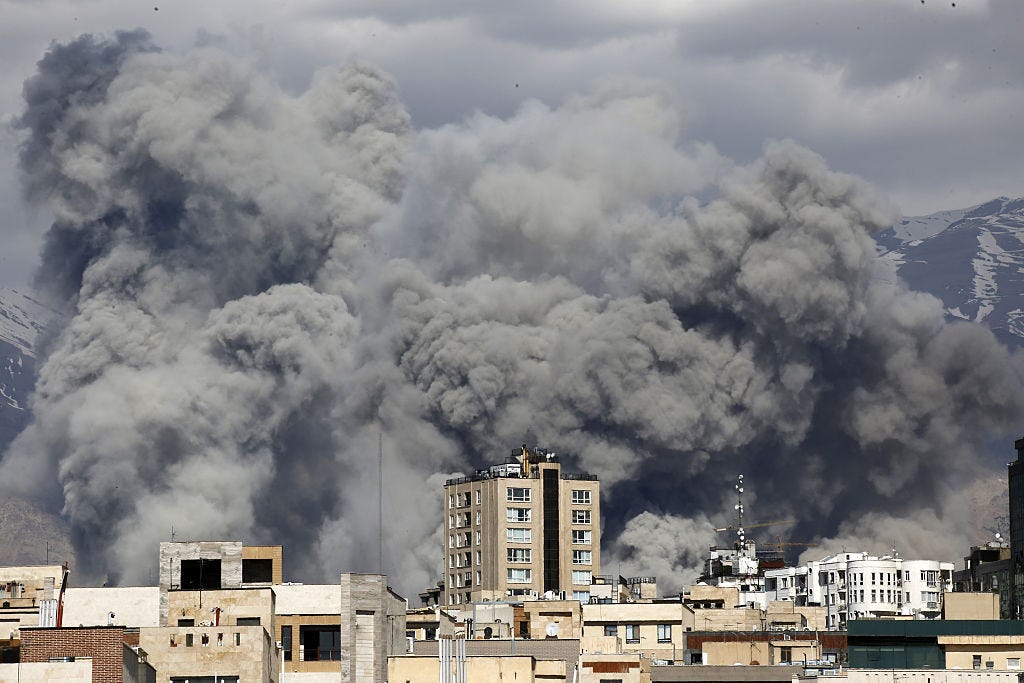
As far back as I can remember, I always assumed that I was on the side of the good guys. The Cold War meant, at core, democracy against authoritarianism. The wars of the ‘90s were sometimes a bit far-fetched but, in a pinch, they could be construed as demonstrating the reach of American benevolence—willing to launch a bombing campaign for the Kosovar Albanians! The Bush wars of the 2000s were obviously pushing things, but the administration did take the trouble of going to the UN to provide a justification for what it was doing—stopping the proliferation of weapons of mass destruction and removing a dictator.
All of that might have been a bit threadbare, but there was an attempt to provide a fig leaf of respectability to the exercise of raw power. With the attack on Iran, that is gone—and likely gone for good. We move from an era of seeing the United States as the “leader of the free world” constraining authoritarianism—and as the broker of a “Pax Americana” protecting the edges of an international order—to seeing the United States simply as a hegemon throwing around the considerable weight it has in competition with other hegemons. A cynic would say that this is always the way it has been—and the cynic would be hard to argue with—but the forms and ceremonies do matter. Once those are gone, it becomes incredibly difficult to legitimate the exercise of power again. The rest of the world will see the future exercise of American power always and only as advancing narrow American geopolitical interests. The moral authority that is needed for coalition-building or for defense of the liberal international order vanishes with unilateral attacks like this one.

With this conflict, the Trump and Netanyahu administrations are entirely dispensing with the forms and ceremonies. No indulgence has been sought from the UN or NATO or even the U.S. Congress. Yes, there are perfectly valid reasons to wish to enact regime change in Iran. The Islamic Republic has long been a menace to the region and a sponsor of terror worldwide. It does pose an “existential threat” to Israel, as the Israelis are never tired of saying. And, yes, the regime recently engaged in a brutal repression of protestors, killing an estimated 30-40,000 people. But, as extensive reporting has documented, the decision to attack Iran had more to do with a calculation that this would be a geopolitically opportune moment to strike as opposed to believing that imminent threats from Iran warranted the escalated use of force. “The U.S. decision to strike Iran was a victory for Mr. Netanyahu, who had been pushing Mr. Trump for months on the need to hit what he argued was a weakened regime,” wrote The New York Times in a deeply-reported piece. In Trump’s Truth Social video on February 28th, he briefly mentioned “imminent threats from the Iranian regime” before making it clear that the reasons for fighting were more preemptive than that—about removing the regime from power and ensuring that “no one should challenge the strength and might of the United States Armed Forces.” Compared even to Israel’s strike on Iran last summer, there is very little attempt here to legitimate the use of force according to international norms.
So what does that do? Well, it confirms everything that was expected to happen since Trump emerged on the world stage—the United States pulling out of the liberal order and a far more simplistic morality taking its place. It’s already a distant memory—actually from a different epoch—to imagine the kind of coalition that pulled together to support Ukraine, not particularly out of affinity for Ukraine as a nation state, but because the liberal international order was worth defending wherever it was attacked.
And something like a clear line is drawn here. We’re no longer in the domain of the Pax Americana, where the West’s gains at the end of World War II, and then at the end of the Cold War, are vigorously defended (even if the defense of the North Atlantic sometimes extended all the way to Afghanistan) with the premise that many of those gains are as much about principles—universal human rights, the rule of law—as territory. We’re also no longer in the kind of sovereignty that the Russians sometimes facetiously proposed—and that Trump not so long ago seemed interested in—where national autonomy is paramount regardless of sticky annoyances like human rights; or where, in an alternative version of the same theory, powers have exclusive control over their regional sphere of influence.
With the strikes on Iran, and to some extent Venezuela, we enter into a fairly clearly different era—we might call it the Warring States Period—where a different political morality prevails. Sovereignty clearly doesn’t matter much if the head of one country can be abducted from his bedroom by the commando team of a major power; and then two months later the head of another country—on the opposite side of the world—can be killed in his residential compound. And the liberal order doesn’t matter if there is no attempt to seek authorization for the strike from the UN or allied partners or even the U.S. Congress.
Other taboos have clearly been violated as well. Out of an instinct for self-preservation, world leaders have had a tendency to let others do the dying and refrained from striking one another. That is clearly going out the window with the attacks on Maduro and Khamenei. The tendency of recent U.S. presidents to shy away from “regime change” is out as well, with Trump insisting on a U.S. role for leadership in both Venezuela and Iran. And the message clearly goes out, as it did after Qaddafi’s fall in Libya, or for that matter Saddam’s in Iraq, that the only effective deterrent is nuclear weapons—everybody else is vulnerable to regime change.
And if all of that is dispensed with, what remains to preserve any sort of balance of power? Well, power itself. For the moment, this new realpolitik is working out well for the United States and Israel. The two clearly have such an immense advantage in precision weaponry capabilities and especially in intelligence that they have had a string of uninterrupted successes, from America’s efforts to keep Ukraine alive to Israel’s military successes since 2023 to the Venezuela operation to the early stages of the Iran war. Israel in particular has been leading the way with an aggressive geopolitical program that has eliminated Hamas’ strike capabilities, decimated Hezbollah, struck at Iran and Yemen, and done so with strikingly little regard for national boundaries.

The calculation—insofar as there is a calculation—is simply that this can last forever, that the United States and Israel have such a technological advantage that nobody is likely to catch up; that Russia and China are basically regional hegemons but unable to come to the aid of even a strategically pivotal ally like Iran; and that any small powers that fall out of the order of things will face the same fate as the leaders of Venezuela and Iran. And from Israel’s perspective, all is well so long as U.S. support continues.
But of course a lot has to go well for this state of affairs to continue. These kinds of showy publicity-driven U.S. missions are, like in Venezuela, often a helicopter rotor away from turning into a Black Hawk Down situation. Israel has forfeited the support of the international community and cements its place on the international scene through a partnership of convenience with, probably, the most mercurial head of state of the modern era—and this against a backdrop of diminishing U.S. popular support for Israel. The United States has made it clear that it will act without any attention to the wishes of European allies and without any pretense of multilaterality. Russia and China know—if they needed any reminders—that they may do what they want without worrying about international law: the only question for them is whether they are able to cut any kind of deal with Trump. And if things start to turn against the new order, there is no principle—no set of treaties, no rallying cry of the “liberal international order,” no system of political values—to fall back on.
For the last 45 years, a lodestar of American policy has been to treat Iran—the nation of fanaticism and revolution; of the Great Satan and the daily “death to Israel” chants—as the pariah. The irony is that, in getting at Iran—and there is no question that a strategic objective has been achieved in the early days of the war—the pariah may turn out to be us.
Sam Kahn is associate editor at Persuasion, writes the Substack Castalia, and edits The Republic of Letters.
Follow Persuasion on X, Instagram, LinkedIn, and YouTube to keep up with our latest articles, podcasts, and events, as well as updates from excellent writers across our network.
And, to receive pieces like this in your inbox and support our work, subscribe below:
> Yes, there are perfectly valid reasons to wish to enact regime change in Iran. The Islamic Republic has long been a menace to the region and a sponsor of terror worldwide. It does pose an “existential threat” to Israel, as the Israelis are never tired of saying. And, yes, the regime recently engaged in a brutal repression of protestors, killing an estimated 30-40,000 people. But, as extensive reporting has documented, the decision to attack Iran had more to do with a calculation that this would be a geopolitically opportune moment to strike as opposed to believing that imminent threats from Iran warranted the escalated use of force.
What an odd quote.
You get to "as the Israelis are never tired of saying" before "killing an estimate 30-40,000 people". To finish it off, the note that now is a easy time rather than a forced time. Many Americans would not wait for Iran to point a nuke at them before attacking!
The Iranian Islamist regime was clearly intent on manufacturing nuclear weapons, presumably for use not only against Israel but against the US as well, which its leaders have persistently vilified as "the great Satan." The ayatollahs and their followers are religious fanatics, moreover, who glorify suicidal attacks that, like those of 9/11, involve indiscriminate slaughter of Israeli or American "infidels" as religious martyrdom that will be richly rewarded in a postmortem paradise. Hence there's good reason to suppose that if the ayatollahs were to have nuclear weapons at their disposal they would not be deterred by concern for self-preservation from using them to attack population centers in the US and Israel. Given that, US and Israeli leaders had, and still have, an ethical obligation to use any means necessary to prevent them from acquiring such weapons -- regardless of the preferences of UN officials, other political leaders, self-appointed moral arbiters, or popular sentiment.