

Why, Exactly, Orbán Lost
Hungary offers big lessons for those hoping to defeat populism—including the Democrats.

Our next ASK THE AUTHOR on Substack Live will take place in JUST OVER AN HOUR at 12:30pm ET. We’re delighted that John B. Judis will join us to discuss his recent article “What Hegel Knew About Trump,” and to answer your questions. Please click here to join!
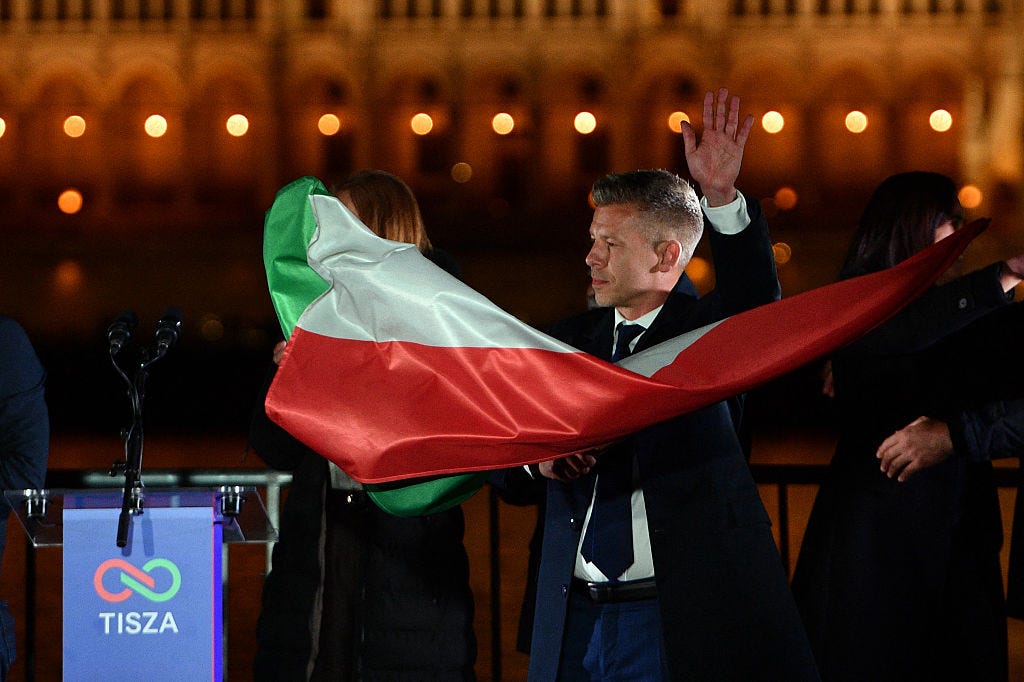
After 16 years in power, Hungarian Prime Minister Viktor Orbán has suffered a decisive election defeat, one so overwhelming and undeniable that the self-styled tribune of “illiberal” politics conceded to his opponents—the Tisza party led by 45-year-old Péter Magyar—with no effort to resist or overturn the results.
Orbán’s defeat is also a setback for the two foreign leaders who had backed him: President Trump had made support for right-wing populists in Europe a key element of his national security strategy and dispatched Vice President Vance to campaign for Orbán days before the election. Russian President Vladimir Putin, meanwhile, had depended on Orbán to defend his interests within the European Union, most notably by vetoing a pending 90 billion euro aid package for Ukraine. Now Putin’s lost his lawyer in Brussels.
It is a watershed moment that opens new possibilities for a more united European front against both Trump and Putin—as well as a fresh start for Hungarians themselves after 16 years of increasingly corrupt and overbearing Orbán rule.
Opponents of right-wing populism on both sides of the Atlantic are celebrating the downfall of Orbán, as well they should. Yet they need to learn the right lessons from Magyar’s victory. And the crucial one is that this defeat for illiberalism is not a victory for liberalism—at least not of the progressive variety now increasingly ascendant within, say, Europe’s Green parties or the Democratic Party in the United States.
Magyar was a moderate conservative defector from Orbán’s own Fidesz party, which he loyally served—including in a senior official position—until just two years ago. At that point, he quit in protest of one of the government’s myriad scandals. As a candidate, corruption was his signature issue, along with bread-and-butter concerns like the stagnant economy and Hungary’s decrepit health and education systems.
Meanwhile, he downplayed cultural liberalism—steering clear, for example, of a controversy over a Budapest gay pride parade Orbán tried to suppress. And he co-opted the more popular parts of Orbán’s agenda, such as his tough approach to public safety and the closure of Hungary to asylum seekers. On the campaign trail, Magyar promised to maintain the heavily patrolled border fence Orbán erected to keep out Middle Eastern and South Asian migrants; he even attacked Orbán from the right on migration, proposing to end a program that lets a handful of people from Armenia, Georgia, and the Philippines into the country for short-term work contracts.
Hungary’s liberal and progressive parties all but died out during the last two decades. The only party other than Fidesz and Tisza to win seats Sunday was the tiny Our Homeland Movement, which is even more right-wing and nationalist than Fidesz. To be sure, the country’s rightward shift reflected Orbán’s determined efforts to stack the political system in his favor, but that is not the only cause. Many Hungarians were genuinely disenchanted by their left-leaning politicians; many, too, were repelled by the EU’s inability to stem the surge of migration and concerned by unrealistic green energy mandates emanating from Brussels. The potential spillover of war in neighboring Ukraine created additional worry.
There is a rough analogy between Hungary in the Orbán era and Israel during the last 15 years of political domination by Prime Minister Benjamin Netanyahu. The latter country’s political center of gravity shifted to the right; the only successful or potentially successful challenges to Netanyahu now come from politicians—some formerly affiliated with his party—who style themselves “right-wing.”

Magyar and his campaign team dealt skillfully with the country’s changed political landscape, understanding that they could depend on the votes of more cosmopolitan, reflexively anti-Orbán, city dwellers, and that the campaign would be won or lost in the traditionally pro-Orbán countryside. Magyar set up “Tisza Islands” across the countryside, a network of over 20,000 volunteers distributed among more than 200 localities—and spent the bulk of his campaign time outside of Budapest and the major cities trying to win over culturally conservative swing voters.
So even though the new Hungarian prime minister will enjoy a two-thirds majority in parliament, giving him maximum latitude to govern, he might not shift policy as dramatically as some of those celebrating his win hope.
He will keep his promise to move Hungary into closer alignment with the European Union, likely by ending Orbán’s veto of Ukraine aid. It’s in his own interest to reverse Orbán’s stacking of the judiciary with Fidesz loyalists, which could help restore 18 billion euros in aid that the EU froze as a punishment to Orbán. Magyar could nevertheless remain relatively cool toward Ukraine and more resistant to migration than the EU would like.
For Brussels, though, the main thing now is to consolidate Hungary as a member of the overall European mainstream. If that means ending the million-euro-per-day fine the EU imposed on Orbán’s government in 2024 for refusing to allow in asylum seekers, so be it. Most EU member states are themselves getting stricter on migration.
In the end, Orbán was a better democratic citizen than Trump, conceding defeat and promising to wage a loyal opposition. There will be no Hungarian January 6.
Still, after 16 years, Orbán simply wore out his welcome. Too much corruption, too much heavy-handed propaganda, and too much emphasis on his own grandiose role in international affairs alienated the electorate. The soon-to-be former prime minister focused on ideological abstractions such as Christian nationalism and increasingly fanciful conspiracy theories about Ukraine and a “pro-war” Brussels. Like most democratic publics, Hungarians mainly want good government: a robust economy, effective public services, and as little drama as possible in international affairs. Orbán failed to deliver on all fronts.

If that reminds you of how Trump is losing the plot politically as the United States mid-term elections approach—well, it should. Ironically, one of the distractions upon which Trump has expended valuable presidential attention and prestige was Orbán’s re-election, though he ultimately delegated the actual campaigning in Budapest to Vice President JD Vance. This intrusion into another country’s internal affairs accomplished nothing except to damage Vance’s standing as a potential Trump successor in 2028.
The outcome in Hungary shows that even a deeply entrenched right-wing populist leader can overplay his hand, and alienate the public, by failing to deliver on issues that most affect daily life. Such a leader is most vulnerable to an opposition that understands the factors that motivated ordinary people to support him in the first place—including the excesses of the liberal left itself.
It’s doubtful that Trump will learn very much from this experience. Can the Democrats?
Charles Lane is a nonresident senior fellow at the American Enterprise Institute and a columnist for The Free Press.
Follow Persuasion on X, Instagram, LinkedIn, and YouTube to keep up with our latest articles, podcasts, and events, as well as updates from excellent writers across our network.
And, to receive pieces like this in your inbox and support our work, subscribe below:
 | A guest post by
|
Important that Magyar is not in any way a progressive, socially liberal, center left politician. He conservative and anti-immigration - and honest. I agree that Trump and Vance were dumb to campaign for Orban, given that Magyar shares conservative values. That said, the EU clearly intervened in this election also- and probably to a greater extent.
One might also ask: can the Republicans?
I'm not sure that either party seems likely to, however.