

Israel Is the Big Loser of the Iran Deal
It’s time for Israelis to face Netanyahu’s failings.

On Thursday at 1pm ET, Sam will interview Nils Gilman on Substack Live about his recent article “The University As We Know It Is Finished.” Set a reminder or click here to tune in!
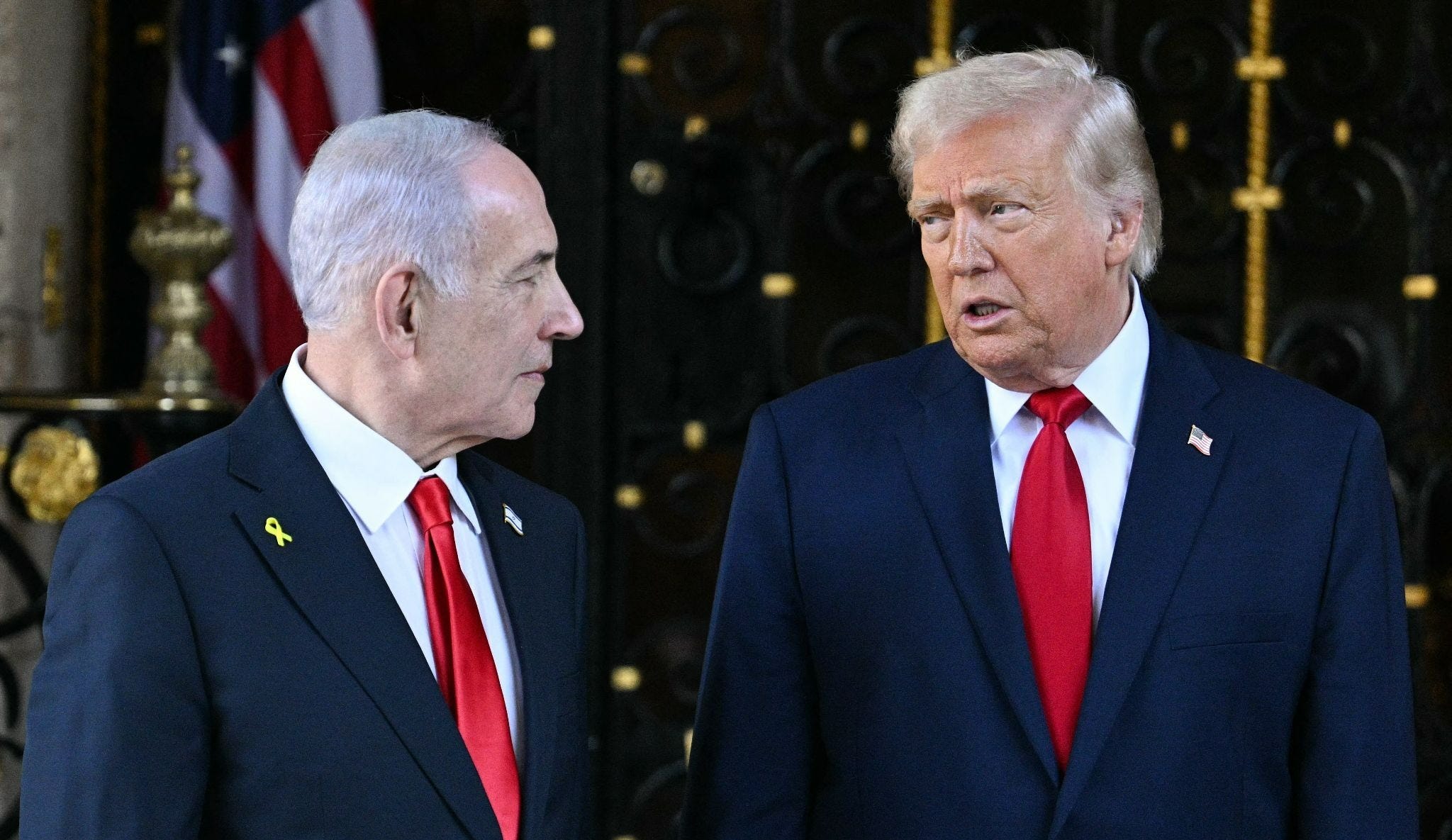
Who are the biggest losers of Trump’s Memorandum of Understanding, signed last week with Iran? Well, it’s a long list. First and foremost is, almost certainly, the Iranian people. Less than four months after being told that the “hour of your freedom is at hand,” Iranians must contend with a deeply-entrenched hardline regime, with the Islamic Revolutionary Guard Corps in greater control than ever and U.S. forces retrograding post-haste out of the “proximity” of Iran. Then there’s Trump, who signed the “Retreaty of Versailles” as a diminished version of Obama’s 2015 deal and agreed to pump $300 billion into Iran’s economy. Then there’s the Republican Party having to somehow spin a chaotic foreign policy, if not a signal defeat, in the November midterms. Then there are the Gulf states who may suddenly find themselves without the umbrella of protection they were counting on if the United States really steps back in the region just when the Islamic Republic finds itself emboldened. Then there’s America’s global reputation. And there’s the enhanced possibility of Iran-sponsored state terror on a frighteningly wide front.
But the absolute unquestioned loser of the agreement is Israel and the entire shape of Israel’s foreign policy under Prime Minister Benjamin Netanyahu. The Iran war was his war—it was supposed to be his masterstroke for generating regime change in Iran and removing the greatest threat to Israel’s existence. The absolute failure of that plan should be a wakeup call to Israelis—if nothing else is—of how ruinous Netanyahu’s foreign policy has been and the extent to which a policy of isolation can’t be anything else but dangerous to a nation as small as Israel is.

In the Israeli press there was surprisingly little effort to spin the MOU. In an impassioned editorial, The Times of Israel—a reasonable bellwether of mainstream Israeli opinion—called Trump’s deal “a catastrophic capitulation to Iran’s aggressors, leav[ing] Israel vulnerable and constrained.” Netanyahu for his part tried to claim that “the war did not go wrong at all,” and that Israel’s primary goals had been achieved, but that was far from the consensus view. “The deal manifestly empowers and finances a mass-murdering regime. It elevates the Islamic Republic to a regional powerhouse,” The Times of Israel wrote. Bezazel Smotrich, the far-right finance minister who is a key piece of Netanyahu’s governing coalition, was even more direct, writing on social media, “The agreement with Iran is bad for Israel and the entire free world. Period.”
And Netanyahu got another negative review from an unlikely source. “He has no fucking judgment,” Donald Trump said in response to an Israeli attack on Beirut that threatened to scuttle the Iran deal. A U.S. official told Axios that Trump went even further in a profanity-laced phone call with Netanyahu. “What the fuck are you doing? You’re fucking crazy. You’d be in prison if it weren’t for me. I’m saving your ass. Everyone hates you now. Everybody hates Israel because of this,” Trump said to Netanyahu in the official’s retelling.
Usually, when Donald Trump of all people tells you to get a grip… that’s when it’s time to wonder if you actually do need to get a grip.
Of course, this is not the first time that people have reacted this way to Netanyahu. You may notice a pattern in remarks U.S. statesmen have directed towards him going back decades. “Who the fuck does he think he is?” Bill Clinton asked aides after his first meeting with Netanyahu in 1996. “Who’s the fucking superpower here?”
“That son of a bitch, Bibi Netanyahu, he’s a bad guy,” Joe Biden said in 2023 to the journalist Bob Woodward. “He’s a bad fucking guy!” Woodward reported that the next time Biden spoke to Netanyahu he erupted at him, “Bibi, what the fuck? You know the perception of Israel around the world increasingly is that you’re a rogue state, a rogue actor.”
And Jeffrey Goldberg, then a reporter for The Atlantic, started keeping a list of descriptions White House staffers in the Obama administration had for Netanyahu. The list included “recalcitrant,” “myopic,” “reactionary,” “obtuse,” “blustering,” “pompous,” “Aspergery,” and “chickenshit.” Obama and French president Nicolas Sarkozy seemed to find common ground in 2011 when Sarkozy was overheard calling Netanyahu a “liar” and Obama replied “you may be sick of him, but me, I have to deal with him every day.”
If Netanyahu lacked congeniality, that tended to be excused by Israeli voters because of his singleminded focus on Israel’s security, but now, two-and-a-half years after October 7, and with Netanyahu pushing his security vision to the maximum, we can finally see what that approach has gotten Israel. 156 countries now recognize the state of Palestine, with 19 choosing to do so in reaction to Israel’s war in Gaza. The International Criminal Court issued a warrant for Netanyahu’s arrest—the first time it has done so for the leader of a democratic country—with the result, among other things, that Netanyahu was unable to plead Israel’s case in negotiations at the G7 in France. The estimated 50-60,000 civilian deaths in the Gaza war produced an international outcry that, for the first time, led to the American public, and younger Americans in particular, evincing greater sympathy for Palestine than for Israel.
The argument has been that that loss of international support is the price to pay for a muscular assertion of Israel’s strength around the region—breaking the striking power of Hamas, dismantling Hezbollah, hitting the Houthis, and launching two waves of attacks against Iran. And it is impossible to argue that Israel, with its allies, has not had battlefield successes—killing Iran’s Supreme Leader Khamenei, Hezbollah leader’s Nasrallah, Hamas’ military leadership and (more treacherously) political leadership.
But Israel’s plan of action hinged entirely on support from the Trump administration. That seemed to work fine when Trump joined in at the end of the 12-day Israel-Iran war in 2025 and when Trump struck at the Houthis in Yemen and when Trump proved a surprisingly easy sell in the plans for a more vigorous attack on Iran in late February of this year. “Mr. Netanyahu delivered his presentation in a confident monotone. It seemed to land well with the most important person in the room, the American president,” The New York Times reported in its description of the critical meeting that led to the joint U.S.-Israeli assaults later that month.

But, in retrospect, that may very well have been Netanyahu’s high-water mark. By late May, The New York Times would report that Netanyahu, “once Trump’s co-pilot against Iran,” was now “a mere passenger,” cut entirely out of the loop on truce talks between the United States and Iran. By June, Israel’s left-leaning Haaretz would report that “Israel has been frozen out of the negotiations while being forced by [Trump] to sit on command.” The entire premise of Netanyahu’s foreign policy seemed to be to generally manipulate and annoy their babyminders in the Biden administration, and to run out the clock until Trump was elected, at which point Netanyahu could really do what he wanted. But if Trump was a kindred spirit in certain ways, his limited attention span obviated the ability to place any long-term trust in him. “The strategic mistake that Netanyahu made was failing to understand that just as Trump is with you, he could also flip on you,” Yaakov Katz of the Middle East-America Dialogue said of the fairly obvious shortcoming of Netanyahu’s grand strategy.
The result is a debacle. On October 8, 2023, Israel had the sympathies of the international community in a way that hadn’t been the case for years, if not decades. The grand strategy of Netanyahu—“Mr. Security”—seemed to be to burn through that goodwill as rapidly as possible, trading it in ultimately for an alliance of force, and a united spirit of bravado, with Trump. That worked until it didn’t, when the grand strategy revealed itself to be encouraging the Kurds to rise against the Islamic Republic, installing Mahmoud Ahmadinejad as Iran’s leader notwithstanding his history of Holocaust denial and advocacy for the destruction of Israel, and selling Trump on wildly optimistic regime change scenarios that U.S. intelligence regarded as “farcical.”
Israel has an election scheduled for October, and that may be the moment for Israel to finally get moderate and rational leadership and some sort of reset in its relations with the international community. But first, it is important that Israel takes a hard look at what it has gotten with its force-first approach. “What’s your strategy, man?” Joe Biden asked Netanyahu in 2023, as reported by Woodward. Well, now we know. It was to cut out all of Israel’s possible allies until Trump was the only one left, and now Trump—or his aides—are calling Netanyahu “fucking crazy” in public. It really is time to get a grip.
Sam Kahn is associate editor at Persuasion, writes the Substack Castalia, and edits The Republic of Letters.
Follow Persuasion on X, Instagram, LinkedIn, and YouTube to keep up with our latest articles, podcasts, and events, as well as updates from excellent writers across our network.
And, to receive pieces like this in your inbox and support our work, subscribe below:
The frustration is shared. However, the liberal use, even in quotes, of the f bomb is inappropriate. And referring to 50,000-60,000 dead in Gaza, as civilian deaths - even as any loss, whether a fighter or a civilian, is to be mourned - is profoundly inaccurate, and needlessly incendiary.
We owe it to ourselves to raise our standards of civil discourse.
Trump and Netanyahu share an abuse-or-be-abused worldview. Both showed that they have the power to beat up on their enemies at will--and both still ended up looking like losers.