

The West’s Greatest Innovation—An Independent Judiciary
Trump is returning America to the dark days of personalist rule.

Now it’s very unfair, and Republicans, judges and justices, they always want to show that they’re independent… “I don’t care if Trump appointed me. I don’t care if he doesn’t make any difference to me. I’m voting against him.” Because they want to show their independence. You know, stupid people.
—Donald J. Trump, April 1, 2026
President Trump was disgruntled after attending, in person, the Supreme Court hearings on his executive order seeking to abolish birthright citizenship. Many of the Justices expressed skepticism over the arguments made by Trump’s solicitor general, John Sauer, as to the constitutionality of the order. Trump not only mocked the idea of birthright citizenship, but also the very idea that judges were supposed to be independent from the president who appointed them. Over the past week, federal lower court judges have blocked a number of his moves, including renaming the Kennedy Center, the $1.8 billion slush fund to reward January 6 rioters, and the Justice Department’s vindictive prosecution of Kilmar Abrego Garcia. This has led to a chorus of attacks by Trump backers against “radical” activist judges allegedly acting out of partisan rancor.
In light of these events, it may be useful to review the history of the idea of judicial independence. It is one of the foundational institutions of Western, and particularly Anglo-American, political development, and indeed one of the ideas upon which the greatness of Western civilization itself rests.
Judicial independence can be traced back to a series of events known as the Investiture Controversy that took place in the second half of the 11th century. This crisis pitted Pope Gregory VII against Henry IV, the Holy Roman Emperor, over the issue of whether the Pope or the Emperor should have the right to appoint priests and bishops within the Church. As is the case today, appointment power over senior officials was the source of control of the Catholic Church itself, which was the dominant institution apart from political authority.
In this period, the Catholic Church was also the guardian of the law. Church officials had discovered a long lost copy of the Justinian Code, the authoritative compilation of Roman Law that had been assembled by the Byzantine Emperor Justinian in the 6th century. This code was the ancestor of contemporary civil law used today in Europe and Asia, and the Church began to teach it in the law schools that had been established in cities like Oxford, Paris, and Copenhagen.

The Investiture Controversy led to a prolonged struggle in which Henry IV was excommunicated and had to seek absolution from the Pope “barefoot in the snow” at Canossa. The matter was settled only in 1122 in the Concordat of Worms, which allowed the Church to keep control over the appointment of its own cadres. Thus, control over ecclesiastical law remained in the hands of an institution, the Church, that was independent of dominant political authority.
Over time, law evolved, both on the continent and in a separate common law tradition in England, into a body of rules that was not directly controlled by executive authorities. This was not for lack of trying: ambitious monarchs over the centuries continued to try to wrest legal authority from the Church.
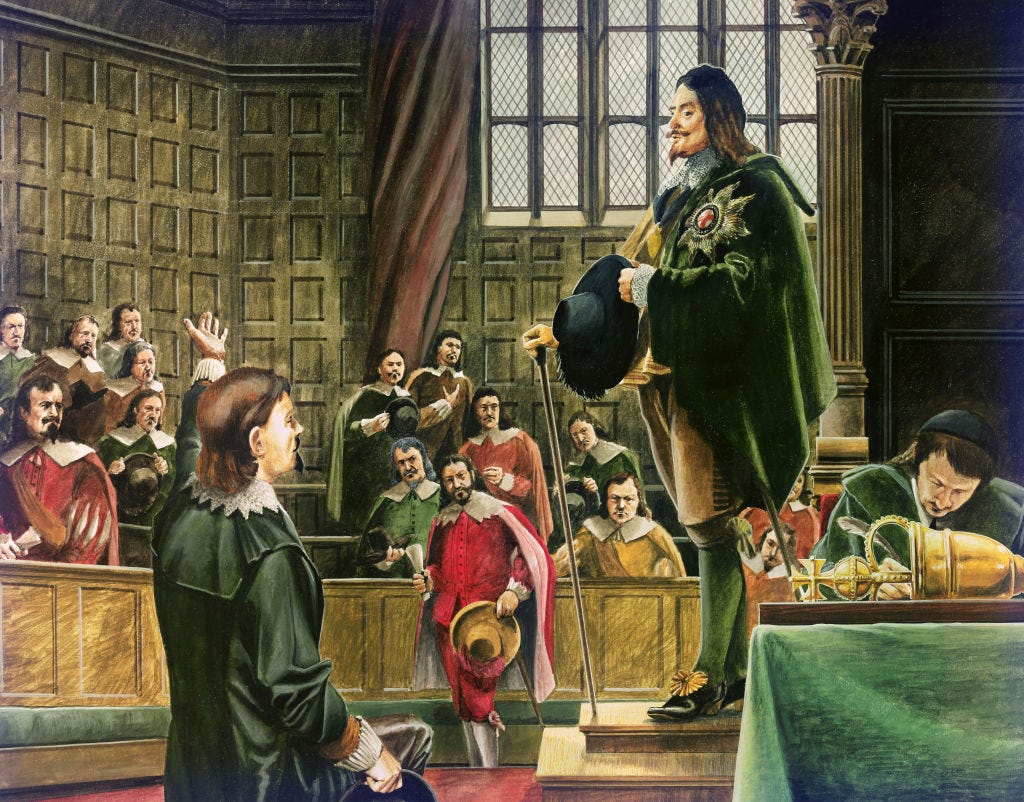
In England, King Henry VIII ultimately created a separate Church of England because the papal authorities in Rome would not grant him a divorce from his first wife. The later Stuart king, Charles I, sought to evade existing legal authorities by exploiting the King’s Court of the Star Chamber, a separate judicial body he controlled that would allow him to go after his political enemies (sound familiar?), instead of working with Parliament. Charles’ repeated efforts to go around the law and evade parliament eventually led to his beheading and the English Civil War. The conflict between King and Parliament festered and was only settled in 1688-9 by the Glorious Revolution, which deposed the Stuart dynasty and established the principle of parliamentary supremacy. Hereafter, English monarchs were not above the law, but below it, and had to submit to laws made by parliament.
Paying Persuasion subscribers are invited to join our Intellectual Bootcamp, where we read classic articles and books that help make sense of the modern world. So far it’s been an enormous success! If you would like to join, please take advantage of a 20% discount on paid membership today. Check out our events page to learn what we’re reading next.
There is a bigger picture to observe here. The fact that law came to be controlled by an independent judiciary was one of the sources of the rise and dominance of Western civilization in succeeding centuries. China, Persia, and Byzantium all practiced a form of what is labeled “Caesaropapism,” in which state authority was fused with ecclesiastical power, giving emperors and kings ultimate control over the law. In England and other parts of Western Europe from the 18th century onwards, by contrast, the law was controlled by independent judicial authorities. This counterbalanced executive power, and made possible the modern economic world. As any economist will tell you, a rule of law (by which they mean property rights and contract enforcement) is critical to modern economic growth. And a rule of law (as opposed to authoritarian rule by law) is made possible only by the existence of an independent judiciary. If kings and presidents can interfere arbitrarily in economic transactions and take property at will, no one will invest or innovate.
An independent judiciary is also what made America great. The United States never had a powerful European- or Chinese-style state, but it did inherit from Britain a strong common law tradition in which a decentralized network of judges could create stable general laws under the principle of stare decisis (that is, judicial decisions made in one jurisdiction would set precedents for all the others). To this was added statute law passed by legislatures at state and later federal levels, which created a platform for economic growth in the 19th century and beyond.

Donald Trump, of course, knows nothing of this history, and operates under the belief that since he was elected president, he has the right to control the judiciary. For his entire career, he has seen the legal system not as a neutral adjudicator of disputes, but rather as a weapon he can use to increase his personal wealth and power. Especially since the beginning of his second term, his attacks on the rule of law have accelerated, and culminated in Acting Attorney General Todd Blanche’s effort to create a slush fund that would put nearly $2 billion taxpayer dollars in the pockets of his cronies and absolve his family from any legal accountability for fraud or abuse.
It is only political pressure, this time coming from some Republicans, that has forced him to pull back on this issue. But Trump will never concede to the principle that he must act according to law, or that the justice system is anything other than a tool that he will bend to his own purposes.
In doing so, Donald Trump is not only rejecting an important source of American greatness, but one of the foundational principles of Western civilization. He thus joins the world’s other Caesaropapists in seeking to fuse law and executive authority.
Francis Fukuyama is the Olivier Nomellini Senior Fellow at Stanford University. His latest book is Liberalism and Its Discontents. He is also the author of the “Frankly Fukuyama” column, carried forward from American Purpose, at Persuasion.
Follow Persuasion on X, Instagram, LinkedIn, and YouTube to keep up with our latest articles, podcasts, and events, as well as updates from excellent writers across our network.
And, to receive pieces like this in your inbox and support our work, subscribe below:
The article is right to note that an independent judiciary is an essential safeguard against authoritarianism, but it overlooks a second structural necessity: a Senate that represents the States. For more than a century, both of these constitutional guardrails have been eroding, and with them the public’s respect for Washington. When neither the Senate nor the courts function as intended, the federal government inevitably panders to the passions of the people — a drift toward mobocracy that the Framers feared above all.
As Congress abandoned its responsibility to confront the country’s core problems, the Judiciary was pulled into the political vacuum. The process reached its tawdriest moment in the Bork hearings, when Ted Kennedy and Joe Biden made judicial politics explicit and theatrical. Once the courts were openly politicized, the consequences were inevitable: every major question became a partisan struggle over who would control the bench.
Fortunately, the current Court has begun restoring constitutional balance by returning certain issues to the states. It has narrowed the Commerce Clause, limited deference to federal agencies, expanded state autonomy in litigation, and reduced the reach of federal regulation. Dobbs (2022) and Loper Bright (2024) stand out as the clearest examples of this effort to reestablish federalism. Even some of President Trump’s executive orders have exposed how urgently the courts must continue to rein in federal power, particularly in the executive branch.
Our democracy will be healthier — and more stable — if an independent judiciary accelerates this work of restoring the constitutional architecture the country was meant to rely on.
Strongmen almost never abolish the courts, because they need to keep up the illusion that this is all normal, all legal, nothing to see here. And it works for the low-information (ahem, MAGA, Fox-News-viewing) voter. But of course six of the nine justices are pawns for either the Heritage Foundation or the Federalist Society - either flat out endorsed, bribed, obviously devoted to the cause, or all three.
So claiming impartiality (by the right) is just another shiny object that obscures the obvious ideological fealty of their SCOTUS henchmen. The right hasn't played by the rules for years, and it's up to the Dems to stack the absolute shit out of the courts. It sucks to need to stoop this low, but there's no time squabble when faced with authoritarianism / fascism.
Of course Trump doesn't even understand the more academic version of the grift, as he's just a schoolyard dunce. For him it's just "disloyalty to me means they're stupid losers." So, dear Dems, it's no time for politesse: stack the courts, let the fascists and deplorables whine, and get down to the adult business of cleaning up the goddamn mess they've made. If an academic occasionally gets your back, great. That's nice. We don't care, we're sick of your bullshit, and your day has passed. Good riddance.